


Entries in Communications Industry Forecast (3)

Monday
Nov072011

Communications Industry Forecast 2011 - 2020: Overall Wired Connections Trends

ILEC Broadband Penetration to Surpass 100% of Access Lines in 2015

For the past few weeks we’ve been sharing our Communications Industry Forecast for the coming decade—we’ve projected access line declines and growth in VoIP lines for both telcos and cable providers, we’ve forecast the proliferations of wireless devices and we’ve estimated total broadband connections through 2020. In this final installment in our series, I’ll consolidate and review the implications for ILECs and for cable companies in terms of overall connections trends and penetration levels.

(Note: We did not create a projection for video services or connections, which if included would dramatically change the total number of wired connections tallied here, given that cablecos are dominant in terms of video connections.)

Based on voice and broadband connections only, we see the total number of ILEC connections falling at a 5%-5.5% pace over the next decade, as access lines fall at a 16%+ rate, VoIP connections increase at a 21%-22% rate and broadband connections grow slowly in the near-term before falling off somewhat in later years (due to displacement by broadband wireless service). Where we counted 144.75m telco access lines/VoIP lines/broadband connections at the end of 2010, we expect that toal to have fallen to just under 85m by the end of 2020.

By way of comparison, the cable companies total connections for voice and broadband service numbered just more than 70m at the end of 2020, but we believe that total will hold relatively steady over the next decade. Both VoIP and broadband connections are expected to increase for the next few years before wireless substitution begins to cut into both voice and broadband service from the cablecos.

Based on current trends in the market, we believe telco broadband penetration of access lines will be approaching 50% by the end of this year; a decade out we look at it in reverse: about one-third of broadband customers will continue to maintain an access line with their telco.

On the cable side, we estimate that 60% of broadband customers will also take a voice/VoIP service by the end of this year; by 2020 we expect that to have fallen to around 53%.
Tuesday
Nov012011

Communications Industry Forecast 2011-2020: Broadband Connections and Market Shares

Telcos and Cablecos Battle, But Wireless Broadband Becomes a Factor by 2020

For the first time this year, we’ve added broadband connections to our 10-year forecast…given that voice service is increasingly an “app” that rides the broadband network, we felt this was appropriate. What does get murky, however, is the definition of broadband.

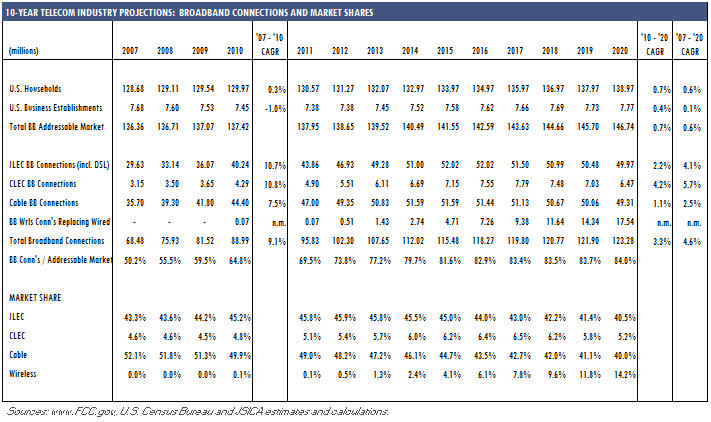
If you consider DSL connections, with average download speeds somewhere around 1.5 Mbps, to be broadband, then the telcos (ILECs and CLECs combined) are hanging pretty steady with the cable companies in terms of market share and connections. Using FCC reports, our own annual Phone Lines survey data, stats from the National Cable Television Association (NCTA) and public company information, we estimate that at the end of 2010 the ILECs had about 40.2m broadband connections; the CLECs, 4.3m, and the cable companies had 44.4m.

If, however, you define broadband as at least 4 Mbps (download speeds) as in the new Connect America Fund Order from the FCC, or as 3 Mbps as some prior FCC data reports have used, then the telcos would fall well behind in terms of broadband market share. Going forward we’ll no doubt need to evolve our thinking and estimates to these higher speed standards, but for the purpose of this year’s forecast, we are including all DSL connections.

Finally, we’ve included broadband wireless connections in our forecast. While the number of homes or businesses where a (for example) WiMax or LTE connection may have replaced a wired connection was very small at the end of 2010, we expect that increasingly broadband wireless solutions will lead to some level of broadband cord cutting.

First, in terms of the addressable market, we’ve combined the total number of households (including Puerto Rico and other territories) with the estimated number of business establishments nationwide (using Bureau of Labor Statistics data) to estimate the addressable market for broadband connections. From an estimated 137.4m addressable residences and business establishments at the end of 2010, we expect that figure to grow by about 0.7% annually, to 146.7m at the end of 2020.

Based on our estimate of 89m broadband connections at the end of last year, overall broadband penetration was just under 65% nationwide, up from 59.5% the year before. Looking out over the next ten years, we’re projected growth for both telco and cable broadband connections based largely on recent trends, but have also factored in overall penetration and the growing availability of broadband wireless solutions.

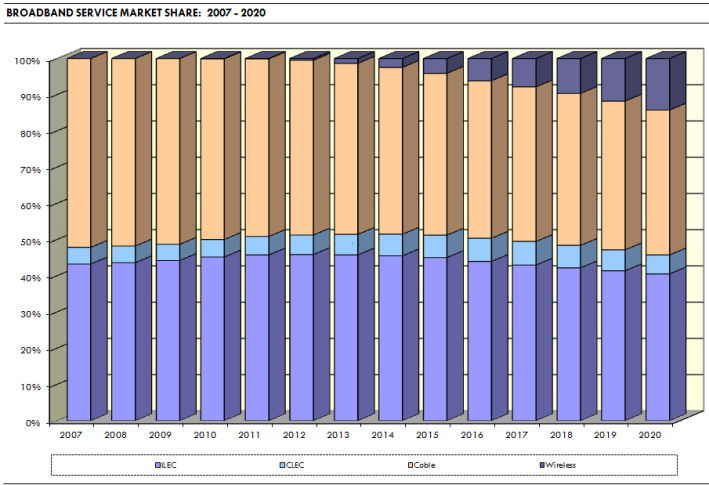
In the nearer term, ILECs and CLECs are expected to grow at a faster pace than cable or wireless due largely to their focus on small and mid-sized businesses, and also to the relatively strong growth being enjoyed by both AT&T (U-verse) and Verizon (Fios). By mid-decade, however, we think the wireless substitution factor and higher overall penetration forces wired broadband connections into a slow decline. Admittedly wireless isn’t a perfect solution for all broadband applications, but on the other hand, it’s likely to get better and it’s mobile. For lower end data users who aren’t streaming their video wirelessly, LTE and other wireless solutions are going to take their share.

By 2020 we believe overall broadband penetration nationwide will be 84% of the addressable market, with ILECs and CLECs controlling about 45%, cablecos controlling 40% and wireless providers grabbing just over 14%.

Tuesday
Oct252011

Communications Industry Forecast 2011-2020: Residential Voice Market Shares

Wireless Will Take the Lead Next Year

Enjoy it while it lasts…the traditional phone service providers are expected to remain on top this year in terms of residential voice market share—but we believe that 2011 will be the last year for that statement to be true. By the end of 2012, wireless-only households are expected to account for 43% of total U.S. households, while ILECs and CLECs combined and including nascent VoIP service, are expected to serve just 36.7% of households. Meanwhile, cable providers were estimated to be serving 16.5% of homes at the end of last year, and we expect that share to grow to a high of 17.5% in 2012—before wireless substitution begins to cut into cable voice penetration levels.

Looking ahead, we expect the number of residential ILEC and CLEC access lines to fall to less than 8m by 2020, while ILEC/CLEC VoIP lines grow to more than 5m—for total telco voice market share of about 9.3% by 2020. Cable share also falls over time, to under 12% of homes. By 2020 we predict that wireless-only homes will be the rule, not the exception, with more than 75% of the residential voice market.