Entries in Industry Trends (90)

Thursday
Jan122012

For ILEC with 210k-Mile Network, IPTV Just "Another Application"

It appears CenturyLink didn't want to miss making an announcement at last week's Citi Entertainment and Media Conference, going with a "me too" approach to IPTV services. The "announcement" was modest, as CenturyLink revealed that they would be extending their IPTV services to one or two new markets in the former Qwest territory. Currently CenturyLink's Prism IPTV service passes 1m homes in select markets and, as of 3Q11, had 50k subscribers. For a telecom provider as large as CenturyLink, however, those numbers are relatively small—but what's interesting is how CenturyLink executive vp and cfo Stephen Ewing characterized IPTV: as just “another application.”

Ewing said, “The incremental cost of us rolling out IPTV is not significant. Once you get a 20 Mbps service out there to a customer the incremental cost of layering IPTV on top we view it as another application.” These sentiments, of course, square with what we've been saying for a while—that since so many providers spent so much time and money on network build-outs and improvements, this was the year to capitalize on those networks with new services, content, and applications.

But CenturyLink's "announcement" seems pretty modest, and offering IPTV in only two markets seems like a paltry "expansion," considering that the company has 210k miles of fiber. With its acquisitions and its expansive network, rollouts like IPTV appear to be an obvious next step. For now, Ewing said that, “The (IPTV) customer base is still small, but we did increase the customer base 25% during the third quarter.”

CenturyLink's network design also makes IPTV easier to distribute, as all of its video content is put into a head end in Missouri and, from there, distributed to each of the 8 markets currently served with IPTV. Each market also has its own mini-head end for local content, and all content is delivered over CenturyLink's fiber network.

Last fall, the company denied speculation that it would expand its Prism service to former Qwest markets. CenturyLink had just inherited Qwest's 1m DirecTV subscribers and was committed to satellite TV. But now the Louisiana-based ILEC says it's following a two-pronged approach to video services: satellite and IPTV. It's a strategy that allows CenturyLink to hedge its bets, capitalize on the satellite subs it's already inherited, and continue to anticipate consumer trends, as greater numbers of Americans access over-the-top video services like Netflix. Ewing said, “If over the top eventually takes some of the traditional TV market, we think we'll be well positioned with the bandwidth with have to our customers to participate in that.”

What is surprising, however, is that CenturyLink does not seem to have an overarching strategy to build out broadband to former Qwest markets. So far the company has just said, vaguely, that it plans to "expand its broadband footprint." Broadband has been a key component to the ILEC's business strategy for a while now, and in 3Q11, the service provider added 57k high-speed Internet subscribers, versus only 12k in 2Q11. Part of these gains, however, come from Qwest's FTTN initiative, which CenturyLink has continued after the acquisition. By the end of this year, CenturyLink estimates that it will pass 5.4m homes with FTTN.

In FTTN service areas, 75% of customers enjoy 20 Mbps speeds, while the remainder of subscribers have speeds of 10 Mbps or higher. As for CenturyLink's big picture, about 20% of subscribers can get 20 Mbps, over half can get 6 Mbps, and two-thirds can get 6 Mbps or higher. According to Ewing, “The speeds will continue to improve over 2012 and future years as we continue to build out the IPTV footprint and the Fiber to the Node footprint in the Qwest markets primarily,” he said.

Of course, CenturyLink will find itself increasingly in competition with LTE services (which we will look into more next week), but for now Ewing said CenturyLink seemed to have an edge, due to its increasing bandwidth. Ewing said that average customer usage is continuing to rise to about 18 Mbps, double where it was a year ago.

Wednesday
Jan042012

A New High Wire Act Along New Hampshire Roads

Sometimes when we discuss the need for broadband in remote or rural areas, it's easy to forget just how much work it takes and how many hours are necessary to complete a fiber build-out. As a case in point, consider New Hampshire, where this winter residents will see more than just snow along the road. There, crews are working demanding hours for Network New Hampshire Now (NNHN), hanging fiber from already-existing telephone poles. Last week, Seacoast Online reported that the BTOP-funded, 750-mile fiber network was “moving into the next phase,” thanks to diligent work and considerable man-hours. But the project is taking time, thanks to a complicated build-out process that involves “stringing cables from pole to pole to pole—over 750 miles in cities, suburban streets and back woods—a lot of hours spent in 'bucket trucks' doing the physical work, but just as many [crew members] figuring out how the cables can fit on the poles, which are owned either by the electric company or telephone company.”

As a public-private consortium, NNHN oversees the $65m project, with $44.5m in grants from the federal stimulus package and $21m in matching funding from other sources. It's an ambitious and far-reaching broadband initiative that, according to NNHN, will “ensure that residents of ten counties in New Hampshire will be able to plug into a powerful future with internet connectivity.”

There are three main components of the network: the middle-mile fiber backbone, last-mile fiber-to-the-premises (FTTP), and a closed middle-mile public safety microwave network.

The middle-mile network will stretch all across the Granite State—from the Seacoast, across the more populated southwest, up to the northwest, and all the way to the remote North Country and mountainous Lakes Region. NNHN says it will “place network access points in or near existing central telephone office locations along the path, allowing all commercial broadband providers to potentially leverage the fiber optic network build across the state regardless of protocol, service or technology.” This portion of the broadband network is being overseen by University of New Hampshire Information Technology—a leader in the initiative.

A variety of partners are coming together to provide last-mile connectivity through what NNHN is deeming an “innovative model called FastRoads,” which will provide fiber-optic connectivity in 35 communities in the southwest part of the state. According to NNHN, these 35 communities translate into 1,300 homes and businesses.

Finally, a closed middle-mile microwave network called NHSafeNet will be made available for public safety, public television, transportation and mobile broadband communications on mountaintops across New Hampshire covering 3,800 square miles.

As with any statewide broadband initiative, the list of partnerships for NNHN is quite long. Last April, Chelmsford, Massachusetts-based Waveguide announced that it would “provide engineering and construction services,” along with New Hampshire Optical Systems, based in Nashua. Additionally, Green Mountain Communications is constructing NHSafeNet, along with other state organizations and departments.

But, despite good planning and an impressive assembly of partners, the issue of actual, physical work remains. And it takes time.

Waveguide president Rob Carmichael described the process of preparing for and hanging fiber to Seacoast Online last week: "We have a right to the space, but the space has to be made available. First we do a survey, walk the pole line with both utilities. We look at the pole, take measurements, engineers in the field decide on this one, power can move up, phone can move down, cable TV can be rearranged, whatever is needed, then you'll have space," he said. "There are no unique issues, other than the timelines. Building 750 miles in this time period is fast.” Completion date for the network is slated for June 30, 2013.

Of course, in addition to deadlines and man-hours in the cold, the network has also faced criticism from existing providers in the area. FairPoint Communications has already built a similar fiber backbone in the area, which it uses to provide its DSL service. In more populated areas like Nashua, in the southern part of the state, FairPoint's FAST provides fiber-to-the-home for residents. But in many “overlooked” regions of the mountainous state, there is no fiber connectivity.

With an impressive scale, NNHN's 750 miles of fiber is just one of many New England fiber builds, as Vermont, Massachusetts, and Maine are all stringing fiber to underserved areas of their states. In Maine alone, 1,100 miles of fiber will crisscross the state, connecting businesses and residents who cannot currently get high-speed service.

But just like in New Hampshire, these networks, too, will be completed in difficult terrain, in a variety of weather—one measurement, one survey, and one cable line rearrangement at a time. No faster.

Wednesday
Dec282011

Digging Deep: Palmetto Rural Looks to Bury Its Competition

When Chuck Crabtree joined Palmetto Rural Telephone Cooperative as its Director of Marketing this year, he was attracted to the co-op's commitment to broadband and advanced services like IPTV. Right now he says PRTC is making great progress towards an extensive fiber build-out that will cover most of Colleton County, South Carolina. And PRTC has been able to fund this upgrade to FTTH “without any big grants. We're mostly doing it ourselves, utilizing business loans,” Crabtree said. With many ILECs and cooperatives counting on broadband, PRTC's story may not seem like a unique one—but the provider's embrace of services like IPTV and advanced video platforms, is. According to Crabtree, PRTC is fighting “formidable competitors” like Comcast and Frontier by offering richer, dependable services through fiber. In underserved areas of the county, PRTC is the first to lay fiber and, in doing so, hopes to better serve its entire territory.

Crabtree characterized PRTC's service area as a combination of Low Country rural lands and small- to mid-sized towns. “Currently we've completed roughly 15% of our fiber build-out, but the overall fiber-to-the-home plan will take longer,” he said. “It's a lot of work. They don't call us the Low Country for nothing— we have a lot of wetlands and it can be very swampy, but we're absolutely committed to getting fiber to every home, even the most remote areas.”

Of course, fiber builds can be tricky for smaller companies and co-ops, with cost often exceeding return on investment. But Crabtree says that PRTC has taken great measures not to just provide broadband services, but to do so with media platforms that rival those from large competitors. Earlier this year, PRTC announced it was transitioning its IPTV-based video services to Alcatel-Lucent's starter pack end-to-end solution, which included the Microsoft Mediaroom 2.0 software platform. Mediaroom, created specifically for Tier 1 service providers, “helped get rid of some traditional IPTV problems, but also opens up new opportunities,” Crabtree said. “Some telcos deploy IPTV and then really aren't thrilled with what they're able to provide. But for us, Mediaroom was really a great choice for the consumer. It really is a very slick, great interface,” he said, noting that the platform makes it possible to introduce VOD, whole-home DVR, caller ID over the TV, and even remote DVR services. Right now, the co-op's IPTV services are about 10% penetrated, but Crabtree says that Mediaroom should dramatically increase marketability and will allow PRTC to “ratchet up marketing for this particular service. We're already seeing great responses, and we believe it's going to be successful.”

But for PRTC, the fiber build-out is about much more than just IPTV services alone. It's about “future-proofing,” as Crabtree put it. “The more fiber you have, the more you can do with it. Fiber-to-the-home provides almost limitless bandwidth capacity, allowing our customers to share multi-media content, watch videos on any device, and so on.” In other words, PRTC is looking to provide the bells-and-whistles that the Big Guys provide, but they plan to bring it to even the most remote areas where subscribers live and do business.

In some areas, DirecTV and Dish Network provide stiff competition, Crabtree acknowledged, but when it comes to providing the whole package of services, PRTC still maintains an edge. In Colleton County, Comcast provides TV and Internet services, but no voice service, and Frontier offers voice and broadband in small pockets of coverage. “We keep hearing rumors of improvements coming down from the Charleston area [in regard to Comcast], but right now they have a pretty standard offering. Our TV service is much richer, according to what we offer, and of course we have a whole package of services we provide.”

Crabtree noted the importance of broadband in small communities and rural areas—something that he says is threatened by recent changes to USF funding. When asked about how the Connect America fund will impact cooperatives like PRTC, Crabtree said, “We stand with everyone at NTCA and the other ILECs who have voiced their opposition to these changes. We're working fast and furious to run fiber and offer as high a service level as possible, and the cutting of USF funds hurts our efforts to do that in the fashion we'd like. We're not happy about the changes in the way they're distributing funds.”

Despite these federal battles, like most cooperatives, PRTC is committed to improving its community, Crabtree said. “We are very involved in the area, and are especially excited about the advanced services that the Colleton County Medical Center is able to offer through our broadband connection.” He explained that, in the past, the facility had to rely on its sister hospital in Charleston for difficult diagnoses, advanced technologies, and specialist services. This often included transporting patients via helicopter or a one-and-a-half hour drive. But now, in seconds, doctors at CCMC can send data to physicians in Charleston and get a detailed diagnosis right away. Doctors at CCMC are also making use of iPads to collect patient information; hospital management will soon rely on “hot boards” to streamline providers and get physicians to the hospital when demand increases, and the hospital website will offer online updates on emergency room wait times. Crabtree said, “These are super patient-friendly services and, while they've had our [PRTC's] broadband for years, they're now really expanding the utilization of its functionality.”

In addition to medical services, Crabtree said that PRTC's broadband has been “a real game-changer” for Colleton County High School and Colleton Preparatory Academy. “We offer broadband connections to each school in a way that fits their needs very well... and we partner with the local schools all the time—to sponsor athletic departments and support recreational teams. We really try to have a local presence in a variety of ways,” Crabtree said, explaining that PRTC also provides telecommunications services to the police and fire departments and sponsors fundraisers for March of Dimes. “That personal connection is really important,” he said.

One of PRTC's smaller business divisions is its wireless service, which Crabtree said is branded PRTC Wireless but also accesses one of the largest networks in the country. PRTC has offered wireless for the last 2-3 years and hopes to more aggressively promote “a quad play in the future,” Crabtree said. “It's not an easy business to grow in, but we're doing it, slowly but surely.”

As for the regional area surrounding PRTC's base in Walterboro, South Carolina—the county seat of Colleton County—there is plenty of growth to go around. PRTC's service area sits outside the main competitive markets of the Charleston area, but the county enjoys growth from nearby economic expansion. Early this month a new aerospace company, Colleton Aerospace LLC, announced it would construct a $15m plant in the county, bringing 300 jobs to the area and hopefully spurring development in the Low Country. PRTC is already scheduled to be the telecommunications supplier to Colleton Aerospace, and Crabtree noted that this was just one of the ways that the area is continuing to see growth in jobs, residential expansion, and population increases. Recently Boeing opened a new facility in North Charleston and tire manufacturers Bridgestone, Continental, and Michelin have all made significant investments in the surrounding area. Likely this growth will spill into PRTC's service area, and Crabtree says the company has already been active in Charleston media markets. “We can't help but think our region's growth will help us, and we hope to enjoy some of its success.”

Sunday
Dec112011

Cultivating Broadband: Group Works to Connect Kentucky


In a recent opinion piece on the ever-provocative Huffington Post, writer Timothy Karr declared “America's Internet—Now as Good as Angola's!” Hyperbole? Of course. But according to the U.S. Department of Commerce's “Exploring the Digital Divide” report, released last month, some states are just not living up to their connectivity potential. Alabama, Arkansas, Kentucky, Mississippi, and New Mexico have the dubious distinction of being the five worst states for broadband adoption—with percentages of 55%, 52%, 58%, 51%, and 58%, respectively. Overall, the average broadband penetration rate for the entire U.S. is about 65%. But in the bluegrass state, the public-private partnership ConnectKentucky has been working since 2002 to address the state's need for broadband—taking a county-level holistic approach to promote “a statewide technology acceleration program.” The vision for ConnectKentucky started out in response to the Kentucky Innovation Act of 2000; it has since become a national model for broadband deployment and the basis for the Broadband Data Improvement Act, which was funded as part of the American Recovery and Reinvestment Act of 2009.

According to ConnectKentucky's Executive Director René True, the Commerce Department report is an accurate portrayal of what is occurring in Kentucky. The lower rates are mostly due to the state’s rural nature and relatively low per capita income. As a result, True believes that ConnectKentucky needs to work on “a project-by-project basis,” in order to tap into the potential of wireless broadband and design networks that fit individual community and county needs.

It would be an understatement to say that ConnectKentucky has its hands in nearly every rural town and county in the state; in fact, in many of those areas, ConnectKentucky has led wireless broadband initiatives by mapping broadband gaps, assisting with wireless network design, drafting requests for proposals, and overseeing broadband network build-outs. True explained that ConnectKentucky is an organization that targets unserved and underserved areas, then works to bring broadband to those communities.

Rather than a one-size-fits-all approach, ConnectKentucky is able to suit broadband services to the needs of individual areas. In some cases, that means going with AT&T (NYSE:T) or Windstream (NasdaqGS:WIN) for network build out, but often the group works with providers who are already in place in those areas, such as Altius Communications, Q-Wireless, KY Wi-Max, and Foundation Communications. According to True, “Connect Kentucky has been involved with some of the smallest broadband communications players serving rural Kentucky.” In fact, he said, “from a pure deployment of services to rural unserved areas, ConnectKentucky is much more likely to be talking with small local companies rather than bigger multi-state companies.”

One such initiative includes “Coal to Broadband”—an innovative project that is funded by a grant from the Appalachian Regional Commission (ARC) and matching multi-county coal severance funds. ConnectKentucky oversees the initiative by providing technical assistance and project management, from conducting research and public awareness campaigns to assisting with network design proposals. This September the group announced it had selected wireless broadband provider Altius Communications for Coal to Broadband's ConnectBELP network build out; the fixed wireless microwave network will connect Breathitt, Estill, Lee, and Powell counties in eastern Kentucky. “The sparse population and rugged topography of the four counties make it difficult for residents to receive broadband services were it not for a public/private partnership,” True said. He also noted that “original funding amounts from ARC and Kentucky Department for Local Development coal severance grants totaled $630,600.”

In other counties of the state, ConnectKentucky has worked to secure broadband for a seven-county region of the state in the ConnectGRADD project. At the outset Daviess, Hancock, Henderson, McLean, Ohio, Union, and Webster counties had next to no broadband access, particularly in the most rural areas. The rolling hills and sparse population made the regions unappealing to larger providers and traditional wired broadband, but it was a perfect proving-ground for wireless broadband. The seven constituent county governments asked ConnectKentucky to assist them in finding vendors who would build a network reaching nearly 100% of households and businesses. The completed network coverage included nearly 100% of existing industrial parks, more than 93% of residences, and offers free wireless hotspots for public use. According to True, “The ConnectGRADD project is serving over 1,800 customers, starting from a zero base.”

Danville-based KY Wi-Max was the local broadband provider of choice for ConnectKentucky's project in Washington County, and True recently said that Glasgow-based South Central Rural Telephone Cooperative plans to team with Windstream to build broadband networks affecting small portions of Warren County.

In addition to a county-by-county approach, ConnectKentucky also assists in bringing broadband to individual towns. Such was the case in Prestonburg and Williamstown, where local cable providers didn't reach outside town limits and residents were left without broadband services. With a fixed wireless broadband system now in place, not only do rural residents surrounding Williamstown enjoy broadband connectivity, but Grant County now has a 94% broadband footprint, up from 58%.

Each of these wireless broadband initiatives echo the competitive growth rates our own Richelle Elberg predicted back in November. She wrote that, in the next few years, “we think the wireless substitution factor and higher overall penetration [will] force wired broadband connections into a slow decline. Admittedly wireless isn’t a perfect solution for all broadband applications, but on the other hand, it’s likely to get better and it’s mobile.” For certain rural areas, of course, wireless broadband is the most cost-effective and the most practical in terms of infrastructure build out—and one can't help but note how partnerships between local providers, national providers, city governments and other municipalities are becoming the norm in areas like rural Kentucky.

But does build out always equal adoption? It seems every broadband penetration study notes that those who aren't connected don't necessarily want to be, nor do they feel that broadband is useful to them. In these cases, True said changing the adoption rate is going to require showing the relevancy of broadband, providing it affordably and increasing technology literacy. “It’s going to require real grass-roots, community-level efforts,” he said.

For ConnectKentucky, such grass-roots efforts are manifest through public relations campaigns and community involvement projects. True noted ConnectKentucky's Computers 4 Kids program, which “brings together public and private partners to help disadvantaged children and their families join the Information Age.” He said that the program has “successfully placed over 3300 computers and other technology with disadvantaged kids and families, not-for-profit after school programs, community centers, libraries, and schools.” These computers and the (hopefully) accompanying broadband availability is crucial to areas of Appalachia, True said. “Without broadband availability, rural communities will fall further behind economically, educationally, and from a total quality of life view.”

As an example of a community-specific technology development program, True also mentioned the work accomplished through ConnectKentucky's Connect Equestrian View initiative. Focused on the Equestrian View neighborhood—a low-income area of eastern Kentucky—this project not only brings hardware like computers and printers to disadvantaged families, but also “subsidizes up to six months of broadband access, technology training and other technology resources to increase access, adoption, and use of technology by residents,” according to True. The project is a partnership with the Kentucky Housing Authority, Lexington Housing Authority, and Lexmark.

While ConnectKentucky's community involvement doesn't necessarily provide a monetary return-on-investment or follow a typical business strategy, it does work on closing the broadband gap in its own way—by addressing unserved and underserved areas and, at least for a time, providing opportunities for residents to see broadband's potential. For True, this is central to ConnectKentucky's overall mission to foster broadband growth in the state through an abundance of partnerships, all with varying but complementary goals. True calls broadband “the killer app” for rural areas and hopefully, for ConnectKentucky and all its partners, their efforts will be enough to one day deem Kentucky “broadband's most improved.

Thursday
Dec082011

One Month Later...How Did the 4G Network Perform versus Cable?

Definitely a Contender...For Some

One month ago I gushed about the fact that I had become a cable ‘cord-cutter’ and how pleased I was with my Verizon 4G LTE experience. With one billing cycle now under my belt I’m prepared to admit that I may have been premature in my over-the-top enthusiasm (pun intended)…but that said, I remain happy with the service and have no intention of going back to Comcast (despite four pleading phone calls from the company since I cancelled service). What I must admit to, however, is that for a household with even one “TV-Head”, it’s going to get expensive.

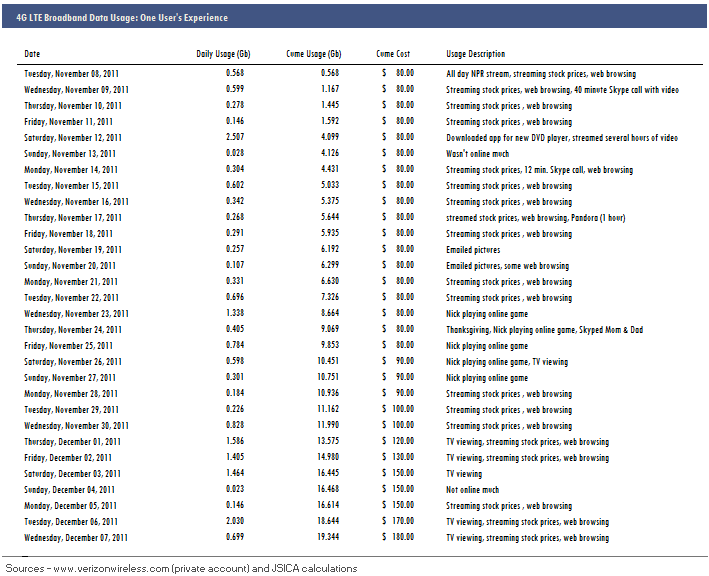
I logged my daily Internet habits throughout the billing cycle; you can see the daily and cumulative usage and cost in the chart below. With 20-20 hindsight, I have to say that the biggest thing I didn’t consider before making the switch was the fact that throughout November and December I have had/will have numerous houseguests.  Among these houseguests in November were my sixteen year old son who likes to play online games ad nauseum, and my television-addicted significant other. I also have yet a third person staying with me now who goes online at least some every day. The good news is that these roommates will help pay for what turned into a $180 bill…

Here’s how it happened. For the first week or so, still a bachelorette, my daily usage was between 0.3 and 0.4 Gigabits on weekdays, and far less on weekends. I realized that I didn’t HAVE to stream NPR over the computer and started listening to the radio. I also noticed that Skype video calls eat up a lot of data, so I cut back a bit on those calls in favor of the “free” Verizon to Verizon mobile calls (I know what my family members look like anyway!). Most days I don’t watch much TV, but on Saturday, 11/12, I purchased a new Blue Ray player with streaming capabilities and downloaded the software that allows me to surf directly to Netflix or Hulu on my TV. (Very, very cool!). That download and the two shows I then watched ate up about 2.5 Gigs.

For the next 10 days my friend, who got to town that weekend, and I used reasonable amounts of data—then my teenage son Nick arrived followed by the aforementioned significant other, for Thanksgiving. As it turned out, Nick’s online game didn’t seem to eat up too much data, but my boyfriend’s enthusiasm for his favorite TV shows, and the extensive library available with Netflix and Hulu, turned into nearly 10 Gigs of overage over the past 10 days or so…that’s $10/Gig, bringing the total fee for the past month to $180.

Now, that sounds like a lot, and it is, but if you consider that my last Comcast bill was $163 and all I had watched was two on-demand movies (literally, all month), and in this case there were probably 15 or more hours of television viewing, then it’s not so bad. And honestly, the TV-Head will be leaving again for a month after Christmas…I’m a big fan of Red Box so I’m betting I can get the January bill back down to less than $100.

But price isn’t the only consideration. Let’s discuss the quality of the signal and overall experience. My Internet connection is consistently fast and only for one afternoon did the Mifi device revert to the 3G network for a couple of hours. The streaming experience has been outstanding, with both Hulu and Netflix. By way of comparison, my Comcast Internet connection was notoriously inconsistent—25 Mbps one day and 1 Mbps the next. (Ironically, my colleagues at the main JSI Capital Advisors office in Manchester, NH have gone without Internet service today…their provider is—you guessed it—Comcast.)

The bottom line is that I really, really like the service and the Netflix and Hulu program offerings are extensive—more than enough even for a TV-Head like my boyfriend. Considering I was paying $145 or more previously, I’m not really going to sweat too much if I go over on data usage—although I would really like to see Verizon offer a 20 or even 30 Gigabit plan. My guess is it will eventually, as the company continues to buy up spectrum. I also love the fact that I can take my Mifi device with me and use it anywhere, and as I tend to travel frequently, that’s exactly what I’ll do.

Overall, while it’s not perfect, the cable option was FAR from perfect, and the 4G wireless broadband option is a really reasonable option for a single person who doesn’t live on the couch. But for larger households—especially those with kids—the 10 Gigabits per month probably won’t be adequate and overage charges could easily become prohibitive.