

Entries in Windstream:WIN (5)

Sunday
Dec112011

Cultivating Broadband: Group Works to Connect Kentucky


In a recent opinion piece on the ever-provocative Huffington Post, writer Timothy Karr declared “America's Internet—Now as Good as Angola's!” Hyperbole? Of course. But according to the U.S. Department of Commerce's “Exploring the Digital Divide” report, released last month, some states are just not living up to their connectivity potential. Alabama, Arkansas, Kentucky, Mississippi, and New Mexico have the dubious distinction of being the five worst states for broadband adoption—with percentages of 55%, 52%, 58%, 51%, and 58%, respectively. Overall, the average broadband penetration rate for the entire U.S. is about 65%. But in the bluegrass state, the public-private partnership ConnectKentucky has been working since 2002 to address the state's need for broadband—taking a county-level holistic approach to promote “a statewide technology acceleration program.” The vision for ConnectKentucky started out in response to the Kentucky Innovation Act of 2000; it has since become a national model for broadband deployment and the basis for the Broadband Data Improvement Act, which was funded as part of the American Recovery and Reinvestment Act of 2009.

According to ConnectKentucky's Executive Director René True, the Commerce Department report is an accurate portrayal of what is occurring in Kentucky. The lower rates are mostly due to the state’s rural nature and relatively low per capita income. As a result, True believes that ConnectKentucky needs to work on “a project-by-project basis,” in order to tap into the potential of wireless broadband and design networks that fit individual community and county needs.

It would be an understatement to say that ConnectKentucky has its hands in nearly every rural town and county in the state; in fact, in many of those areas, ConnectKentucky has led wireless broadband initiatives by mapping broadband gaps, assisting with wireless network design, drafting requests for proposals, and overseeing broadband network build-outs. True explained that ConnectKentucky is an organization that targets unserved and underserved areas, then works to bring broadband to those communities.

Rather than a one-size-fits-all approach, ConnectKentucky is able to suit broadband services to the needs of individual areas. In some cases, that means going with AT&T (NYSE:T) or Windstream (NasdaqGS:WIN) for network build out, but often the group works with providers who are already in place in those areas, such as Altius Communications, Q-Wireless, KY Wi-Max, and Foundation Communications. According to True, “Connect Kentucky has been involved with some of the smallest broadband communications players serving rural Kentucky.” In fact, he said, “from a pure deployment of services to rural unserved areas, ConnectKentucky is much more likely to be talking with small local companies rather than bigger multi-state companies.”

One such initiative includes “Coal to Broadband”—an innovative project that is funded by a grant from the Appalachian Regional Commission (ARC) and matching multi-county coal severance funds. ConnectKentucky oversees the initiative by providing technical assistance and project management, from conducting research and public awareness campaigns to assisting with network design proposals. This September the group announced it had selected wireless broadband provider Altius Communications for Coal to Broadband's ConnectBELP network build out; the fixed wireless microwave network will connect Breathitt, Estill, Lee, and Powell counties in eastern Kentucky. “The sparse population and rugged topography of the four counties make it difficult for residents to receive broadband services were it not for a public/private partnership,” True said. He also noted that “original funding amounts from ARC and Kentucky Department for Local Development coal severance grants totaled $630,600.”

In other counties of the state, ConnectKentucky has worked to secure broadband for a seven-county region of the state in the ConnectGRADD project. At the outset Daviess, Hancock, Henderson, McLean, Ohio, Union, and Webster counties had next to no broadband access, particularly in the most rural areas. The rolling hills and sparse population made the regions unappealing to larger providers and traditional wired broadband, but it was a perfect proving-ground for wireless broadband. The seven constituent county governments asked ConnectKentucky to assist them in finding vendors who would build a network reaching nearly 100% of households and businesses. The completed network coverage included nearly 100% of existing industrial parks, more than 93% of residences, and offers free wireless hotspots for public use. According to True, “The ConnectGRADD project is serving over 1,800 customers, starting from a zero base.”

Danville-based KY Wi-Max was the local broadband provider of choice for ConnectKentucky's project in Washington County, and True recently said that Glasgow-based South Central Rural Telephone Cooperative plans to team with Windstream to build broadband networks affecting small portions of Warren County.

In addition to a county-by-county approach, ConnectKentucky also assists in bringing broadband to individual towns. Such was the case in Prestonburg and Williamstown, where local cable providers didn't reach outside town limits and residents were left without broadband services. With a fixed wireless broadband system now in place, not only do rural residents surrounding Williamstown enjoy broadband connectivity, but Grant County now has a 94% broadband footprint, up from 58%.

Each of these wireless broadband initiatives echo the competitive growth rates our own Richelle Elberg predicted back in November. She wrote that, in the next few years, “we think the wireless substitution factor and higher overall penetration [will] force wired broadband connections into a slow decline. Admittedly wireless isn’t a perfect solution for all broadband applications, but on the other hand, it’s likely to get better and it’s mobile.” For certain rural areas, of course, wireless broadband is the most cost-effective and the most practical in terms of infrastructure build out—and one can't help but note how partnerships between local providers, national providers, city governments and other municipalities are becoming the norm in areas like rural Kentucky.

But does build out always equal adoption? It seems every broadband penetration study notes that those who aren't connected don't necessarily want to be, nor do they feel that broadband is useful to them. In these cases, True said changing the adoption rate is going to require showing the relevancy of broadband, providing it affordably and increasing technology literacy. “It’s going to require real grass-roots, community-level efforts,” he said.

For ConnectKentucky, such grass-roots efforts are manifest through public relations campaigns and community involvement projects. True noted ConnectKentucky's Computers 4 Kids program, which “brings together public and private partners to help disadvantaged children and their families join the Information Age.” He said that the program has “successfully placed over 3300 computers and other technology with disadvantaged kids and families, not-for-profit after school programs, community centers, libraries, and schools.” These computers and the (hopefully) accompanying broadband availability is crucial to areas of Appalachia, True said. “Without broadband availability, rural communities will fall further behind economically, educationally, and from a total quality of life view.”

As an example of a community-specific technology development program, True also mentioned the work accomplished through ConnectKentucky's Connect Equestrian View initiative. Focused on the Equestrian View neighborhood—a low-income area of eastern Kentucky—this project not only brings hardware like computers and printers to disadvantaged families, but also “subsidizes up to six months of broadband access, technology training and other technology resources to increase access, adoption, and use of technology by residents,” according to True. The project is a partnership with the Kentucky Housing Authority, Lexington Housing Authority, and Lexmark.

While ConnectKentucky's community involvement doesn't necessarily provide a monetary return-on-investment or follow a typical business strategy, it does work on closing the broadband gap in its own way—by addressing unserved and underserved areas and, at least for a time, providing opportunities for residents to see broadband's potential. For True, this is central to ConnectKentucky's overall mission to foster broadband growth in the state through an abundance of partnerships, all with varying but complementary goals. True calls broadband “the killer app” for rural areas and hopefully, for ConnectKentucky and all its partners, their efforts will be enough to one day deem Kentucky “broadband's most improved.
Tuesday
Sep062011

Building for the Future: Gig.U's Investment in 1GB Networks

Public/Private Partnerships Spur Ultra-High-Speed Internet

When Google (Nasdaq:GOOG) announced in early 2010 that it would build a 1GB fiber network in one lucky city, the company received more than 1,100 applications. Eager citizens and local organizations made the case (sometimes in outlandish ways) for why their cities needed ultra-high-speed networks for their businesses, schools, hospitals, local government, and homes. Elise Kohn, program director for University Community Next Generation Innovation Project (a.k.a., Gig.U), says the Google experiment demonstrated an unprecedented desire for ultra-high-speed networks across the country, making a strong case for why ultra-high-speed networks were essential to U.S. growth. But, as a national investment, who would be willing to pay for such extensive infrastructure? And what sectors would make immediate use of such robust connectivity? According to Kohn and Blair Levin, who is heading up the Gig.U project, research universities and their surrounding communities will be the foundation of the 1GB revolution. These communities conduct top-notch research, scientific innovation, medical advances, and so on, which makes them a vital test-bed for ultra-high-speed capabilities. In short, research universities both “consume and create,” in Kohn's words, and will allow us to see what's capable in the future with 1GB.

“We're not saying everyone in America needs a gig—that's why this is a targeted investment where there's highest demand and highest yield,” Kohn says. At research universities, innovation and development would benefit from faster broadband speeds and even allow new advances in science, engineering, and medicine—key fields to U.S. global competitiveness. “If you look internationally or at what's happening at research universities,” according to Kohn, “there are important reasons that, if you want to be ahead, [1GB] is where it's going.” Not only would an ultra-high-speed network allow for smooth videoconferencing and webcasting, but the improved capabilities and data transfer rates would encourage the development of new applications, research opportunities, and learning tools. As just one example, Kohn sites current innovations in medical technology that, with advanced network capabilities, allow surgeons to practice on life-like 3D projections when training for open-heart surgery.

Kohn also highlights technologies already implemented at Case Western Reserve, a school that she calls “a great champion of Gig.U's plan.” Case Western is one of Gig.U's 30 members and last year set up a pilot program connecting a several block area surrounding campus. The Case Connection Zone now provides 1GB fiber-optic networking to more than 100 homes and has been a test bed for what Gig.U plans to do across the nation. “A number of our members [universities] are very well connected on campus,” Kohn says, “so that's not necessarily where we need to fill a need. But staff, faculty, and researchers go home at night, students live off-campus... and the research and development—the advanced work that they're doing—continues there.”

These dynamic research communities can also attract new businesses to a town or city, according to Lev Gonick, chief information officer at Case Western. Gonick said that within three months of implementing Case Connection Zone, three startups moved to the neighborhood. “Gig.U members came together to address our unique connectivity gap. We intimately understand that for American research institutions to continue to provide leadership in areas important to U.S. competitiveness, we have to act to improve the market opportunity for upgrading the networks in our university communities. We believe a small amount of investment can yield big returns for the American economy and our society,” says Gonick.

And Gig.U agrees with Gonick's more national focus. Its entire leadership team has direct experience with America's broadband needs (and lack) from working in various capacities at the FCC. Levin served as director of the FCC's National Broadband Plan, where he asserted that broadband was essential to American growth and competitiveness and that ultra-high-speed would be key to cutting edge research and development. Kohn says the National Broadband Plan also revealed that ultra-high-speed was not something the federal government would be able to invest in, at least in the short term. So early this year, Levin contacted CIOs at several universities to get the conversation going, and at the end of July Gig.U's project was announced publicly.

Gig.U's member universities come from nearly every region of the country—from the deserts of Arizona and New Mexico to the mountains of Colorado, and from the heartland states of Nebraska and Illinois, to coastal communities in Maine, Florida, and Hawaii. Most importantly, the research universities of Gig.U represent midsized communities which could potentially benefit from advanced connectivity, according to Kohn. “The universities in Gig.U have strong relationships with the communities around them,” Kohn says, “so we're allowing the universities to do the outreach to communities and surrounding areas [to explain the Gig.U initiative].”

Karl Kowalski, chief information technology officer for the University of Alaska System, says he thinks Gig.U's public/private partnership will bring value for the community surrounding University of Alaska. “While much has been done to connect the University of Alaska Fairbanks to major research networks,” he says, “our communities, our partners and our state could advance this research through innovative testbeds and community involvement if ultra-high speed networks were available to all.”

At West Virginia University, another of Gig.U's member companies, Chief Information Officer Rehan Khan says that the group is looking for proposals in order "to deploy networks not in decades but rather within the next several years." The school, along with Gig.U's other members, hopes that new networks will spur local economies and job opportunities in their regions. Jay Cole, WVU chief of staff who initiated the University’s involvement in Gig.U said, "It is the general population we are seeking to serve and encourage to use University innovation to create new jobs and improve the economy."

On Aug. 18, Gig.U issued a Request for Information in the form of an open letter, saying the group will “consider ways in which multiple Project communities can work together... to improve the private sector business case for next-generation networks.” Kohn says the group has sought input from a variety of communications providers—from national providers like AT&T (NYSE:T), Comcast (Nasdaq:CMCSA), Frontier (NYSE:FTR), Windstream (Nasdaq:WIN), and Verizon (NYSE:VZ), to regional providers like Blackfoot Telecommunications Group in Montana and Smithville Communications in Indiana. “We are doing direct outreach to them,” Kohn says, “and they are also coming to member companies and expressing interest. We've also talked with Google, Lucent (NYSE:ALU), Cisco (Nasdaq:CSCO), and anyone involved in the ecosystem. If providers in the vicinity of one of our members have an idea for how to meet the needs of that community, together, they should definitely respond. It's a learning exercise.” The Request for Information period will end in November.

It's still hard to tell what Gig.U will look like when implemented, but Kohn says much of that will depend on the specific needs and the network configuration of each member university and its community. The group is not seeking federal funding, however, and new network build outs would be funded by Gig.U members as well as private-sector companies and non-profits who join the project.

When asked about the precariousness of a “build-it-and-they-will-come” approach, Kohn said that scenario isn't really a concern in Gig.U's case. “Research universities and the communities around them already have a history of development, and this really creates a cycle of opportunity.” Kohn says this is not unlike the progression to high-speed from dial-up, in the way that high-speed has become a new standard, while creating new applications and advancements. “The risk/return profile for a private company to help build out these networks is better because of the universities,” according to Kohn. “They're more tech-savvy communities. Give them access now and they'll understand what they can do, and with those advances, more and more will start to need it."

Monday
Jan312011

Large ILECs Lessening Reliance on Consumers

RLECs…Not So Much

Several of the publicly traded ILECs that we follow have made a concerted effort over the past few years to shift their customer base from residential consumers to enterprise customers and small/medium business customers.  The rationale is clear—business users, regardless of the type of product or service they offer—have been considered less likely to cut the cord, or at least more willing to opt for a bundled plan that includes a wired voice offering along with broadband connectivity.  Windstream (Nasdaq:WIN) has been a vocal proponent of this strategy and its desire to shift its revenue base from consumers to business was a clear factor in several of the acquisitions it made over the past two years.

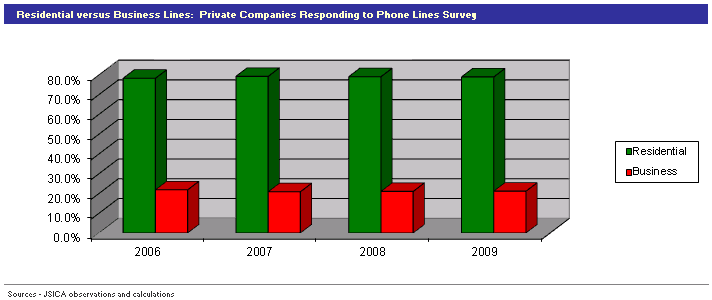
We decided to take a look at the trends in business versus consumer lines for those public companies that report the breakdown.  We then compared those trends with data we collect in our annual Phone Lines census, where we survey the nearly 1,200 LECs nationwide on their connections.  Several hundred respondents each year provided information on the breakout between consumer and business lines.  

What we find is that the largest LECs (i.e., RBOCs) have been reporting steady increases in the proportion of business lines in the mix.  RLECs, on the other hand, have been reliant upon consumer lines for approximately 80% of their lines since 2003, with no notable shift in the breakout between consumer lines and business lines.


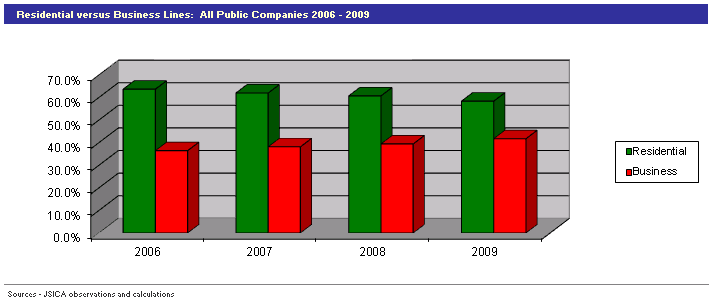
First the public companies.  We found that 10 of the public ILECs reported a breakdown for business versus residential lines for at least some of the years between 2006 and 2009.  And where in 2006 the percentage of business lines was about 36%, by the end of 2009 that percentage had grown to nearly 42%.  These figures are, of course, heavily weighted by the two RBOCs—Verizon (NYSE:VZ) and Qwest (NYSE:Q)—that report the breakdown. 

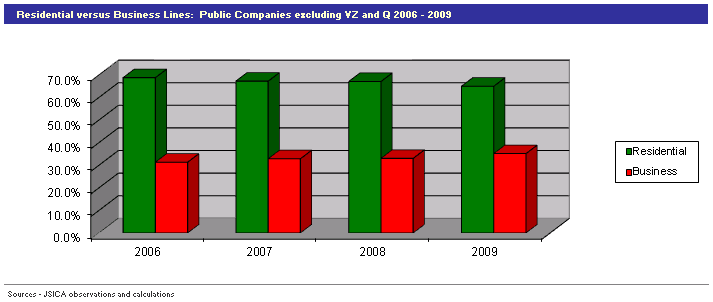
Next we had a look at the public companies excluding the RBOCs.  The eight remaining public companies reported that business lines accounted for 31% of total lines in 2006; by 2009 that figure had grown to 35%.

Of course, the larger LECs, and the RBOCs in particular, have suffered the steepest overall access line declines in recent years.  If you assume that a large proportion of cord cutters are (were!) residential customers, than the shift makes sense. Most RLECs on the other hand, have lost lines at a rate of just 3% - 5% on average for the past several years. 

Based on data gathered in our annual Phone Lines census, where we survey each of the nearly 1,200 RLECs nationwide on their connections, we were able to find nearly 300 companies that had provided the business versus residential breakout for at least two of the years examined.  And while the number and composition of companies included in the analysis varied from year to year, the proportion of business to residential lines was uncannily stable, going all the way back to 2003.

In 2003 our analysis indicated that nearly 80% of the access lines served by RLECs were for residences and just more than 20% were identified as business lines.  Fast forward to 2009 and we find that 79% of lines were for residences and 21% served businesses.

So what does it all mean?  Obviously, change comes more slowly to rural markets, and particularly in areas where wireless coverage may have been sub-par, mobile substitution has not occurred as rapidly.  On the other hand, in those places where coverage is solid, or attractive VoIP options have been available, small business owners looking to save money may have made the switch at roughly the same pace as consumers.

Looking ahead, however, we wonder if there isn’t more that rural LECs can do to build up their importance to local businesses.  Getting there first with a VoIP option may be a solid strategy, particularly if the local cable company is aggressively promoting the service.  Fixed wireless solutions with a VoIP component may also work well in some areas, especially for those who’ve warehoused spectrum over the past decade.  At the end of the day, both consumers and business customers will be seeking the best value for their dollars, but a healthy relationship with local business owners could well be one of the best defenses an RLEC can employ.

Thursday
Sep302010

Broadband Stimulus Deadline Approaching

As $7 Billion Program Ends, a Look Back

The last month has brought nearly $1.4b of grant and loan award announcements under President Obama’s Broadband Stimulus program.  The funding is being awarded under the Broadband Technology Opportunities Program (BTOP)- administered by the Commerce Department’s National Technology and Information Administration (NTIA); and the Broadband Initiatives Program (BIP)– administered by the Department of Agriculture’s Rural Utilities Service (RUS).  The nearly $7b program, part of the Recovery Act, was reduced from $7.2b over the summer. 

U.S. Commerce Secretary Gary Locke announced the final 14 BTOP awards on September 27, 2010.  All told, NTIA has awarded approximately $4b in funding to 233 projects nationwide.   The majority of BTOP awards are for middle mile networks that expand high-speed Internet availability to communities and connect community anchor institutions. Other types of projects include public computer centers and sustainable broadband adoption initiatives.

According to a September 13, 2010 RUS press release, RUS has leveraged $2.5b in Recovery Act funding “to provide loans and grants of $3.6b to construct 307 broadband infrastructure and satellite projects in 46 states and one territory.”  It is unclear whether or not RUS will make any further award announcements, but all funding must be awarded by September 30, 2010. 

Barring any large last minute awards, California has emerged as the biggest beneficiary of broadband stimulus funding, garnering more than 6.0% of total funding ($448m).  Delaware received the smallest amount of funding of the 50 states, receiving just $5.1m.  On average, each state or U.S. territory received more than $126m; the average award was $13.9m per project. 

Last month, we noted the largest award to date was $126m in first round grant funding awarded to the executive office of the state of West Virginia for construction of a middle mile network utilizing microwave and fiber technology.  That award has since been topped by $154m grant funding awarded to the Los Angeles Interoperable Communications Systems Authority, which will deploy an inter-operative wireless public safety broadband network across Los Angeles County to serve more than 80 public safety agencies and up to 34,000 first responders. 

The Broadband Stimulus Program has not been without controversy– we’ve seen complaints about everything from companies claiming award recipients are gaining unfair competitive advantage in a particular region to awardees complaining the grant/loan terms are too onerous.  Windstream Corporation (Nasdaq:WIN) announced recently that it is seeking to amend certain provisions of its existing credit facilities because the “amendment is required to permit the signing of rural broadband stimulus grant agreements” with RUS.  WIN has received 16 awards totaling $168m in grant funding to deploy ADSL2+ technology, not including the $17m awarded to recently acquired Iowa Telecommunications

And on September 7, 2010, Connected Planet reported RUS has rescinded a $19m grant awarded to TierOne Converged Networks.  According to the website, RUS used a “clawback” provision provided in the award because the recipient is currently being investigated by the U.S. Securities and Exchange Commission for alleged federal securities violations. 

It seems in some instances recipients have withdrawn their requests for funding after receiving awards.  There is little information available disclosing the reasons behind such withdrawals.  For example, round one recipient Allegiance Communications, which was awarded $29m grant funding to deploy more than 680 miles of fiber optic network, makes no mention of the award on its website. Further, although an April 16, 2010 press release from NTIA describes the grant, the applications database no longer lists the project under “awarded.”  As best we can determine, Allegiance Communications withdrew its request sometime after being notified it had been awarded funding. 

With the September 30, 2010 deadline upon us, we expect the focus to shift from applications and award announcements to grant/loan term negotiations, and, eventually, progress updates on the projects themselves. 

Other Broadband Stimulus Developments: Occam Networks announced it has been selected to provide access network equipment to the Marquette-Adams Telephone Cooperative.  The company was awarded $13.8m grant and $6.2m loan funding to extend fiber optic service from the existing service area to unserved rural areas bordering the telephone company’s current territory……CommScope, Inc. reported it has been selected by BTOP round one award winner MCNC—which received $28m grant funding to build a 494 mile fiber optic middle mile network—to provide all materials related to the project……Infinera announced its partnership with United States Unified Community Anchor Network (U.S. UCAN) on September 7, 2010.  U.S. UCAN received $62.5m grant funding to build a national scale middle mile network to connect all community anchor projects funded by BTOP with each other.

Tuesday
Aug312010

Broadband Stimulus Funds Awarded En Masse as Deadline Looms

287 Projects Have Received Funding in Second Round So Far

Over the last month, NTIA and RUS have announced approximately 220 Broadband Stimulus awards totaling more than $3.0b in grants and loans.  The awards are part of President Obama’s $7.2b Broadband Stimulus Program.  By our count, more than $6.1b has been awarded thus far.  In the first round, nearly $2.3b in funding was awarded to 150 different projects; so far in the second round, more than $3.8b has been awarded to 287 projects.  All funding must be awarded by September 30, 2010. 

Of the 437 awards announced so far, the average award is approximately $14m; the largest award was given to the executive office of the state of West Virginia– $126m in first round grant funding to build a middle mile network with multiprotocol label switching (MPLS) over microwave and fiber technology.  The smallest award went to Big Island Broadband/ Aloha Broadband, which received $107k in first round loan funding to bring terrestrial fixed wireless broadband services to an unserved area in the northern part of Hawaii’s Big Island. 

A substantial number of incumbent local exchange carriers (ILECs) have received awards– 200 projects have received a total of $2.4b in funding.  Telephone & Data Systems’ (NYSE:TDS) subsidiaries have received funding for 41 projects in round two of funding, on top of the two projects that received funding in round one.  All told, TDS has received approximately $103m in funding.  The company plans to bring high-speed DSL services to unserved rural areas within its subsidiaries’ service territories. 

Similarly, Windstream Corporation (Nasdaq:WIN) has received 12 awards in the second round, totaling nearly $131m, not including the $17m awarded to recently acquired Iowa Telecommunications (The Deal Advisor, 06/10, p.8).  WIN will deploy ADSL2+ technology to reach unserved homes and businesses.  The two Iowa Telecommunications projects include deploying fiber-to-the-node and last mile DSL. 

LICT Corporation subsidiaries have received nearly $22m in funding for six projects.  Five of the projects include a fiber build-out; but LICT subsidiary Cal-Ore Communications broke from the pack and will deploy wireless broadband in California’s north central Siskiyou County. 

Princeton, Mo.-based Grand River Mutual Telephone has received $62m in funding for five fiber-to-the-home projects. 

We’ve noted in the past that fiber-based projects have received a substantial portion of awards– in the first and second round thus far, fiber-only projects have received more than 60% of total awards, and projects that combine fiber and another technology—such as wireless, DSL or broadband over powerline—comprise nearly 16% of awards.  Wireless projects are a distant third, making up just more than 10% of awards. 

The second round of BIP funding includes a new category– Satellite.  Although the funding is being distributed under a separate RFP and applicants benefited from a later application deadline than other project types, thus far only four satellite projects have received funding.  The range of funding for satellite projects seems to vary considerably– from $59m for Hughes Network Systems’ “Hughes RUS” project—which will offer satellite broadband service to residential and commercial subscribers nationwide—to $7.5m for Spacenet, Inc.’s “StarBand Open Skies Initiative”—which will bring satellite broadband service to residential subscribers in Alaska and Hawaii. 

The other pieces of the broadband expansion puzzle—namely increasing broadband adoption and providing computer workstations capable of utilizing the increasing speeds—have received a much smaller proportion of Recovery Act funding.  Sustainable Broadband Adoption projects have received nearly $142m in funding, or 2.32% of total awards, and Public Computer Center projects have received nearly $125m in funding (2.04%). 

Other Broadband Stimulus Developments:  Congress passed a $26b state aid package—HR 1586—that will trim broadband stimulus funding by approximately $302m, reducing the $7.2b Broadband Stimulus program to $6.9b.  The bill was aimed at preventing layoffs among state educators and other employees……Stimulus award winner Wabash Mutual Telephone has selected Occam Networks’ BLC 6000 multiservice access platform (MSAP) for its project to expand broadband services in west central Ohio.  Wabash Mutual received $4.3m for its fiber-to-the-home project……Medicine Lodge, Kan.-based South Central Telephone Association has selected the Calix Unified Access Portfolio for its two stimulus projects.  The company received $871k grant funding to deploy fiber-to-the-home in its Lake and Sun City exchanges, and $558k grant and $560k loan funding to deploy fiber-to-the-premises in Attica, Kan…….Madison, Kan.-based Madison Telephone Company selected the Calix Unified Access Portfolio for its fiber-to-the-premises project in the company’s Madison and Lamont exchanges.  The company received $3.5m grant and $3.5m loan funding for the project in round one.