



Entries in Verizon Wireless (21)

Thursday
Dec082011

One Month Later...How Did the 4G Network Perform versus Cable?

Definitely a Contender...For Some

One month ago I gushed about the fact that I had become a cable ‘cord-cutter’ and how pleased I was with my Verizon 4G LTE experience. With one billing cycle now under my belt I’m prepared to admit that I may have been premature in my over-the-top enthusiasm (pun intended)…but that said, I remain happy with the service and have no intention of going back to Comcast (despite four pleading phone calls from the company since I cancelled service). What I must admit to, however, is that for a household with even one “TV-Head”, it’s going to get expensive.

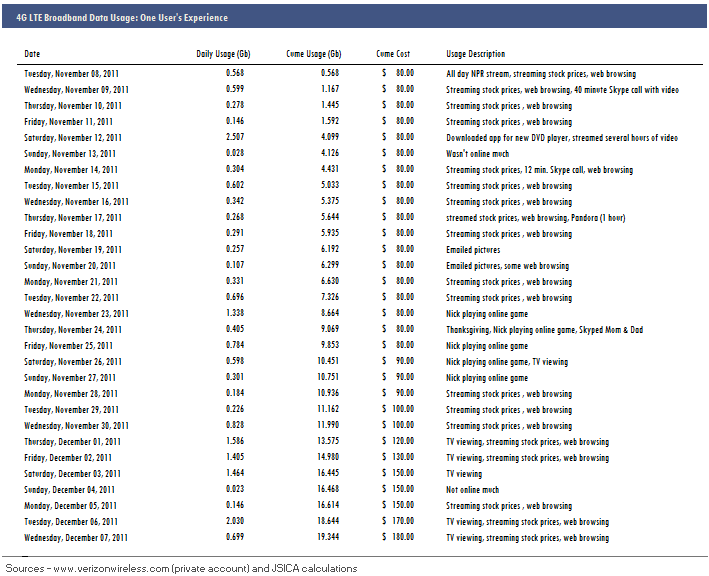
I logged my daily Internet habits throughout the billing cycle; you can see the daily and cumulative usage and cost in the chart below. With 20-20 hindsight, I have to say that the biggest thing I didn’t consider before making the switch was the fact that throughout November and December I have had/will have numerous houseguests.  Among these houseguests in November were my sixteen year old son who likes to play online games ad nauseum, and my television-addicted significant other. I also have yet a third person staying with me now who goes online at least some every day. The good news is that these roommates will help pay for what turned into a $180 bill…

Here’s how it happened. For the first week or so, still a bachelorette, my daily usage was between 0.3 and 0.4 Gigabits on weekdays, and far less on weekends. I realized that I didn’t HAVE to stream NPR over the computer and started listening to the radio. I also noticed that Skype video calls eat up a lot of data, so I cut back a bit on those calls in favor of the “free” Verizon to Verizon mobile calls (I know what my family members look like anyway!). Most days I don’t watch much TV, but on Saturday, 11/12, I purchased a new Blue Ray player with streaming capabilities and downloaded the software that allows me to surf directly to Netflix or Hulu on my TV. (Very, very cool!). That download and the two shows I then watched ate up about 2.5 Gigs.

For the next 10 days my friend, who got to town that weekend, and I used reasonable amounts of data—then my teenage son Nick arrived followed by the aforementioned significant other, for Thanksgiving. As it turned out, Nick’s online game didn’t seem to eat up too much data, but my boyfriend’s enthusiasm for his favorite TV shows, and the extensive library available with Netflix and Hulu, turned into nearly 10 Gigs of overage over the past 10 days or so…that’s $10/Gig, bringing the total fee for the past month to $180.

Now, that sounds like a lot, and it is, but if you consider that my last Comcast bill was $163 and all I had watched was two on-demand movies (literally, all month), and in this case there were probably 15 or more hours of television viewing, then it’s not so bad. And honestly, the TV-Head will be leaving again for a month after Christmas…I’m a big fan of Red Box so I’m betting I can get the January bill back down to less than $100.

But price isn’t the only consideration. Let’s discuss the quality of the signal and overall experience. My Internet connection is consistently fast and only for one afternoon did the Mifi device revert to the 3G network for a couple of hours. The streaming experience has been outstanding, with both Hulu and Netflix. By way of comparison, my Comcast Internet connection was notoriously inconsistent—25 Mbps one day and 1 Mbps the next. (Ironically, my colleagues at the main JSI Capital Advisors office in Manchester, NH have gone without Internet service today…their provider is—you guessed it—Comcast.)

The bottom line is that I really, really like the service and the Netflix and Hulu program offerings are extensive—more than enough even for a TV-Head like my boyfriend. Considering I was paying $145 or more previously, I’m not really going to sweat too much if I go over on data usage—although I would really like to see Verizon offer a 20 or even 30 Gigabit plan. My guess is it will eventually, as the company continues to buy up spectrum. I also love the fact that I can take my Mifi device with me and use it anywhere, and as I tend to travel frequently, that’s exactly what I’ll do.

Overall, while it’s not perfect, the cable option was FAR from perfect, and the 4G wireless broadband option is a really reasonable option for a single person who doesn’t live on the couch. But for larger households—especially those with kids—the 10 Gigabits per month probably won’t be adequate and overage charges could easily become prohibitive.
Thursday
Jun302011

How Do You Measure Wireless Competition?

AT&T’s Read of FCC’s 15th Annual Report on CMRS Competition Doesn’t Tell the Whole Story

On Tuesday the FCC issued its 15th annual report on wireless competition.  On Wednesday AT&T (NYSE:T) proclaimed the FCC’s report clearly showed that the market for wireless services was robust and highly competitive (so it should, of course, be allowed to acquire T-Mobile).   The basis for AT&T’s claims is a chart showing that the percentage of Americans served by five or more wireless service providers rose from 74% in 2009 to almost 90% in 2010, an increase of nearly 44m people.  But does this fact, which the FCC caveats by saying that its estimates are overstated, mean that the market for wireless services is really competitive?

The answer to this question is largely a function of how you define the word ‘competitive.’  Implicit in AT&T’s statement is that competition is determined solely by the number of players in the game.  Count the number of companies offering service to a large percentage of the population and when that figure exceeds a certain threshold, in this case five, the market is competitive.  But the word competition implies something more than a simple number, it also implies something about quality play.  To have true competition each player must have at least a marginal chance of victory. 

The FCC’s report contains information beyond what AT&T has gleaned, though it does take slightly more work to unearth it.  For example, the report contains a wealth of information about net subscriber additions.  First, there are estimates of the total number of net subscriber additions realized by the wireless industry as a whole. Using this information we can construct a good view of how the market for wireless services has been changing with regard to customer acquisition.

According the information supplied in the FCC report, between 2006 and 2009 the combined share of net subscriber additions for AT&T and Verizon Wireless (NYSE:VZ) rose from 59% to 92%, implying a compound annual growth rate of 16% in net subscriber additions, and over the four years analyzed, the top-two carriers accounted for 71% of total net additions.  Figures like these speak for themselves.

This is just one example of many that contradictions found in AT&T’s hyperbolic statements about the nature of competition in the wireless industry.  Factoring in spectrum holdings, the ability to offer advanced 3G and 4G services and device availability only further dilute AT&T’s claims.  The fact is that the wireless industry is a practical duopoly and nothing AT&T or its numerous surrogates say can change that basic fact.   

Thursday
Apr212011

Handset Subsidies and the Consumer Conundrum – Part 4

What’s It All Mean?

If you’ve been following our series on handset subsidies and the consumer conundrum, you know by now that I believe that the market power concentrated in the hands of AT&T Mobility (NYSE:T, “AT&T”) and Verizon Wireless (NYSE:VZ, “VzW”) gives them unregulated market control.  You’ve also read my analysis of the practice of subsidizing handsets, requiring a contract for same, and charging an Early Termination Fee (ETF) when a subscriber breaks his contract.  You also understand that I view the handset subsidy as a loan to the customer and the construction of the ETF has a built-in form of interest expense. In this last installment, I’ll explain why I believe these things are truly bad for both the industry and consumers.

First, the actual amount of the cash subsidy matters, and that’s the one piece of information that consumers don’t have. Knowing the actual cash subsidy amount is the single most important piece of information needed to truly understand the total financial impact of the purchase. The large wireless carriers would likely point out that the full retail price represents what the actual market price would be in the absence of the subscriber contract system.  This is a hollow answer; the fact is that the contract system does exist and carriers set the full retail price at levels which virtually guarantee that transactions involving wireless devices end with the consumer signing a 24-month service commitment.

Furthermore, the cash incentives provided by carriers aren't subsidies at all, they are loans that are repaid by the consumer over the life of the subscriber contract; if the actual cash subsidy is equal to or less than the initial ETF, then the way in which ETFs are administered today produces punitive results for subscribers who terminate their subscriber contracts early. This means that payments made to wireless carriers which are now called Early Termination Fees, are in fact Early Termination Penalties. These penalties represent yet another hurdle to consumer choice with regard to wireless services. So why does this confusing system of hidden handset subsidies and penalties exist? 

The answer is that the subscriber contract is a significant brick in the foundation that supports the entire wireless industry. The subscriber contract ties the consumer to the wireless provider for up to 24 months at a guaranteed minimum ARPU, meaning that the contract system provides a means by which wireless carriers regulate both subscriber churn and service revenue. Churn and ARPU are two metrics that are closely tracked by financial analysts as indicators of future earning; if either of these metric were allowed to fluctuate unpredictably, the equity prices for both AT&T and VzW would become more volatile. Uncertainty is not viewed positively by large investors and is ultimately a threat to senior management. Therefore, the need to maintain the subscriber contract system as a means of controlling these two metric is paramount, even if it comes with great financial costs.

Elimination of handset subsidies and its implications for the all-important subscriber contract represents a significant threat to the status quo and would be fiercely opposed by the major wireless carriers.  In all likelihood, AT&T and VzW would proclaim that handset subsidies are pro-competitive and good for consumers. Practically speaking, the notion of AT&T and VzW as consumer advocates does not compute and claims made by either company that purport to be pro-consumer should be viewed with a high degree of skepticism.

The reality is that even if the use of handset subsidies were eliminated, it would not spell the end of the subscriber contract; subsidy dollars would simply be reallocated. Depending on the timetable under which the current system could be replaced, the impact to wireless carriers would be a net cash savings based on the fact that they would no longer be making large outlays to subsidize the purchase of wireless devices. The cash savings would be enormous, but these savings would come at the cost of having to forgo the use of subscriber contracts. Giving up the use of subscriber contracts means ending the primary ARPU and churn controls now in existence; this, in turn, would make senior managers at both AT&T and VzW less certain of their future financial performance.

Because of the increased uncertainty that would be created, the likely response would be for service providers to find new subsidies to exchange for subscriber contracts. The most obvious scheme would be for carriers to offer consumers promotional/ introductory pricing such as two or three months of free or reduced pricing for wireless service. 

In my view, if wireless carriers were effectively eliminated from the supply chain for wireless devices, the most likely result would be that prices for wireless service go down. How far prices for service would drop is unclear but the fact is that prices would not fall below the amount of the actual cash subsidies that are offered today and would make the entire system function with significantly more transparency. Under the scenario envisioned here the consumer is provided with far better information about the exchange between service provider and consumer allowing for the use of subscriber contracts under conditions that are less compulsory than they are now.

A second, less likely outcome would be that wireless providers accept the elimination of subscriber contracts. Under this scenario consumers may not pay lower prices for wireless service but then service providers would need to compete for subscribers based on some form of product differentiation. Achieving that differentiated status is extraordinarily difficult to do with a product such as wireless service. Carriers would need to commit to a level of capital investment, which could be funded from the savings described above to raise the customer experience to the point where very high levels of customer satisfaction would create product loyalty. The issue is that the success of any service improvement program is far from guaranteed and corporate entities such as AT&T and VzW are reluctant to invest capital in programs that can’t guarantee a return.

Lastly – yes, absolutely without a doubt, consumers would pay higher prices for wireless devices. The question is, will prices for devices be as high, or higher, than the full retail prices that exist today? If the answer to this question is no, which I think is likely, then net, net the industry and the consumer would be much better off without the convoluted system of handset subsidies and contracts that exists today.

Richelle Elberg contributed to this series of articles.

Tuesday
Apr192011

Handset Subsidies and the Consumer Conundrum – Part 3

Subscribers Are Paying Hefty Interest on the Handset “Loan”

In Part 1 of this series, I described how Verizon Wireless (NYSE:VZ, “VzW”) and AT&T Mobility (NYSE:T, “AT&T”) are acting as unregulated market makers within the handset market, because of their overwhelming dominance, market share and resulting sway with equipment vendors. 

Part 2 showed the calculation of the net present values of a hypothetical AT&T subscriber and a hypothetical VzW subscriber, under a scenario where the subscriber accepts a handset subsidy in exchange for signing a contract and alternatively, where the subscriber pays the advertised retail price. Not surprisingly, the NPV of each subscriber is sharply higher under the unsubsidized scenario than under the subsidized scenario; the difference between the two scenarios is supposedly explained by the out-of-pocket expense that wireless carriers incur to offer the discounted device to their customers.  It is also used to rationalize the Early Termination Fee (ETF) that subscribers incur if they terminate service before fulfilling their contract. Now I will explain why I think this system is unfair to the consumer.

The following is a hypothetical situation that is faced by U.S. consumers every day.  Consumer X arrives at the local ValueZone Wireless store to buy the new CoolPhone, which is manufactured by Apricot Electronics Company; the full retail price is $499.99 and the contract price is 199.99, implying a total subsidy of $300.00. 

The consumer doesn’t like the idea of signing a contract and he takes issue with the fact that the implied subsidy is less than the ETF, which is $350.00.  When the consumer points out this inconsistency (the ETF is greater than the subsidy), he is told that there is an additional discount available in the amount of $100.00, making the contract price $99.99.  This brings the implied subsidy to a total of $400.00—this is beginning to look like a good deal.  Still being uncomfortable with notion of signing a contract, the consumer asks if the additional discount can be applied to the full retail price.  The answer is no, the additional discount is only applicable to the contract price and in order to get the additional discount, Consumer X must signup online.

Now things have become more confusing.  There are three prices instead of two and two different implied levels of subsidy: there is the full retail price of $499.99, the contract price which is $199.99, implying a subsidy of $300.00 and the online contract price of $99.99, which implies a $400.00 subsidy. 

But what if the real price paid to Apricot Electronics was really $100.00 less than the full retail price and that ValueZone Wireless had chosen to only pass those savings on to consumers who purchase the CoolPhone at the online contract price?  For the consumer willing to forego the additional discount, the implied subsidy is $300.00 and the actual cash subsidy is $200.00.  A similar situation hold true for the subscriber who signed up on line; the implied subsidy is $400.00 but the actual cash subsidy was really $300.00.  Does this really happen? The answer is that I don’t know; none of the information that is needed to answer this question is ever disclosed.

The next issue that must be tackled is the interaction between the implied cash subsidy, the actual cash subsidy, the initial ETF and the ETF amortization.  This task is difficult because the information provided in the subscriber contract, while seemingly simple, is in truth very confusing.  Nevertheless, if we begin with the assumption that the inclusion of the ETF in the subscriber contract is a fair proposition, that the wireless carrier incurs an out-of-pocket expense at the time the wireless devices is sold and should be allowed to recoup that expense if the subscriber terminates the contract early, then we can proceed.

But what is the proper amount that should be paid for early termination?  This is where the issue becomes murky and determining the amount is made particularly difficult because the actual amount of the cash subsidy is an unknown quantity.

The ETF policies for AT&T and VzW as it relates to smartphones are the following:  AT&T sets the initial ETF at $325.00, for each full month during which the subscriber remains active on AT&T’s service, the ETF is reduced by $10.00.  VzW, starts its ETF at $350.00 and, like AT&T, for each full month of service the ETF is reduced by $10.00.  By dividing the initial ETF by the monthly reduction of $10.00, the total life of the ETF is 32.5 months for AT&T and 35 months for VzW.  These implied ETF lives are at odds with the fact that the term of the typical subscriber contract is 24 months.

Recalculating the monthly ETF amortization based on a life of 24 months yields amortization rates of $13.54 for AT&T and $14.58 for VzW.  In my view, the differences between the recalculated ETF amortization rate and the actual amortization rate, which are $3.54 ($13.54 less $10.00) and $4.58 ($14.58 less $10.00), constitute an interest payment.  Furthermore, I see the device subsidy as nothing more than a loan made by the carrier to the consumer for the purchase of the wireless device.  The handset subsidy is a loan that is repaid over the life of the subscriber contract.  If the contract isn’t terminated, then intuition would tell us that the implied annual interest rate on the loan should be zero percent. 

Shown in Table 4 is the financial impact and implied annual rate of interest that is experienced by an AT&T subscriber choosing to terminate service early, under the terms and conditions described in the subscriber contract currently used by AT&T today (For the purpose of establishing a reference point for comparison, I also provide the calculation showing the financial impact if the subscriber contract is not terminated early.) 

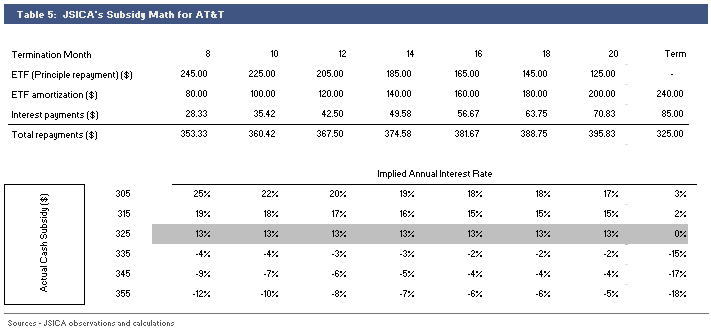
Table 5 presents the same calculation, which I call the JSICA Calculation, assuming that the subsidy is actually a loan. Under this scenario I add the amount of the difference between the recalculated amortization rate and the actual amortization rate in the form of interest payments.

Looking back at the implied subsidies I calculated in Part 2 of this series, AT&T and VzW would like consumers to think that the subsidies are generous and in many cases exceed the amount of the ETF.  While subsidies are large, it is unlikely that on average, actual cash subsidies exceed the ETF for either company.  Because of this, I calculate the implied interest rates assuming actual cash subsidies that revolve closely around the AT&T and VzW initial ETF amounts, rather than using the implied subsidy numbers found in Table 1 of Part 2 in this series.

Tables 6 and 7 show the same set of calculations as in Tables 4 and 5 but using the terms and conditions found in the VzW subscriber contract.

AT&T and VzW would probably disagree strongly with the analysis but I think this methodology is sound.  The reason for this belief is that the JSI calculations pass the “aw, shucks” test.  The results of the AT&T and VzW math produce nonsensical answers, whereas the JSICA calculations produce results that are predictable and just seem to make common sense.  The best example of the difference between the two sets of calculations is the scenario where the actual cash subsidy matches the ETF.  If the contract runs to term intuition tells us that the implied annual interest should be zero percent; this is exactly the result found in both sets of JSICA calculations.  On the other hand, the AT&T and VzW calculations produce annual interest rates of negative 14 and negative 17 percent.  Unless you believe in the tooth fairy, Santa Claus and that there really is such a thing as a free lunch, these results simply don’t hold water.  In Part 4 of this series on Handset Subsidies and the Consumer Conundrum, I’ll explain why.

Thursday
Apr142011

Verizon Wireless Up to Seven LRA Partners

14 Affiliated ILECs Involved in the LTE in Rural America Program to Date

Earlier this month a seventh Verizon Wireless (NYSE:VZ) LTE in Rural America (LRA) partner was announced; this time the partner is Indiana-based S and R Communications, which is a joint venture between Swayzee Communications and Rochester Telephone Co.  S and R will lease 700 MHz spectrum from Verizon and build an LTE network covering five Indiana counties, including Carroll, Cass, Fulton, Miami and Wabash.

Several things struck me after reading the press release.  First, it’s been a few months since Verizon Wireless announced a new LRA partner—the last was Utah-based Strata Networks back in early February.  Prior to that, Michigan-based Thumb Cellular and Wisconsin-based Cellcom announced LRA agreements in January and back in December came the news of the first three to sign on:  Cross Telephone (Sprocket Wireless), Bluegrass Cellular and Pioneer Cellular.

The second thing I realized is that back in December/January, as Verizon announced the new partners, it also said that it was in talks with roughly a dozen more…but we’ve only had two new takers since then, which leads me to think that some of those negotiations may have since broken down.

The last thing that I noted in reading S and R’s press release was that the JV represented itself as the first ILEC partner in the program. Tim Miles, president of Swayzee Communications, said "We are excited and honored to be the first landline based companies to participate in Verizon's LTE in Rural America program.  We believe we will bring a skill set and rural market understanding that will bridge the gap between wireless and small independent landline companies in our area."

Technically that’s correct—all of the other partners are wireless companies.  But all of those wireless companies are in fact affiliated with ILECs.  I decided to take a looksee at the ILECs which have decided to catch a ride on the Verizon LRA train.

By my count there are now 14 ILECs indirectly involved in the LRA program, covering seven primarily midwestern states.  At the end of 2009, those companies served about 171k access lines. 


It seems rural LECs have mixed feelings about the Verizon LRA.  On the one hand, AT&T/T-Mobile deal notwithstanding, Verizon is THE wireless carrier to beat these days and now that it has the iPhone its momentum should accelerate this year and beyond.  It’s now covering about 120m POPs with LTE service and says it will cover its entire CDMA footprint by the end of 2013.  The opportunity to market that network is appealing, particularly for ILECs like Swayzee and Rochester, which didn’t have a wireless play.

On the other hand, there are other options out there, specifically Lightsquared and even Clearwire (Nasdaq:CLWR), and Verizon is known to be a tough negotiator.  The automatic data roaming rules adopted by the FCC last week could also give some companies a higher comfort level if they’re sitting on spectrum licenses but were heretofore wary of investing in the build.

At the end of the day, I believe Verizon’s LTE network will be, like its 3G network, the best nationwide, or at least the first, best network.  Longer-term I have no doubt that other competitors will encroach, but there’s just no discounting the market strength that Verizon has today.  Seems to me the wireless companies and affiliated ILECs who’ve decided to work with Verizon have made their decisions based on two important tenets:  “If you can’t beat ‘em, join ‘em” and “You get what you pay for.”