


Entries in Universal Service Reform (4)

Wednesday
Jun222011

Rural Telcos Illustrate Impact of USF Reform

Three RLECs Provide Evidence of Financial and Community Harm in Ex Parte Filings

Over the last few weeks, representatives from three RLECs have held ex parte meetings with the FCC on the topic of Universal Service Fund reform. Randy Fletcher and Tom Bowden from Lennon Telephone Company (Lennon, MI); Jeff Leslie from ITS Telecommunications Systems, Inc. (Indiantown, FL); and Jan Lovell, Tom Lovell and Doug Klein from Clear Lake Independent Telephone Company (Clear Lake, IA) each met with members of the Wireline Competition Bureau. Each company was represented by John Staurulakis, Inc., and each company illustrated the significant financial harms and negative community impacts that could come as a result of the FCC’s proposed USF reforms.

In their June 15 ex parte meeting, representatives from Lennon Telephone Company (“Lennon”) argued that the company is “heavily dependent on universal service support.” Lennon is a family-owned business with 15 employees, and the company provides service to 392 broadband customers and 981 voice customers. Lennon is concerned that reforming USF will hinder the company’s ability to repay loans, noting that they currently have two outstanding loans (one is for a softswitch). Lennon argued that “the near-term proposals in the FCC’s Notice of Proposed Rulemaking on universal service reform would significantly reduce the amount of universal service support that the company receives,” and the company currently receives 53% of its regulated revenues and 28% of its total revenues from USF support.

ITS Telecommunications Systems, Inc. (“ITS”) representatives held their ex parte meeting on June 9, where they stressed their company’s importance to the local community in Martin County, FL, noting that they are a top employer, a leader in economic development in an economically depressed area, and they support schools, community organizations and help attract new business to the area. ITS has 1,011 broadband and 2,973 access lines. ITS has utilized RUS loans and made significant investments in infrastructure to provide broadband at speeds of 10-100 Mbps based on the current USF support system, but unfortunately, “ITS would default on Rural Utilities Services loan commitments under the proposed reforms.” ITS illustrated that under a USF scenario based on the FCC’s NPRM, the company would fail the Times Interest Earned Ratio (TIER) test, with a TIER of less than 1.0000 for each of the next 3 years. As a result, ITS would default on its RUS loans and be unable to secure any additional capital investment opportunities.

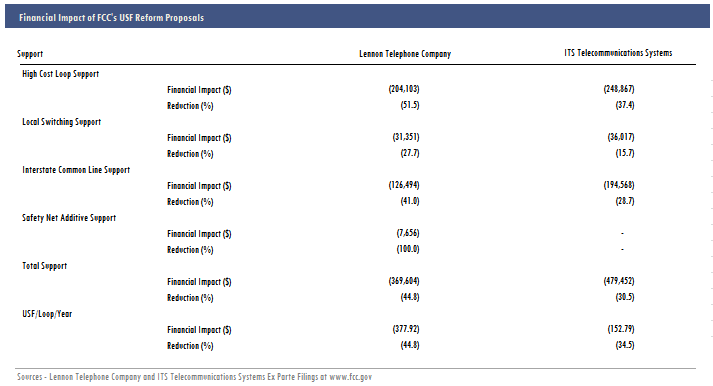
Both Lennon and ITS provided “impact statements” showing probable financial losses to the companies as a result of reducing High Cost Loop Support, Local Switching Support, Interstate Common Line Support, and Safety Net Additive Support. As you can see in the chart below, these two companies stand to lose approximately 30-45% of their annual total universal service support if the FCC’s NPRM proposals are implemented:
The financial loss is only one side of the story. Clear Lake Independent Telephone Company (“CL Tel”) provided testimonials from members of their community to illustrate that RLECs are more than just telecommunications service providers in many rural areas. CL Tel has a total of 2,423 broadband and 5,299 voice access lines, and the company’s role in the Clear Lake, IA community should not be overlooked. CL Tel’s ex parte filing notes that “the company is a major contributor to the local communities both financially and with managers lending their expertise to community organizations and the area community college which recruits new industry and supports existing ones.” CL Tel also provides backhaul to four major wireless companies, and their fiber network helps bring new businesses to their rural Northern Iowa service area. CL Tel argues that rate-of-return regulation has facilitated long-term investments and has allowed the company to secure RUS and RFTC loans. According to CL Tel, these sources of capital will be at risk if the FCC’s USF reforms are implemented.

I found the testimonial letters from the Clear Lake community to be especially critical evidence to support first how important RLECs are to rural communities, and second how detrimental the FCC’s reforms may be to many rural Americans—not just RLECs alone. The superintendent of the Clear Lake Community School wrote, “CL Tel has always worked with the Clear Lake Community School District to improve telecommunications and to expand broadband to enable students, teachers, administrators and parents to keep up in the rapidly evolving world of technology.” I remember FCC Chairman Julius Genachowski’s opening remarks when the USF Reform NPRM was introduced back in February. He told an emotionally-charged story about a young student who had to spend the night in a parking lot of a library in order to complete a class project—the student did not have broadband at home and had to resort to using the library’s Wi-Fi network. Does the FCC really want to eliminate support for a company like CL Tel, which provides a 100Mbps WAN connection to all of the Clear Lake Community School buildings? CL Tel apparently provides free and reduced services to the school that amount to an annual savings of $25,856.20. The superintendent noted that this is particularly crucial as the school faces increasing budget cuts and layoffs. I believe that if funding is reduced for RLECs who strive to support their community schools, the FCC will have many more sad stories to tell about students going to great troubles to complete their homework.

In addition to the school, the Clear Lake Public Library, Clear Lake Arts Center, Clear Lake Police Department and the Mayor of Clear Lake all provided letters in support of CL Tel’s admirable community involvement. Each of these organizations receives free or discounted broadband services. CL Tel has also contributed to library and arts center renovations, and they are helping the police department install a fiber network for security cameras. The Mayor of Clear Lake commended the company’s support, adding that CL Tel “has been a major contributor in all our public/private capital campaigns such as: the Public Library, swimming pool, Central Gardens, lake restoration and Arts Center projects.” In total, Clear Lake public institutions save thousands of dollars per year on telecommunications services as a result of CL Tel’s community-oriented corporate philosophy. I am particularly impressed by CL Tel, because I imagine that offering free and reduced-cost services to community institutions probably hurts the company’s bottom line, yet the company clearly cares about the community enough to continue these programs despite the constant onslaught of financial, regulatory and technological challenges that most RLECs face these days. 

CL Tel is by far not the only RLEC that goes to great extents to support its rural community. I think it is very important for the FCC to realize just exactly how much rural America stands to lose if USF support is drastically reduced or eliminated for RLECs. I don’t argue with the FCC that in some cases, the RLEC might not be the proverbial “most efficient” broadband provider, but I do argue that it is absolutely critical for the FCC to acknowledge the goodwill contributions of RLECs to their communities in addition to the financial data. Should there be some type of goodwill or community support weighting factor in the new USF methodology, and if so, how would that work? I have to wonder if an investor-owned large price cap carrier would provide tens of thousands of dollars each year to ensure the survival of small-town schools, libraries and public safety departments—what would their stockholders and Wall Street brokers say?

You can read Lennon Telephone Company’s ex parte filing here, ITS’s filing here, and CL Tel’s filing here.

Thursday
Jun162011

USF Reform - Their Two Cents: Hargray Telephone Company

Hargray Proposes Broadband Incentive Plan as an Alternative to FCC’s NPRM

On June 9 and 10, 2011, representatives of Hargray Telephone Company (“Hargray”) met with members of the FCC to discuss their alternative plan for USF Reform, the Broadband Incentive Plan (“BIP”). Hargray outlined the BIP in an ex parte filing and in reply comments filed on May 23 in the USF Reform proceeding. The BIP proposes to consolidate high-cost USF support and freeze per-line subsidies at 2011 levels, then tie future support to the number of telephone and broadband lines with a weighting factor based on broadband speeds. I find that this proposal is simple, forward-looking, and market-driven; and it does not discount the accomplishments that RLECs have made thus far in broadband deployment, nor does it leave traditional telephone subscribers in the dark.

Hargray’s ex parte filing describes how the BIP could provide a reasonable transition to a completely broadband-centric USF methodology.  Support distributed under the BIP would be contingent upon the number of broadband and voice access lines per carrier, not how much money the carrier spends. According to Hargray, “due to declining trends in voice access lines, only those carriers that are aggressively building out infrastructure and delivering affordable broadband to their residents and businesses will be able to sustain levels of support at or near their current levels.” Hargray believes this will act as an incentive for RLECs to invest in broadband facilities and keep consumer prices low in order to stimulate demand and adoption.  With per-line support frozen at 2011 levels, a carrier would lose support for each cord-cutter, but then have an opportunity to reclaim a slightly higher level of support for each new high-speed broadband customer.

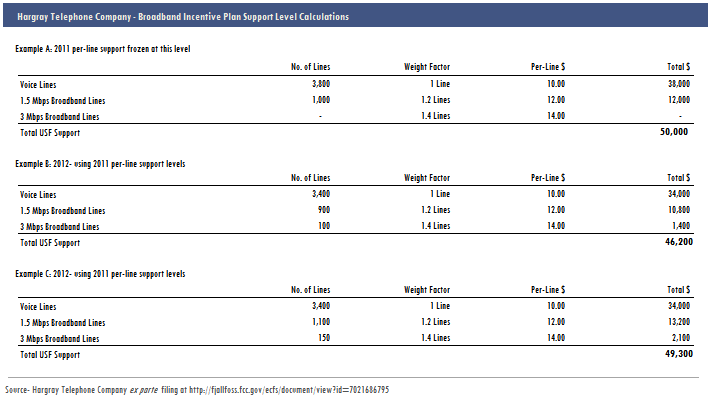
Hargray’s reply comments outline the possible benefits of the BIP: it could “promote broadband investment, economic stimulus and job growth;” “allow consumer choice to direct what services the fund supports;” and “manage the size and burden associated with the fund.” As for the mechanics of the BIP, Interstate Common Line Settlement support (ICLS), Interstate Access Support (IAS), High Cost Loop Support (HCLS), Local Switching Support (LSS) and Safety Net Additive support (SNA) would be combined, and per-line support would be frozen at 2011 levels. Each recipient of support would become a Carrier of Last Resort (COLR) in their study area. I believe the most interesting aspect of the BIP is the weighting factor for broadband lines. Hargray proposes that a broadband line between 768 kbps and 1.5 Mbps would receive support equal to one telephone line, but as speeds increase so would the support level. For example, broadband lines between 1.5 and 3 Mbps would be equal to 1.2 telephone lines, and broadband lines exceeding 25 Mbps would be equal to 2 telephone lines. The weighting factors could be easily adjusted in the future as the market dictates. Hargray illustrates how support administered under the BIP would reduce over time, assuming providers continue to lose landline customers. The following data was included in Hargray’s ex parte filing:

I believe the broadband speed weighting factor is an excellent alternative to the FCC’s proposed broadband support speed limit of 4 Mbps download, 1 Mbps upload (“4/1”). Although 4/1 may be a sufficient definition of broadband in the very near term, customer demands will rapidly outgrow this definition. I also think it would be very unfortunate if RLECs failed to upgrade broadband infrastructure because they could not receive support for speeds higher than 4/1, but the BIP may effectively solve this dilemma by encouraging RLECs to upgrade networks based on demand and likely customer take rates.

Another benefit of the BIP is that it will not undermine the still-relevant landline business in rural areas. According to Hargray, the BIP does not compromise the progress and investments that RLECs have made in both voice and broadband so far, and it “leverages the benefits provided by the existing [High Cost Support] program by establishing a mechanism that enables recipients to make additional investment in reliable and robust broadband services throughout America.”  Instead of abruptly ending support for landlines, RLECs would continue to receive support based solely on the number of landline subscribers. As customers continue to migrate away from landlines, “the amount of support associated with voice-only services would drop over time consistent with the industry trend of declining voice lines.” Hargray proposes that BIP would act as a bridge to the Connect America Fund and potentially eliminate some of the risks associated with implementing a sweeping reform that could potentially leave RLECs without any USF support—or private investment opportunities. Hargray argues that the FCC “should adopt a structure that does not represent a risky start over.”

I agree with Hargray that the BIP might incentivize some RLECs who have been slow to invest in broadband infrastructure to finally step up their game. Although RLECs have traditionally been leaders in broadband deployment in rural areas, not every RLEC has modernized—this has been a significant source of criticism from the FCC and others, who claim that many rural providers are inefficiently utilizing USF. I think it is very unfortunate that the inefficiencies of a very small number of RLECs have been projected onto the collective RLEC community, and I think Hargray’s BIP could help overcome some of the negative sentiments about RLECs. Hargray shows their concern about this situation, and they argue that the BIP could “encourage companies to not only build broadband networks, but also to build them where customers want them and to price services on those networks so as to spur adoption.”

I applaud Hargray for submitting an alternative proposal because the FCC said from the very beginning of the USF Reform proceeding that they wanted to see solid models and data from the industry. I am particularly impressed with the BIP because it is forward-looking, practical, and logical. Hargray also argues that the BIP will reduce administrative burdens on the FCC, USAC and NECA because support would be based on estimated line counts rather than complex cost recovery calculations. I encourage RLECs to utilize the model illustrated above to calculate how much support they may receive in the future based on frozen 2011 per-line levels and a weighted broadband speed factor. Would your overall support decrease under the BIP, and would the BIP serve as an incentive to invest in broadband facilities capable of higher speeds?

Hargray Telephone Company is an RLEC serving Jasper and Beufort Counties in South Carolina with 41,000 telephone access lines and 16,400 broadband lines. Hargray’s reply comments are available here, and their ex parte filing is available here.

Monday
Jun132011

USF Reform -Their Two Cents: Satellite Broadband Providers

Debating the Role of Satellite Broadband in the Connect America Fund

DISH Network (Nasdaq:DISH), EchoStar Technologies (Nasdaq:SATS), Hughes Network Systems, ViaSat Inc. (Nasdaq:VSAT), and WildBlue Communications (“The Satellite Broadband Providers”) filed joint reply comments in the Universal Service Fund Reform proceeding, arguing that satellite broadband providers should be allowed to receive direct support through the proposed Connect America Fund. The Satellite Broadband Providers also argue in favor of reverse auctions, and they claim that the technological advances of next-generation satellite broadband will make satellite broadband a competitive alternative to terrestrial wireless and wireline services.

The Satellite Broadband Providers claim that there is a role for all broadband technologies in the Connect America Fund.  They cite broad support for satellite broadband in the USF Reform proceeding and argue that “a wide range of commenters concur that satellite is the least expensive way to bring broadband to many consumers.” The Satellite Broadband Providers contend that $21b could be saved if 47% of unserved households are served with satellite broadband instead of terrestrial broadband. The Satellite Broadband Providers reference support from comments by the California and Ohio Public Utility Commissions and Comcast (Nasdaq:CMCSK), and they dispute criticism by the Federal State Joint Board and RLECs. They insist that the criticisms are “based on outdated and incorrect information,” because their opponents do not consider the benefits of next-generation satellite broadband, which is expected to be launched this summer.

One of the most common criticisms of satellite service is latency, but the Satellite Broadband Providers claim “satellite broadband performs just as well as terrestrial wireless broadband for highly latency-sensitive applications such as gaming.” They add that next-generation satellite broadband will enable 12/3 Mbps with moderate latency, coupled with low deployment costs and competitive consumer rates. A May 2011 report by Stephen Cobb for the Rural Mobile & Broadband Alliance (RuMBA) entitled “Satellite Internet Connection for Rural Broadband” is not nearly as optimistic about the technical capabilities of satellite service. This report questions whether satellite is a viable broadband service for rural areas, and it outlines four “satellite service gaps:” latency, bandwidth, price/performance, and service. Based on these critical gaps, this report concludes that satellite service does not enable basic broadband functionality, and “satellite Internet service is an amazing technological achievement but it is not broadband.” I highly recommend this report as a technical critique of satellite broadband, as it provides some interesting analysis which refutes many of the claims made by the Satellite Broadband Providers.

The Satellite Broadband Providers also support reverse auctions, but warn that RLECs should not receive any “rights of first refusal” or preferential treatment in reverse auctions. The Satellite Broadband Providers call RLEC comments in favor of preferential treatment “self-interested attempts to advance private interests at the expense of the public.” The Satellite Broadband Providers add that preferential treatment would violate competitive and technological neutrality, and RLECs should only win reverse auctions if they present the most efficient case—if not, they insist that “RLECs should lose.”

In their reply comments, AT&T (NYSE:T) argues “the Commission should permit CAF recipients to satisfy their service obligations via satellite in extremely high-cost areas.” AT&T and other large price cap carriers wish to be able to partner with satellite providers to deploy broadband in rural areas that would be unprofitable to serve alone. I interpret this argument as a means for the large carriers to secure USF support without actually having to commit to serving rural areas or put forth the investment to do so. The way I see it, the CAF recipient partnered with a satellite provider would receive support to serve a high-cost area.  The recipient would pass along some of this support to their satellite partner, but also probably keep a share of the support for themselves. I believe the additional cost of providing support to a satellite provider plus their partner would inflate the bidding price in a reverse auction, defeating the purpose of finding the lowest-cost and most efficient broadband provider. Why is it necessary to direct support through an intermediary if the satellite provider will be doing all the heavy lifting?

I do believe there is a limited opportunity for satellite providers to reach the most uneconomical unserved households with broadband. In some cases is it literally not technologically possible or fiscally practical for a wireline or terrestrial wireless carrier to reach certain locations in remote and rugged areas.  However, I do not condone large price cap carriers using satellite broadband providers as a crutch to lean upon only when it is conveniently uneconomical to reach the extremely remote households with terrestrial broadband.  If satellite providers participate in CAF, I believe they should be the direct recipients of CAF support, without using a price cap carrier as an intermediary.

Many questions remain regarding the role of satellite broadband providers in the reformed Universal Service Fund:  Should satellite providers become direct recipients of CAF, possibly to compete with RLECs, or should they become indirect recipients of CAF support on behalf of price cap carriers? Do extremely rural customers actually want satellite broadband service, even if it is the only option? Will the alleged improvements in satellite technology really make this service a competitive alternative to cable, DSL and wireless broadband? Hopefully some of these issues will be worked through in time for the FCC’s final decision on USF Reform, or extremely rural households may be treated as second-class broadband citizens and the FCC will fail to achieve the goal of reducing the rural-rural digital divide.

The Satellite Broadband Provider’s reply comments are available here, and AT&T’s reply comments are available here.

Monday
Jun062011

Dorgan Weary, Levin Optimistic of FCC’s USF Reform Proposals

Two Different Directions on the Path to USF Reform

On June 3, Former Senator Byron Dorgan (D-ND) and Aspen Institute Fellow/National Broadband Plan Director Blair Levin hit the media to discuss different perspectives on the FCC’s proposals for Universal Service Reform. Dorgan discussed his skepticism of the FCC’s ability to promote broadband deployment in extremely rural areas on The Hill’s Congress Blog, and Levin discussed his feelings about the success of the National Broadband Plan on C-SPAN’s “The Communicators.” These two divergent opinions illustrate the controversial nature of the USF Reform debate, which will surely become increasingly more contentious as the FCC moves towards a rulemaking, presumably within the next few months.

Dorgan’s blog post, “Will the FCC Stay Committed to Rural America?” marvels at the progress of the global telecommunications industry, which “is possible because…governments have made access to telecommunications a priority.” However, Dorgan points out that rural Americans are often disadvantaged in broadband service. Dorgan asks, “Will the people who live in rural and hard-to-reach areas have the same access as other Americans?” This is definitely one of the most troubling questions in the USF Reform debate, and depending on whom you ask, the answers may be quite different.

Dorgan reiterates many of the fears and concerns shared by the rural telecommunications industry, and he states “Now there is a real danger that the FCC could seriously undermine the concept of ‘universal service,’” due to the uncertainty over funding for small rural telecommunications providers. Dorgan warns that the companies who have successfully provided telephone and broadband service to the most rural and economically unattractive areas of the country must not be weakened in the process of transitioning to a broadband-supported USF.  He is concerned about the “market-driven” aspect of the Connect America Fund, noting that “history has shown us that if we had relied on the ‘market’ to move electricity and telephone service to rural and high-cost areas, we’d still be waiting.” Dorgan sincerely hopes that the FCC will implement the right path for USF Reform, whereby rural America can prosper and benefit from broadband instead of falling further behind in the urban-rural digital divide.

Blair Levin on the other hand is often considered an opponent of the rural telecom industry. He has made negative statements in the past about RLECs, and he arguably does not wish to see future USF/CAF support going to small rural telecom providers.  In the C-SPAN interview, Levin praised the 2010 National Broadband Plan as “very, very successful” overall, largely because nearly every significant telecom debate and proceeding going on right now can be traced to a National Broadband Plan recommendation.  Levin strongly supports “incentive auctions,” or reverse auctions, which are typically not favored by the rural telecom industry.

When asked about USF Reform, Levin commented that it is possible—but not likely—that the FCC will meet its aggressive deadline. However, he is optimistic about the reforms underway, and unlike Dorgan, Levin believes USF Reform is moving in the right direction. Although Levin did not outright say anything negative about rural telecom providers, he did say that the FCC should not continue to “prop up certain phone companies” that act in uneconomic ways. Knowing his opinions about rural telecom providers, that comment could certainly be translated as a backhanded dig at RLECs. Levin is concerned that these “certain phone companies” are not demonstrating a public gain, but if many rural areas only have one option for high-speed, high-quality broadband—from an RLEC—how can he say USF is not supporting a public gain by funding these companies? These rural communities would not have any broadband if not for the investments of RLECs, supported by USF.

RLECs are definitely more likely to relate to Dorgan’s blog post, but it is important to understand both sides of the debate. It is interesting that two leaders, on the same day, came out and essentially said that USF Reform is moving down polar opposite paths—one the “right,” and one the “wrong.” From the RLEC perspective, Dorgan really summed up the severity of the debate by stating, “The wrong decision by the FCC could be a disaster for the economic future of high-cost and rural areas. Without access to the latest and best telecommunications services, rural areas of our country will be on the wrong side of the digital divide, and consigned to a future without economic opportunity or development.”