



Site Search

Entries by Matt Lydon (274)

Wednesday
Apr252012

Leap And T-Mobile Announce Spectrum Exchange

Realign Spectrum Holdings with View Toward 4G Deployment

Leap Wireless International announced on April 9, 2012 that it has entered into definitive license exchange agreements with T-Mobile USA, Cook Inlet/VS GSM VII PCS (a joint venture between T-Mobile and Cook Inlet) and Leap’s non-controlled, majority-owned venture Savary Island Wireless to exchange wireless spectrum in various markets. Financial details of the transaction were not disclosed.

These transactions involve only the assignment of spectrum – no other assets are included, and are primarily aimed at realigning the spectrum holdings of the involved parties. “These transactions will enhance our spectrum depth in these markets and provide us longer term flexibility to offer a larger LTE channel,” said Leap’s president and ceo Doug Hutcheson. “In addition the transactions will allow us to re-align spectrum in key markets into contiguous channels thereby optimizing our delivery of wireless services.”

Through its wholly-owned subsidiary, Cricket License Company, Leap has agreed to assign eight of Cricket’s AWS licenses to T-Mobile covering portions of Alabama, Illinois, Missouri, New Jersey and Pennsylvania, among others. Cricket acquired the majority of these licenses at Auction 66 for approximately $230 million, or $0.42/MHz POP on average.

Also, Leap’s non-controlled, majority owned venture Savary Island Wireless will assign four AWS D-block licenses covering portions of Illinois and the midwest to T-Mobile.

In exchange, T-Mobile will assign nine AWS licenses to Cricket. These licenses were purchased by T-Mobile at Auction 66 for approximately $572 million in aggregate, or $0.33/MHz POP on average. These licenses cover portions of Arizona, Texas, New Mexico, New Jersey and Pennsylvania, among other areas.

T-Mobile’s joint venture, Cook Inlet/VS GSM VII PCS, will assign two PCS licenses covering Austin and Temple-Killeen, Texas to Cricket. These licenses were acquired at Auction 58 for approximately $12 million, or $0.73/MHz POP.

And in exchange, Leap will assign two PCS licenses covering Austin and Temple-Killeen, Texas to Cook Inlet/VS GSM VII PCS.

According to the companies, there will be no loss of an existing service provider in any of the market areas subject to the transactions at issue. Although T-Mobile, Cook Inlet/VS GSM VII PCS and Cricket are each providing service using some of the licenses included in the license exchange, all of these operations will be transitioned to other spectrum that the applicable carrier has in the same market or is acquiring through this transaction. In the case of the Savary Island Wireless licenses included in the exchange, the company is not currently providing service on these licenses.

Looking at the licenses included in the exchange, it’s clear the geographic realignment of spectrum is the main goal of the transaction. By aligning the spectrum blocks in adjacent markets, the carriers are able to operate more efficiently by facilitating handoffs when users transition to the adjacent markets.
Tuesday
Apr242012

Hargray Buying Spree Continues

Agrees to Acquire Beaufort, S.C. Cable System from Charter

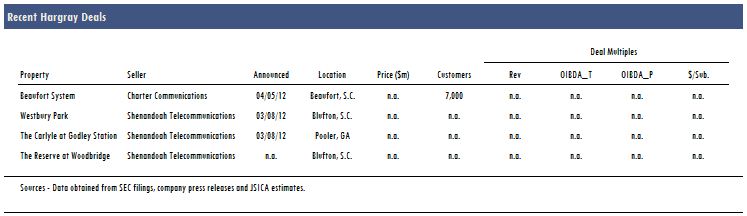
Hargray Communications announced on April 5 it will acquire Charter Communication’s cable system in Beaufort, S.C. The system serves approximately 7,000 customers. “Acquiring Charter’s system in Beaufort will enable us to efficiently expand our footprint and bring our full suite of advanced services to areas in Beaufort we have heretofore been unable to serve,” said Hargray ceo Michael Gottdenker. “Combined with our recent fiber investments in downtown Savannah, this transaction will generate meaningful revenue and earnings growth well into the future.” As part of the deal, Hargray will also acquire Charter’s franchise agreement to provide service Beaufort. The terms of the deal, expected to close by June 30, 2012, weren’t disclosed.

Hilton Head, South Carolina-based Hargray has announced a flurry of deals in the last few months, including two back in March. Hargray, owned by private equity firm Quadrangle Capital Partners, seems to be on the hunt for small systems either within or in close proximity to its service area, which includes Beaufort, Blufton, Estill, Hardeeville, Hilton Head and Ridgeland, South Carolina, and Pooler, Georgia. The Beaufort system is by far the largest of the recent deals.

St. Louis, Missouri-based Charter is the fourth largest cable services provider in the U.S., and provides video, Internet and telephone services across 25 states. As of December 31, 2011, Charter reported serving more than 5 million customers. 

Sunday
Apr082012

Oxford Networks Acquires IT Services Firm

Raises $4.8m to Launch Commercial Data Center

Oxford Networks announced the launch of its commercial data services center on March 26, 2011. The facility is a re-purposed former high-security military communications center located in at the former Brunswick Naval Air Station in Brunswick, Maine. In addition to the launch, Oxford Networks announced it has acquired IT consulting firm Norton Lamb & Company to provide managed IT services at the new facility. Norton Lamb, based in Falmouth, Maine, provides outsourced IT solutions for manufacturing, healthcare, retail/ distribution and government entities throughout Maine, New Hampshire, Vermont and Massachusetts. Terms of the deal were not disclosed.

Lewiston, Maine-based Oxford Networks started as the Oxford County Telephone & Telegraph Company back in 1900. The company operated primarily as an ILEC until 2000, when it began doing business as Oxford Networks. In 2010, Oxford Networks expanded service offerings to include data storage, disaster recovery and managed data services.

We’ve been noting for a while that in order to succeed, ILECs need to branch out and provide new services to remain competitive. Oxford Networks ceo Craig Gunderson recently commented “We can’t rest on our laurels. We’re looking to grow, we’re looking to continue being relevant, continue to evolve.” Oxford Networks attempted to make gains in wireless and IPTV in the past, to no avail. But, the company deployed a fiber network that extends from Bangor into Waterville and Lewiston-Auburn, Maine, and has telecom pipelines that run into Boston, Mass. and Manchester, N.H. As a result of these efforts, Oxford Networks has become considerably less dependent on traditional wireline voice service revenues. In fact for 2011, of the company’s $29.6m of revenue, only approximately $7m came from regulated telecommunications services. $12m came from non-regulated telecommunications services and another $9.7m was from fiber optic networks.

Oxford Networks raised $4.8m from existing investors for the data center launch, and with the launch Oxford Networks will further diversify its revenue streams.  In addition to providing managed services at the new data center, Norton Lamb will continue to serve its existing customers, which means Oxford Networks will see an immediate increase in its customer base. The deal will add approximately 20 people to Oxford Networks’ staff of 120 employees.

Sunday
Apr012012

Comcast Leads The Pack in 2011 Revenue Growth

Average Revenue Growth Increasing from Recent Lows 

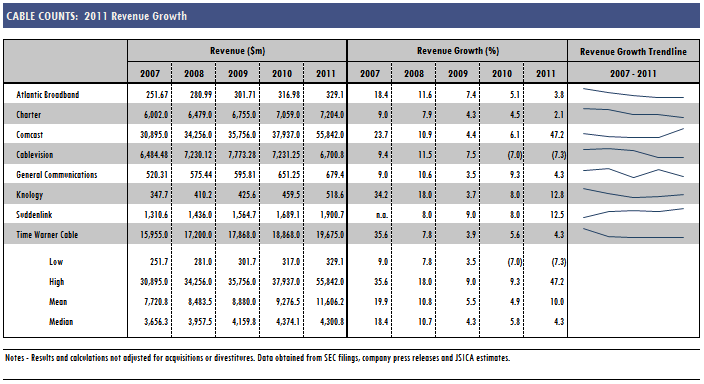
Revenue growth seems to be continuing its upward climb from recent lows. Based on our sample of public cablecos, average revenue growth reached 10.0% for 2011, up from 4.9% during 2010. On a company by company basis, 2011 revenue growth ranged from Cablevision's negative 7.3% to Comcast's positive 47.2% growth. One caveat, however: none of the results have been adjusted for acquisitions or divestitures. So, for example, Comcast completed its acquisition of NBC Universal on January 28, 2011, which added approximately $14.5b of revenue to Comcast's 2011 results. On a pro forma basis, Comcast's revenue growth would have been closer to 3.7%. The chart below details the revenue and revenue growth for each of the public cablecos.

Thursday
Mar292012

Where Have All The Values Gone?

Our Annual Review of ILEC Values Indicated By Deals Announced During the Prior Year

2011 was a slow year for ILEC deals. We counted a measly six deals announced during the year, fewer than half of the 16 announced deals during the previous year. We surmised that the uncertainty surrounding the NPRM related to USF and ICC reform was keeping many would-be players on the sidelines.  And when ICC/USF funding is such a large component of some rural companies’ revenue streams, it’s not hard to imagine value estimates coming in all over the map. Who wants to buy a company if the buyer isn’t reasonably confident in the future revenue estimates of the target company? And there are probably a number of potential acquisition targets out there that turned down deals because the owners felt the target company was worth more than the price being offered.

When we analyze deals, we typically calculate multiples of revenue, OIBDA and connections, which give us an apples to apples comparison of different deals.  For example, during 2010, buyers paid an average of 2.8x revenue and $2,060 per connection. Any deal multiples coming in significantly different than the averages indicates we should take a look to see if something else is going on with the target property.  In 2009 and 2008, the average multiples were 2.1x and 2.7x revenue and $1,650 and $3,193 per connection, respectively. So clearly there was a downward trend from 2008 to 2009, but 2010 multiples indicated values were perhaps on the rebound. And 2011?

Because only one of the six announced deals during 2011 disclosed the price – Otelco agreed to pay $4.5m to acquire Shoreham Telephone – we’re unable to calculate the multiples implied by the other five observed deals.  Based on Shoreham’s 2010 revenue of approximately $2.4m and 4,975 access line equivalents, Otelco paid 1.9x revenue and $905 per connection for Shoreham Telephone.  Based on this data point, it appears values have fallen precipitously since 2010.  Without any other 2011 deal multiples it’s difficult to know where in the range these multiples fall, from average to outlier. Nevertheless, this is a deal values article, and it’s important to look at the few data points available to estimate what has happened to deal values over the last year, and what to expect in the future. 

A second data point for us to analyze is Consolidated Communications’ recently announced deal to acquire SureWest. Announced on February 6, 2012, Consolidated will pay 2.2x revenue and $1,548 per connection for SureWest. These multiples are higher than the Shoreham/ Otelco deal, but still down from 2010 multiples.  Based on these two deals, one announced in 2011 and one in 2012, we could infer a couple of different trends.  It’s possible that deal values have hit their lows, and are just bouncing along the bottom.  Or, more likely, we are starting to see a greater divergence between the values of large and small properties.  Large companies such as SureWest can command a premium because of the scale and diversity of operations.  Generally speaking, smaller companies with fewer connections and less diverse operations have more difficulty adapting to the changing telecommunications industry, and values suffer as a result.  Nevertheless, in the past, industry averages that included large public companies provided a reasonable benchmark against which we could compare smaller transactions.  This may no longer be the case. 

It used to be the case that a buyer would pay more than $3,100 per connection, as each connection provided for a relatively stable recurring revenue stream.  And historically, there was little competition for rural ILECs.  These were the glory days, and for a while it seemed they would last forever.  But all that has begun to change.  Access lines have declined in recent years as customers switch to wireless and VoIP.  If the connection multiple for the SureWest acquisition is any indication, buyers are only willing to pay about half of what they would have paid a few years ago for each connection (less than a third if the Shoreham multiple is the new norm), and if connections are falling….well, you get the idea.  Generally speaking, this doesn’t bode well for the value owners of ILECs can realize through sales of their companies.  Additionally, although there is far more certainty surrounding ICC/USF reform now that the NPRM has been released, future USF funding will be targeted more towards expanding broadband and wireless services to unserved areas.  Of course many ILECs already provide other services, be it Internet, video, or wireless, and those that can refocus investment on new revenue streams and maintain some level of high cost support may well see a resurgence in value.