


Entries in Deals: CLEC (48)

Monday
Jan092012

Birch Continues “Tuck-In” Acquisition Strategy in Florida

Georgia-based CLEC Acquires Operating Assets from AstroTel

Atlanta, Georgia-based CLEC and managed services provider Birch Communications announced on January 3rd that it has signed a definitive agreement to purchase the operating assets of AstroTel, a Sarasota, Florida-based CLEC. Through the deal, Birch will acquire AstroTel’s IP-based network that spans multiple cities along Florida’s West Coast.

Birch kicks off the New Year utilizing a growth strategy that it has stuck with for the past five years: using M&A to expand its private, IP-based network and to extend the reach of its services. Birch offers IP-based communications services in 38 states and has implemented a “tuck-in” acquisition strategy through which it targets properties that will expand its IP network near its current footprint and increase customer density in its existing markets.

While Birch’s roots are as a local telephone provider and long distance reseller, the company has since moved into managed communications and IT services, which it delivers to small and medium-sized business customers over its private IP network. Since 1997, Birch has grown its client base from 100 customers to over 100k customers, primarily through acquisitions.

The AstroTel deal represents Birch’s 14th acquisition since 2006, and its second Florida-based purchase in recent memory. In October 2011, Birch closed on a deal to acquire the assets of Orlando-based CLEC Cordia Communications for $8m.

A home state is not the only characteristic that Cordia and AstroTel share.  AstroTel, like Cordia at the time of its acquisition, has been operating under Chapter 11 for the past year.  It filed for bankruptcy protection in early-2011, reporting only $325k in assets and $675k in debts. AstroTel’s Chapter 11 filing coincided with an antitrust lawsuit that the CLEC brought against Verizon, in which it claimed anticompetitive actions on behalf of Verizon that included illegal cross-subsidizing of unregulated Internet services and intentional impairment of services to AstroTel subscribers. AstroTel’s lawsuit against Verizon is still pending.

While financial terms of the deal have not been disclosed, based on AstroTel’s distressed financial position, Birch likely picked up AstroTel’s assets at a discount. Over the past few years, the CLEC deals we have observed involving companies in Chapter 11—including Birch’s purchase of Cordia—have carried an average price tag of 0.2x revenue. According to its bankruptcy filings, AstroTel generated approximately $1m in revenue during 2009 and 2010.

While the AstroTel purchase marks Birch’s first deal of the year, odds are that it will be the first of many deals for the company in 2012. In June, Birch secured $77.5m in debt financing to help fund future acquisitions and network development. 
Tuesday
Dec062011

HickoryTech to Pay $28m for IdeaOne Telecom

Fargo-based CLEC Sells at 2.3x Revenue

HickoryTech (Nasdaq:HTCO) announced today that it has entered into an agreement to acquire IdeaOne Telecom Group, LLC, a Fargo-based CLEC and fiber network provider. The Minnesota-based ILEC will pay a reported $28m in cash for IdeaOne, in a deal that is expected to close by the end of 1Q12.

During its 3Q11 earnings call in November, HickoryTech continued to beat the business and broadband drum, and its purchase of IdeaOne supports the company’s strategy to expand services in both areas. Through the deal, HickoryTech will add 225 fiber route miles and 650 on-net buildings to its current fiber network in North Dakota, and will gain a customer base of 1,900 business and 1,700 residential customers.  

In addition to voice and Internet services, IdeaOne offers hosting, colocation, and data networking services to its business customers, utilizing a fiber network that includes multiple 10 GB fiber rings in and around Fargo. The acquisition deepens HickoryTech’s fiber footprint in the region and complements its ongoing $24m fiber build, that once completed will extend from Brainerd, Minnesota to Fargo.

On a conference call earlier today, John Finke, ceo of HickoryTech discussed the appeal of the North Dakota market, and shed some light on the capabilities that IdeaOne will provide. “There’s a lot of growth (in Fargo). The Fargo market has continued to expand due to the oil businesses. There is very low unemployment there, in the 3% range, and there are a lot of businesses which are expanding. When we built the route in 2010 to Fargo, really it was on a long haul basis to connect to the Fargo market place. We’ve been working with other providers in this market, like IdeaOne, to actually do the last mile termination to customers, so this will give the ability for us to own that last mile network all the way to the customer.”  

Financially, the acquisition will further shift HickoryTech’s revenue mix towards business and broadband services, which during 3Q11 accounted for over 70% of its top line. IdeaOne reported revenue of $11.1m in 2010, 85% of which was generated from business services, and it projects revenue of $12.3m in 2011. The deal will be accretive on a free cash flow basis for HickoryTech as IdeaOne expects its cash flow margins to be in the 40% range for 2011, while HickoryTech’s margins have been just shy of 27% over the past three quarters.

Despite the immediate margin improvement, the company does not expect significant future cost synergies from the deal, as it plans to invest more in Fargo in the coming years. Carol Wirsbinski, coo of HickoryTech, also indicated that integration costs are expected to be insignificant and will be spread over 4Q11 and 1Q12.

At a price tag of $28m, HickoryTech will pay around 2.5x IdeaOne’s 2010 revenue in the deal, but with IdeaOne’s top line projected to have grown 10%-11% YoY, the deal’s run rate multiple should be closer to 2.3x. From a cash flow perspective, the deal will be done at 5.8x projected 2011 OIBDA.

Wednesday
Nov162011

PAETEC Deal Clears Key Hurdles

Shareholders Approve Deal, City Opposition Withdrawn

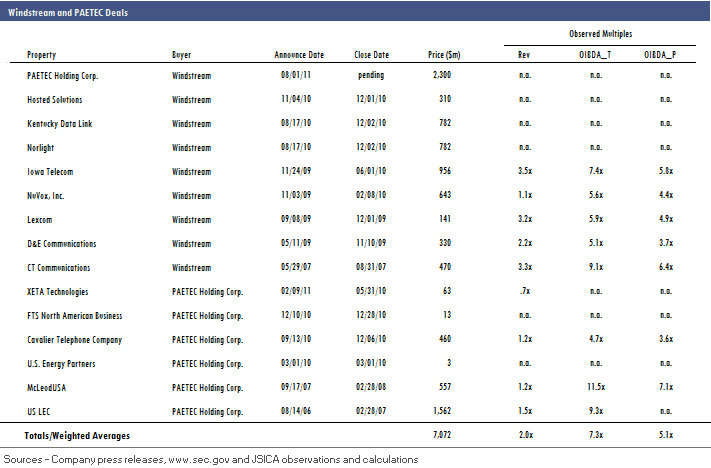
Since we last looked at Windstream’s (Nasdaq:WIN) pending $2.3b PAETEC acquisition on TDA, the deal has received key regulatory approvals, and Windstream has navigated some key opposition to the purchase, keeping it on track for its late 4Q11/early 1Q12 close.

In late August, PAETEC announced that it had received notice from the Federal Trade Commission of early termination of the waiting period for its merger. And on October 30th, PAETEC shareholders voted overwhelmingly (99% approval of voters present) to approve the deal, through which PAETEC stockholders will receive 0.460 shares of Windstream common stock for each share of PAETEC common stock.

While Windstream sailed through the FTC and PAETEC shareholder approvals, garnering support from PAETEC’s hometown, Rochester, NY, and New York state proved more difficult (and costly). On September 29th, the city decided to wage war with Windstream, filing its formal opposition to the PAETEC deal with the FCC. The subject of the complaint: concern that Windstream would renege on a PAETEC commitment to relocate its headquarters to downtown Rochester.

This past January, Arunas Chesonis, ceo of PAETEC, along with then mayor of Rochester, Robert Duffy, signed an agreement that would see PAETEC construct its corporate headquarters in downtown Rochester, creating what would be the flagship building in the city’s redevelopment. In what was dubbed “The PAETEC Project,” Rochester invested $60m of state and city funds to create a shovel-ready building site for PAETEC. In return, PAETEC's commitment was to construct a new building, to move existing jobs downtown, and to occupy the 225 square foot facility for 20 years. To fund the construction, PAETEC committed to obtain $34m in loans and use $5m of its own equity.

When Windstream announced its merger with PAETEC in August, the initial reaction in Rochester was that “The PAETEC Project” was dead before it even started. After Chesonis confirmed that 800 Rochester-area workers would lose their jobs post-merge, it became even more evident that Windstream didn’t plan to make good on PAETEC’s commitment. As job threats loomed, animosity towards the deal built.

The city filed its comments with the FCC and the New York public service commission, arguing the deal would adversely impact Rochester residents. US Senator Charles Schumer joined the city, putting pressure on Windstream to honor PAETEC’s commitment. Initially, Windstream and PAETEC fired back at city and state’s criticism, filing a joint response to the FCC.  The pair argued that concerns about the city and job losses were not within the FCC’s power to review, and that efficiencies (job losses) are created in every merger and couldn’t be used to block the deal. Political pressure however mounted, and Windstream decided to compromise.

At a press conference Monday, Windstream ceo Jeff Gardner announced that the company will move 335 employees to downtown Rochester. It will occupy 67k square feet of office space under a 15-year lease with annual payments around $1.2m, compared to the initial PAETEC agreement of a 225k square foot building and a 20-year lease.  

The city subsequently withdrew its complaints from the FCC and New York Public Service Commission. While Gardner maintains that the agreement to stay in Rochester was not a political move, the lease agreement included a stipulation that the city withdraw its complaints and support Windstream’s efforts to get regulatory approval. The New York Public Service commission is set to weigh in on the deal during its session on November 17th.

With the end of the regulatory hurdles in sight, the real work for Gardner and Windstream is set to begin after the deal’s close. Both Windstream and PAETEC turned in lackluster 3Q11 results, and Windstream has set aggressive cost synergy targets following the deals close—$50m in the first year and $100m per year after three years.

PAETEC reported a loss of $17.1m in 3Q11, on revenues of $536.3m. While its revenue was up 31% YoY in 3Q11, the gains were due to its acquisition of Cavalier Telephone. PAETEC, like Windstream, has generated top line growth through M&A in recent years, but the company has been in the red since 2007. In that time frame, PAETEC has spent $2.65b on its six acquisitions, but the deals have not benefited PAETEC’s bottom line.

We recently reviewed Windstream’s 3Q11 results in Phone Numbers, and the story once again was: where’s the growth?  Pro forma revenue was down at Windstream YoY in 3Q11 to $1.02b, as earnings and operating margins dropped as well. Acquisition and merger related costs, not cost synergies appear to be having the largest impact on Windstream’s earnings.

The struggle and compromise between the city of Rochester and Windstream reveals just how difficult (and ugly) a road Windstream has ahead of it in order to meet the $100m cost savings it projects. Windstream is set to invest around $18m into the Rochester development, and take on around $1.2m in annual lease payments—costs it had not factored in when projecting the PAETEC deal’s synergies. And while the city’s opposition to the deal was ultimately withdrawn, the root of the city’s complaint and the main driver of the deal’s synergies— the loss of 800+ jobs at PAETEC—is still likely to occur.

Friday
Nov042011

California-based CLEC Utility Telephone Agrees to Buy Nevada ISP

CLEC Adds 2.7k Internet and VoIP Customers in CA, NV

Stockton, California-based CLEC Utility Telephone announced on October 28, 2011 that it has entered into an agreement to acquire Reno, NV-based Internet and VoIP service provider, Great Basin Internet Services, Inc (GBIS). The deal is expected to close within the next sixty days. Financial terms of the agreement have not been disclosed. This is not the first time GBIS and Utility have sat together and hashed out an agreement on a deal; just a year ago, Utility acquired WPTI Telecom from Great Basin.

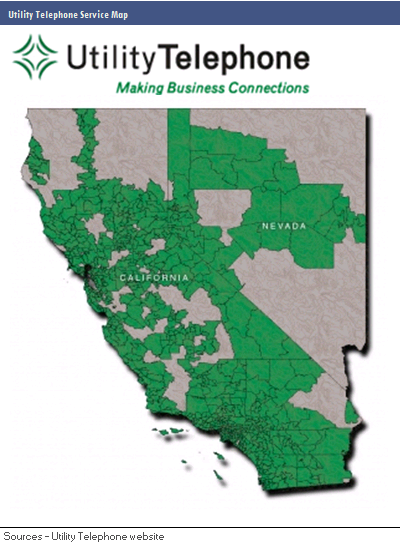
Utility Telephone was founded in 1996 by Jason Mills, who chose to focus exclusively on providing telecommunications services to small and medium sized businesses. Currently, Utility serves SMB customers all across California and in Northern Nevada with basic voice, VoIP, data, Internet and managed IP services.

GBIS provides similar SMB centric services in and around Utility’s footprint in Northern Nevada and Eastern California, making it a logical acquisition target. At the time Great Basin was founded in 1994, Reno, Nevada was void of ISPs and founder Bruce Robertson, seeking his own web access, decided to start a company that would provide Internet connectivity. Great Basin started out providing DSL to customers, and eventually expanded into web hosting and web design in 1997. Today GBIS serves approximately 2,700 wireless broadband, DSL, VoIP and collocation customers in Nevada and California that Utility Telephone will inherit.

Unlike Utility’s customer mix, residential subscribers represent a sizable portion of GBIS’ client base; this led to some financial difficulties for the ISP in 2008. The company acquired WPTI Telecom and Broadband in February 2008, gaining CLEC status and a landline voice offering. At the time of the WPTI acquisition, AT&T and Charter began to steal residential Internet subs in GBIS’ markets. Its revenue streams began to dry up, and GBIS was forced to file for bankruptcy protection in August 2008.

As part of its Chapter 11 reorganization plan, GBIS began to target more SMB customers, suiting Utility’s business model well. In 2009, GBIS opened a new data center in an attempt to attract more business clients seeking co-location services. And the company then sold off WPTI Telecom to Utility Telephone in September 2010 in an effort to raise cash, although financial terms of the deal were not disclosed. After nearly three years working to get back on track financially, Robertson decided selling GBIS to Utility was in the best interest of the company and its customers.

Utility’s acquisitions of both WPTI and GBIS represent significant expansions into Nevada for the CLEC.  In Douglas County, a market it expanded into with its WPTI purchase, Utility is competing with Frontier for business customers. Both LECs are new to the area as Frontier (NYSE:FTR) acquired the landlines in Douglas County from Verizon (NYSE:VZ) in 2010. The GBIS purchase deepens Utility’s penetration in Reno and Carson City. 

From a revenue perspective, the GBIS acquisition will increase Utility’s top line approximately 25%. According to its bankruptcy filings, Great Basin had $2.3m sales in 2008, $2m in sales in 2009, and according to Hoover’s, the company’s 2010 revenue jumped to $2.5m in 2010. Utility currently generates approximately $10m annually.

With a pair of deals under its belt in the past year, Utility remains active on the M&A front. On November 1st, just two days after announcing its agreement to purchase GBIS, Utility Telephone filed an application with the FCC to acquire a California-based long distance telephone reseller, US Telestar.

Monday
Sep262011

JAB Wireless Acquires Illinois CLEC Essex Telcom

Fixed Wireless Internet Provider Nearing 70 Acquisitions

At JSI Capital Advisors, we constantly track the M&A activity in all communications related industries. Occasionally we come across companies that go on shopping sprees, during which their seats at the deal table never get cold. JAB Wireless is one such company, having spent $77m on sixty-seven acquisitions since it was founded in 2006. JAB recently added another deal to its tally, acquiring Illinois-based CLEC Essex Telcom in an effort to expand into a new geographic market. Financial terms of the deal were not disclosed.

JAB Wireless is a Colorado-based wireless broadband service provider, which operates under the Skybeam and Digis brands. It serves 100k subscribers in Colorado, Utah, Wyoming, Idaho and Texas and has acquired an average of 1k customers in each of its slew of small WISP purchases. Since 2005 JAB has raised near $70m in equity and debt funding from private equity firms such as ABRY Partners and Hercules Technology Growth Capital Inc. Boston-based ABRY Partners, which focuses on communications investments, holds a 21% equity stake in JAB.

The Essex Telcom acquisition represents an expansion geographically for JAB, as it enters its fourth market (Colorado/Wyoming, Utah/Idaho, Texas, and Illinois). Based in Northern Illinois, Essex offers local exchange, T1, transport, wireless broadband and DSL services to a mixed customer base of residents and small businesses. Currently Essex has active interconnection agreements with Frontier Citizens Communications of Illinois, Illinois Bell Telephone Company (AT&T subsidiary) and Verizon. Estimates of Essex’s customer based are in the mid thousands, while its annual revenue is unknown.

According to filings with the FCC, Essex Telcom will be merged with JAB’s wholly owned subsidiary Skybeam Inc.  The new entity will be named Skybeam-Essex and will operate as a subsidiary to JAB Wireless. Management has indicated that the rates, terms and conditions to Essex’s current customers will remain unchanged after the merge.

JAB touts itself as the largest fixed wireless broadband service provider in the U.S. in terms of both subscribers and revenue. Its wireless network is comprised primarily of unlicensed Motorola Canopy equipment in the last mile, with a mix of licensed and unlicensed backhaul. JAB services its customers through 750 towers that provide more than 25k square miles of wireless broadband coverage. It also offers a wireless VoIP product.

The busiest employee at JAB Wireless is without a doubt co-founder Jeff Kohler, who is responsible for mergers and acquisitions. After topping the 50 acquisition mark, Kohler commented on JAB’s aggressive growth strategy and the challenges of integrating a large amount of companies in such a short window. “It takes a lot of experience and capital to execute a plan like this, and you can’t rely only on acquisitions for growth. Organic growth must be equally as strong,” commented Kohler. 

Currently the growth strategy at JAB focuses on three components: organic growth, acquisitions of WISPs within its target markets, and increasing ARPU through bundled service offerings. Kohler’s co-founders at JAB successfully implemented a similar growth strategy in the cable television industry in the mid-1990’s. JAB ceo Jim Vaughn and coo/cfo Jack Koo started FrontierVision, a rural cable system consolidation investment, which in four years they grew into an MSO serving 700k customers. In 1999, they sold FrontierVision to Adelphia for $2.1b.

Breaking down JAB’s growth, the company estimates that 64k of its customer base was acquired through M&A, while another 36k wireless subs were gained organically over the past 60 months—a compound growth rate of 28.5%. With regards to ARPU growth, the main service JAB looks to bundle is its VoIP product. Currently its VoIP penetration is around 20% of data subs, but for new customers the sell-in rate is approaching 40%.  

From a revenue standpoint, JAB has grown from $7m in 2006 to $47m in 2010, with trailing six months annualized revenue of near $55m. Given that Essex does not report revenue, its unclear what impact JAB’s most recent purchase will have on its top line.  Using information on JAB’s past deals however, we can make some estimates. In a recent company presentation, JAB estimated that it has paid an average of 1.8x revenue and $900 per wireless Internet sub for its acquisitions over the years. With an Essex customer base of around 3k-4k subs, we can back into a price tag of $2.7m to $3.6m for Essex, with its annual revenues coming in around $2m.

The Essex deal likely represents the first of many WISP purchases on behalf of JAB Wireless in the Illinois market, as the company continues to aggressively pursue growth. JAB is by far the largest WISP in its other markets, and looks to become the dominant provider in Northern Illinois as well. After recently closing on a financing agreement that will provide it with $40m in new growth capital, JAB has ensured that it will be back at the deal table in no time.