



Entries in Deals: Fixed Wireless (26)

Monday
Oct312011

Towerstream Makes Largest Buy to Date

Fixed Wireless Provider Expands in Los Angeles

Middletown, R.I.-based wireless broadband provider Towerstream Corp. (Nasdaq:TWER) announced October 31, 2011 that it has entered into a definitive agreement to acquire certain business assets from Los Angeles-based Color Broadband, in a transaction comprised of cash, common stock and assumed debt. Towerstream will acquire all customer contracts, network infrastructure and related assets of the fixed wireless service provider, and is expected to close the deal by the end of the year.

It’s Towerstream’s fourth buy over the past two years, and also the largest to date. The value of the deal was not disclosed, but the biggest deal prior to this announcement was for nearly $3.5m. Towerstream said that the Color Broadband business will increase its L.A. market revenue by 70%, implying annual revenue for the target of around $2.8m. That's based on the $1m Towerstream did in L.A. in 2Q11, as reported in the company's 10-Q. It’s still tough to guesstimate the deal value, however. While Towerstream trades for more than 5x revenue presently (see below), it paid just 1.2x revenue when it acquired the fixed wireless operations of Chicago-based Sparkplug in April of 2010.

Arguably, Towerstream is still in ramp-up mode, which justifies the relatively high trading multiple. The company has posted little in the way of positive cash flow over the past year, but is still actively seeking and building acquisition markets. At the end of 2Q11, Towerstream was serving an estimated 3,200 business customers with its fixed wireless solution, in a dozen markets.
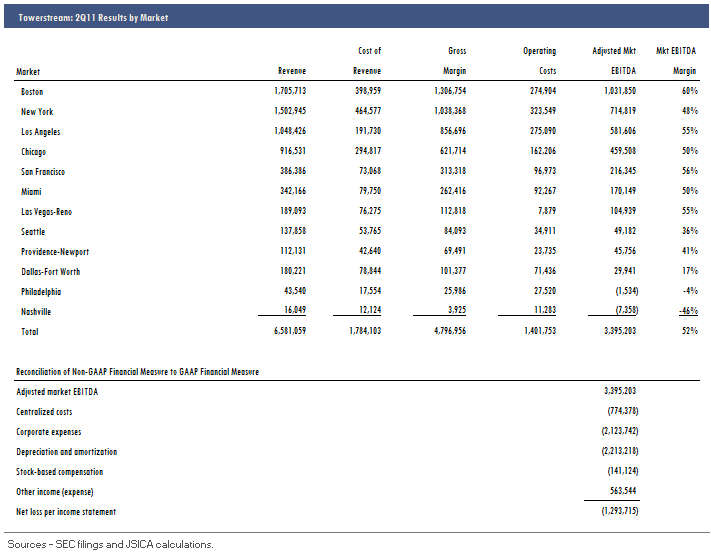
Based on Towerstream's closing price on October 28, 2011, and backing out the company's substantial working capital surplus (some of which may now be committed to the Color Broadband deal), the market is valuing the company at about $146m, or 5.4x run-rate revenue. Based on the healthy margins reported in its more mature markets there may be a good deal of upside to the company's cash flow--IF it can maintain market share.

But it seems that everyone and his brother is going after the broadband and business markets these days; in order to hit those promising cash flow targets, Towerstream's wireless solution (which relies on both licensed and unlicensed spectrum as well as WiFi) will have to increasingly compete with fiber-based competitors. My guess is that the company is able to compete effectively on price--a wireless solution is generally cheaper than fiber--but the question will become one of capacity and speeds over the longer term.

Tuesday
Oct112011

Gardonville Cooperative Telephone Assoc. Acquires Wisper Wireless

Expanding Broadband Wireless Service in Douglas County, Minnesota

Just more than a year ago, acquisitive Arvig Communication Services announced that it was acquiring nearby DiversiCOM, an ILEC/CLEC serving Melrose, Minnesota. Also included in the deal was wireless broadband service provider Wisper Wireless, which delivers Internet access service over leased EBS spectrum in Douglas County, Minnesota.

Yesterday the companies announced that Gardonville Cooperative Telephone Association, based in Brandon, Minnesota, has acquired Wisper Wireless. Financial details were not disclosed, nor were subscriber counts.

Gardonville currently provides wireless broadband service over two leased 700 MHz licenses, also in Douglas County. The company intends to integrate the two systems and according to FCC filings, now has control of up to 55.5 MHz of spectrum in parts of the county.


Wisper Wireless offers six different monthly service plans, based on the speed provided. At the low end, customers can get 256k service for $29.95 per month; at the high end Wisper offers 1.5 Mbps for $54.95 per month. All plans include five email addresses, spam and virus filtering, 24/7 technical support and 50 MBs of disk storage.

In the transfer application for the leases, Gardonville and ACS pointed out that “When the Commission adopted new rules for this [EBS] spectrum, it did so to help meet its ‘goal of providing all Americans with access to ubiquitous wireless broadband connections, regardless of their location.’ By significantly revising its rules, the Commission has encouraged the ‘provision of new technologies and services to the public.’ In addition, the Commission expects that services in the 2.5 GHz band will ‘offer a significant opportunity to provide competition to cable and digital subscriber line (DSL) services in the provision of broadband services in all areas.’ Grant of this application will meet all of these Commission goals by permitting Wisper and Gardonville to hold the spectrum necessary to provide a competitive broadband service within the Douglas County, Minnesota area."

It’s interesting to see the EBS (Educational Broadband Service) spectrum being used for broadband service when most ILECs are jumping on the Verizon LRA bandwagon or waiting for 700 MHz LTE equipment and handsets to become available for licenses acquired at auction. At 2.5 GHz, however, the propagation characteristics are less attractive than 700 MHz, but for a one-county market area, it  just might do the trick. With a high end speed of just 1.5 Mbps, however, it seems to me that technological advances will be needed before the service can be truly competitive with cable broadband.

Monday
Sep262011

JAB Wireless Acquires Illinois CLEC Essex Telcom

Fixed Wireless Internet Provider Nearing 70 Acquisitions

At JSI Capital Advisors, we constantly track the M&A activity in all communications related industries. Occasionally we come across companies that go on shopping sprees, during which their seats at the deal table never get cold. JAB Wireless is one such company, having spent $77m on sixty-seven acquisitions since it was founded in 2006. JAB recently added another deal to its tally, acquiring Illinois-based CLEC Essex Telcom in an effort to expand into a new geographic market. Financial terms of the deal were not disclosed.

JAB Wireless is a Colorado-based wireless broadband service provider, which operates under the Skybeam and Digis brands. It serves 100k subscribers in Colorado, Utah, Wyoming, Idaho and Texas and has acquired an average of 1k customers in each of its slew of small WISP purchases. Since 2005 JAB has raised near $70m in equity and debt funding from private equity firms such as ABRY Partners and Hercules Technology Growth Capital Inc. Boston-based ABRY Partners, which focuses on communications investments, holds a 21% equity stake in JAB.

The Essex Telcom acquisition represents an expansion geographically for JAB, as it enters its fourth market (Colorado/Wyoming, Utah/Idaho, Texas, and Illinois). Based in Northern Illinois, Essex offers local exchange, T1, transport, wireless broadband and DSL services to a mixed customer base of residents and small businesses. Currently Essex has active interconnection agreements with Frontier Citizens Communications of Illinois, Illinois Bell Telephone Company (AT&T subsidiary) and Verizon. Estimates of Essex’s customer based are in the mid thousands, while its annual revenue is unknown.

According to filings with the FCC, Essex Telcom will be merged with JAB’s wholly owned subsidiary Skybeam Inc.  The new entity will be named Skybeam-Essex and will operate as a subsidiary to JAB Wireless. Management has indicated that the rates, terms and conditions to Essex’s current customers will remain unchanged after the merge.

JAB touts itself as the largest fixed wireless broadband service provider in the U.S. in terms of both subscribers and revenue. Its wireless network is comprised primarily of unlicensed Motorola Canopy equipment in the last mile, with a mix of licensed and unlicensed backhaul. JAB services its customers through 750 towers that provide more than 25k square miles of wireless broadband coverage. It also offers a wireless VoIP product.

The busiest employee at JAB Wireless is without a doubt co-founder Jeff Kohler, who is responsible for mergers and acquisitions. After topping the 50 acquisition mark, Kohler commented on JAB’s aggressive growth strategy and the challenges of integrating a large amount of companies in such a short window. “It takes a lot of experience and capital to execute a plan like this, and you can’t rely only on acquisitions for growth. Organic growth must be equally as strong,” commented Kohler. 

Currently the growth strategy at JAB focuses on three components: organic growth, acquisitions of WISPs within its target markets, and increasing ARPU through bundled service offerings. Kohler’s co-founders at JAB successfully implemented a similar growth strategy in the cable television industry in the mid-1990’s. JAB ceo Jim Vaughn and coo/cfo Jack Koo started FrontierVision, a rural cable system consolidation investment, which in four years they grew into an MSO serving 700k customers. In 1999, they sold FrontierVision to Adelphia for $2.1b.

Breaking down JAB’s growth, the company estimates that 64k of its customer base was acquired through M&A, while another 36k wireless subs were gained organically over the past 60 months—a compound growth rate of 28.5%. With regards to ARPU growth, the main service JAB looks to bundle is its VoIP product. Currently its VoIP penetration is around 20% of data subs, but for new customers the sell-in rate is approaching 40%.  

From a revenue standpoint, JAB has grown from $7m in 2006 to $47m in 2010, with trailing six months annualized revenue of near $55m. Given that Essex does not report revenue, its unclear what impact JAB’s most recent purchase will have on its top line.  Using information on JAB’s past deals however, we can make some estimates. In a recent company presentation, JAB estimated that it has paid an average of 1.8x revenue and $900 per wireless Internet sub for its acquisitions over the years. With an Essex customer base of around 3k-4k subs, we can back into a price tag of $2.7m to $3.6m for Essex, with its annual revenues coming in around $2m.

The Essex deal likely represents the first of many WISP purchases on behalf of JAB Wireless in the Illinois market, as the company continues to aggressively pursue growth. JAB is by far the largest WISP in its other markets, and looks to become the dominant provider in Northern Illinois as well. After recently closing on a financing agreement that will provide it with $40m in new growth capital, JAB has ensured that it will be back at the deal table in no time.

Friday
Mar042011

KeyOn Makes 9th Broadband Wireless Buy Under Rural UniFi Program

Seller ERF Wireless Planning to Focus on Oil and Gas Vertical

Las Vegas-based KeyOn Communications Holdings (OTCBB:KEYO.OB) and ERF Wireless (OTCBB:ERFW.OB) announced on February 16, 2011 that KeyOn has acquired certain broadband wireless network assets and customers in east central Texas, including ERF’s Central Texas network west of Austin and the smaller North Texas network in Granbury.  Total consideration was $3m in cash and 100,000 shares of KeyOn stock, valued at $39,000 as of the deal close.  In fact, the deal was apparently popular with KeyOn investors, who bid the shares up from $0.32 the day before to $0.39 per share upon close, for a 22% one-day gain.

Financial details about the acquired assets were not disclosed, although KeyOn said that the buy will “contribute material revenue growth, positive EBITDA and strengthen its network footprint in East Central Texas.”

We do know that in KeyOn’s last reported purchase, subscribers were valued at $456 each, which would imply upwards of 6,700 customers if that metric applies this time around, but it’s not at all clear that the business included in this deal is necessarily similar to the Wells Rural Electric Co. deal in Nevada.  Also, there is a master services agreement (MSA) component whereby ERF will utilize certain KeyOn network services as it expands its operations in oil and gas markets, initially in Kansas and Texas. I may be able to back into the approximate revenue base of the business included in the KeyOn transaction once ERF’s 2Q11 results are reported; if possible, I’ll report back then on where the multiple lies.

ERF Wireless, which has historically generated the bulk of its revenue from its residential/commercial wireless broadband service offerings, has seen its revenue base decline in recent quarters.  In 3Q10, the Wireless Bundled Services division reported $1.1m in revenue, down 13% versus 3Q09.  ERF attributed the falling revenue to “a reduction in our retail wireless and dialup customer base.” 

In its press release announcing the deal close, ERF head Dr. H. Dean Cubley stated, “As our focus has migrated away from being solely a WISP to a WISP having multiple vertical markets, we have had to adjust our assessment of our own networks for the long-term benefit of our shareholders. We are very pleased to announce closing on this sale of a limited portion of our WISP networks as part of our plan to rapidly expand our higher-margin vertical markets and to improve our overall corporate posture. Our primary allocation of the initial cash proceeds will be to provide aggressive growth for our oil and gas vertical subsidiary, Energy Broadband."

For now, KeyOn continues its relentless foray into rural broadband wireless.  As I’ve pointed out before, KeyOn has now accumulated total losses of nearly $24m and revenue in 3Q10 was just $2m. And did anyone notice the action in ERF’s stock price last year?  Its 52-week range is from a high of $0.23 per share a year ago down to a low of a penny a share…though more recently it traded for just under $0.02 per share. 

What's that say about the underlying asset base and the prospects for the business KeyOn is so determined to enter?  Not that there won't be demand for rural broadband wireless service, there will, but with terrestrial/satellite LTE services on their way from LightSquared and the Verizon LRA program, plus new broadband wireless plan money to be distributed, I'm just skeptical about the prospects for a "bleeding edge" player like KeyOn.

Friday
Feb042011

KeyOn Buys BB Wireless Assets from Wells Rural Electric Co

Deal Values Rural Wireless Broadband Subs at $456 Each—Or Does It?

KeyOn Communications (OTCBB:KEYO.OB) announced on February 3, 2011 that it completed the purchase of substantially all of the wireless broadband assets of Wells Rural Electric Company (WREC) covering Wells and West Wendover, Nevada.  The purchase price, disclosed in an 8-K filing with the SEC in December, was $373,920 in cash, with 25% paid at close and the remaining balance paid over a two-year time frame.  The unpaid balance will accrue interest at a rate of 5.25% annually. 

Attached to the filing was the purchase and sales agreement between WREC and KeyOn, which indicates that the final closing price would be adjusted based on the total number of subscribers multiplied by $456.  That implies that WREC had a subscriber base of 820 as of December 9, 2010, the day the contract was signed, though the closing announcement did not indicate how many subscribers had been acquired or what the final price was.

KeyOn expects to integrate WREC’s network with its planned project to provide 4G wireless broadband access and VoIP services to rural Nevada.  KeyOn received $10.2m in ARRA funds last September and expects to provide the next-generation services to 93,000 POPs, more than 5,500 businesses and 849 critical community facilities. 

WREC represents the eighth acquisition of network assets and subscribers since the inception of Rural UniFi in the fourth quarter of 2009 and is the company’s twelfth acquisition overall. KeyOn also said that the transaction will add positive operating cash flow in its first month of operation under KeyOn’s ownership because of its assimilation into KeyOn’s centralized network and customer operations center.  Rural UniFi is KeyOn’s strategic acquisition initiative designed to aggregate independent wireless broadband companies. 

KeyOn’s press release indicated that it now covers 2.8m POPs across 55,000 square miles.

Beneath That Glossy Exterior…

We continue to have concerns about KeyOn’s business plan and ability to execute.  Most of the deals it’s done have been with stock, or cash over a period of time as in the WREC deal. Its quarterly revenue in 3Q10 was just over $2m, compared to about $1.5m in 2Q10, but the year-to-date totals were just $5.3m in 3Q10 versus just under $5.2m in 3Q09—that despite all these acquisitions! 

The stock that KeyOn’s been issuing willy-nilly has fallen to a price of just $0.30 per share—notice the most recent seller didn’t accept stock as payment?  At that price, the equity cap is about equal to the cash and marketable securities.

In November the company’s cfo resigned and in December KeyOn agreed to convert its outstanding $15m note to preferred equity valued at $1/share, along with warrants ranging in price from $0.25 to $0.60.  Looks to us like California Capital, LP is basically taking over.  As part of the conversion, KeyOn agreed to, among other things,

  • "reduce our authorized capitalization from 175,000,000 shares to 145,000,000 shares;
  • reduce the number of authorized shares of preferred stock from 60,000,000 shares to 30,000,000 shares;
  • change the name of “Series CalCap Preferred Stock” to “Series A Preferred Stock”;
  • eliminate the “Series KIP Preferred Stock”;
  • provide the holders of Series A Preferred Stock with three votes for each share of common stock that the Series A Preferred Stock held by them is convertible into on all matters submitted to our stockholders for a vote; and
  • provide the holders of Series A Preferred Stock with the right, so long as at least 10,000,000 shares of Series A Preferred Stock remain outstanding, to appoint a majority of the members of our board of directors;”

So California Capital now controls the board and gets 3x voting power for its shares, and they’ve reduced KeyOn’s ability to issue new shares.  And if all that doesn't give you pause, a recent post on the Yahoo! message board for investors in KeyOn said, "Keyon has to be the worst provider I have ever had, I can't wait for someone else to enter this local market. Dial up is almost as fast and much more reliable."  Granted, that might be someone shorting the stock....but ARRA funding notwithstanding, we’d think twice before selling a broadband wireless operation to KeyOn for anything less than 100% cold, hard cash at closing.