



Entries in The Rumor Mill (4)

Monday
Aug222011

Sprint, Clearwire and the Cablecos Dance Around a Deal 

Clearwire Shares Double on Word of Renewed Talks

Earlier this month I commented on the untenable situation that has developed between Sprint (NYSE:S) and Clearwire (Nasdaq:CLWR), and also wondered about the wisdom of the announcement Sprint made that it had entered into a nine year, $13.5b network deployment deal with startup LTE wholesaler LightSquared. 

Specifically, I pointed out that if Sprint continues to ignore Clearwire’s financial woes, it stands to lose its nearly 50% ownership position should Clearwire end up restructuring via bankruptcy….I also mentioned the fact that LightSquared’s spectrum is still constrained by interference issues with GPS providers.

Well according to a report published by Bloomberg last Friday, Sprint hasn’t completely lost sight of its investment in, not to mention reliance upon, Clearwire. In fact, the two may be in deal discussions as I write, and their cable step-brothers Time Warner Cable (NYSE:TWC) and Comcast (Nasdaq:CMCSA) may also be seated at the table.

Shares in Clearwire skyrocketed on the rumor last Friday, more than doubling from the sub-$2/share level they had fallen to in the wake of the Sprint/LightSquared announcement.  While Clearwire was trading at present levels (around $3/share) just a month or so ago, after tumbling to a low of $1.32 in early August, $3+ per share suddenly looks a lot better.

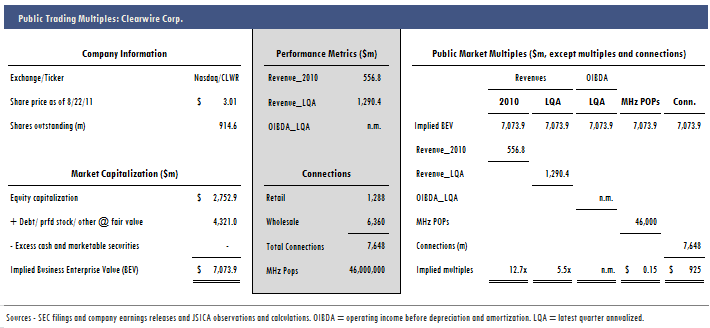
But what does it imply in terms of Clearwire’s value?  Back in June I wrote a story on Clearwire’s ongoing struggles to raise capital via a spectrum sale or a broader deal.  At the time, Pardus Capital’s Karim Samii had written a letter to interim ceo John Stanton bemoaning the fact that, at $4.60/share, Clearwire’s massive spectrum holdings were valued at less than $0.20 per MHz POP.  Samii urged Stanton to sell off some of Clearwire’s excess spectrum in order to get the company’s business plan back on track.

After Friday’s run-up, Clearwire appears to trade at an even more discounted $0.15/MHz POP, and at its low two weeks ago, Clearwire’s public market cap indicated a value of just $0.12/MHz POP….But according to the FCC, not to mention AT&T in its T-Mobile lobbying efforts, U.S. wireless carriers are facing a serious spectrum shortage!
I’ve been flummoxed by Sprint’s refusal to step up and support Clearwire for some time now…clearly the company’s bet on WiMax technology has proven to be a misstep in hindsight, but in the meantime Sprint keeps adding 4G customers, to the tune of 1.7m net new 4G customers on the Clearwire network in the second quarter.

Sprint needs every advantage it can get its hands on in the face of the AT&T/Verizon Wireless duopoly.  Why bet billions on LightSquared’s fledgling plan when it already bet billions on Clearwire’s 4G plan years ago?  And why haven’t the cable guys stepped up sooner?  They desperately need a wireless strategy—and that’s what their investments in Clearwire was supposed to be…but the partnerships have floundered in recent years; the vast majority of Clearwire’s wholesale customers have come from Sprint.

Clearwire’s 2.5 GHz spectrum isn’t as desirable as the 700 MHz licenses that Verizon and AT&T will use to deploy their 4G systems on, but it has LOTs of it. Furthermore, the FCC is still considering a proposal to raise the out of band emission limits, which would enable Clearwire to use 20 MHz of spectrum and deliver speeds of 90 Mbps.

It just makes sense for Sprint and the cable players to really get behind Clearwire and make it the basis of their next generation wireless strategies. But after the drubbing the stock has taken this year, due largely to Sprint’s relative lack of support, Clearwire’s existing backers may now be in a position to take over for a much lower price than would have been demanded last winter.  Maybe that was the point?
Tuesday
Mar082011

Sprint and T-Mobile in Talks (Again)

It Just Doesn’t Seem Likely

With AT&T (NYSE:T) and Verizon Wireless (NYSE:VZ) increasingly dominant in the wireless sector, rumors of talks between Sprint (NYSE:S) and Deutsche Telekom regarding a combination of #3 Sprint and #4 T-Mobile USA (and maybe Clearwire (Nasdaq:CLWR) too) have caused a stir before…today the Wall Street Journal and news wire service Bloomberg both reported that the two are back (still?) at the table, though a deal doesn’t appear imminent.

It’s been about eight months since the last time such a combination was the topic of heated speculation, but now, as then, I just can’t see it happening.  The reasons are many, but perhaps most important is the fact that Sprint has just now started to recover from its calamitous Nextel acquisition.  The company managed to grow subscribers in 2010 for the first time in years and ceo Dan Hesse seems to be working his magic to bring Sprint back to growth and (eventually) positive earnings.

Meanwhile, T-Mobile USA just reported its own 2010 results and the headline was a loss of 318k postpaid subscribers in the fourth quarter, for a nearly 400k loss in the year.   Revenue and cash flow held pretty steady, but the company lost about a total of 56,000 customers for the year overall, and many of the new subscribers are less profitable MVNO subs.  So they’re replacing high margin postpaid subs with lower margin prepaid and wholesale customers.  

T-Mobile also has a need for spectrum in order to remain competitive as 4G services proliferate. The company believes its ongoing upgrade to the HSPA+ system will allow it to remain competitive through this year at least, but consumers clearly didn’t buy its holiday season campaign touting “America’s Largest 4G Network.”  

Clearwire, which Sprint owns 54% of, has lots of spectrum and T-Mobile and Clearwire have reportedly been in talks as well.  Alternatively, T-Mobile may opt to resell LightSquared’s LTE service when it launches later this year.

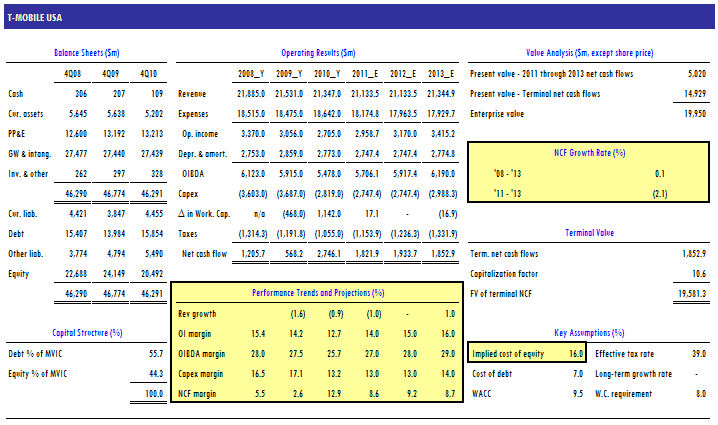
But the bottom line is really one of valuation.  Sprint still has a hefty debt load and when we run a discounted future income model on T-Mobile, based on its recent performance, we can’t get the enterprise value above $20b.  T-Mobile carries its equity alone on the balance sheet at more than $20b and there’s also $15b in debt there…

Not that it couldn’t happen, but there are a lot of moving parts and we’re thinking Sprint probably wants to stick to its own knitting, overhaul its network, clean up its murky relationship with Clearwire and keep moving forward without the added burden of another major combination.

I have to acknowledge, however, that Wall Streeters apparently don't take my Doubting Thomas view.  Shares in Sprint surged as much as 7.4% today before closing up nearly 5% on the "news."  After what happened with Nextel, you'd think investors would be slightly more suspicious of a major transaction.

Tuesday
Dec212010

MetroPCS Said to be in the Hunt for TerreStar Networks

20 MHz S-Band Licenses Expected to Command up to $1b

A report in the Wall Street Journal indicated that MetroPCS (NYSE:PCS) is among a group of potential suitors interested in acquiring the assets of bankrupt TerreStar Networks, a majority owned subsidiary of TerreStar Corporation (Nasdaq:TSTRQ.PK).  On October 19, 2010, TerreStar Corporation reported that TerreStar Networks and certain other affiliates had filed voluntary petitions for reorganization under Chapter 11 of the U.S. Bankruptcy Code as part of a strategic plan to strengthen their financial position and achieve long-term success in the mobile satellite services market.

TerreStar Networks, in cooperation with its Canadian partners, TerreStar Canada and TerreStar Solutions, is planning to launch a wireless communications system to provide mobile coverage throughout the United States and Canada using integrated satellite-terrestrial smartphones and other devices.  The system is to be based on an integrated satellite and ground-based technology intended to provide communication service in most hard-to-reach areas and was expected to provide a nationwide interoperable, survivable and critical communications infrastructure.  TerreStar Network's plan is to provide multiple communications applications, including voice, data and video services.

TerreStar Networks launched its first satellite, “TerreStar-1,” on July 1, 2009 and placed it into its assigned orbital slot in the geosynchronous arc.  The company was planning to offer its mobile satellite service (MSS) in conjunction with ancillary terrestrial component (ATC) service, creating an integrated satellite and terrestrial wireless communications network.  The network was expected to allow a user to utilize a mobile device that can communicate with a traditional land-based wireless network when in range of that network, but communicate with TerreStar-1 when not in range of such a land-based network or when such network is unavailable.  

TerreStar has the right to use two 10 MHz blocks of contiguous and unshared MSS S-band spectrum covering a population of over 330m throughout the United States and Canada.  On January 13, 2010, TerreStar Networks was granted authority by the FCC to operate dual-mode mobile terminals that can be used to communicate either via TerreStar’s geosynchronous-orbit MSS satellite or ancillary terrestrial component base stations.  ATC base station operations were also authorized.  These ATC authorizations provide for the ability to integrate terrestrial mobile services with MSS.  TerreStar Networks hopes to use this ATC authorization to create a two-way wireless communications network providing coverage, services and applications to mobile and portable wireless users.  The company expected to achieve this result through one or more strategic partnership with terrestrial-based wireless carriers.

According to the Wall Street Journal, MetroPCS is interested in obtaining TerreStar's S-band radio licenses which could be worth as much as $1b.

Sunday
Feb282010

THE RUMOR MILL

Wireless Runners Up Consider Options

Reports over recent weeks that Germany’s Deutsche Telekom (NYSE:DT) is considering a spin-out of its T-Mobile USA division, punctuated by Leap Wireless International’s (Nasdaq:LEAP) engagement of Goldman Sachs to explore its “strategic options,” highlight the quandary facing the majority of wireless carriers nowadays:  if you Can’t Hear Me Now, or offer an iPhone, you’re probably in a bit of a pickle.

For several quarters now, Verizon Wireless and AT&T Mobility have been stealing market share from the competition:  in the nine months ended September 30, the top-two carriers accounted for more than 11m net adds (excluding acquisitions).  All public companies combined added just 12.3m.  In the latest quarter, the two accounted for 600,000 more net adds than the group as a whole.  Verizon’s network quality, coverage and marketing machine are formidable and AT&T’s exclusive rights to the iPhone put the two carriers heads and shoulders above the competition.  Recent price cuts made by the two were immediately matched by competitors who literally have no other choice.

So what’s an ‘also ran’ to do?  Sell, merge, bulk up…we’ve said for years that several of these carriers belonged together—back in September we wrote that a MetroPCS (NYSE:PCS)/ Leap Wireless International/United States Cellular (NYSE:USM) union might make sense (The Deal Advisor, 09/09, p.4), although in October we noted that a T-Mobile/ Sprint (NYSE:S) combo was less appealing (The Deal Advisor, 10/09, p.2).  Sprint, which has a nationwide footprint, is probably more in need of broadening its product offering a la some form of combination with a wireline provider (see p.4).  But T-Mobile doesn’t have nationwide coverage, nor do we see an obvious merger partner, due largely to its GSM technology standard.  Most of the remaining smaller players have deployed CDMA technology, meaning integration could be tough, and AT&T, the largest GSM player, would surely run into Justice Department opposition.

A public offering is likely the best way DT is going to unlock some T-Mobile USA value for its shareholders, but we’re not clear that the market gets too excited.  We’ve run a discounted cash flow analysis on T-Mobile, and based on our estimates, the division might be worth about $36b, or 1.7x revenue and 5.9x cash flow. 

Critical assumptions include flat revenue in 2010-2011 (the top line actually fell in 2009 through the third quarter as ARPU was pressured by a growing prepaid component of the subscriber base), and moderately better OIBDA margins.  We think T-Mobile will slow its capital investment some, but given its relatively less strong 3G footprint, it can’t afford to cut too much here. 

We’ve estimated a required cost of equity to be 11.6% and the company’s cost of debt is around 6%.  T-Mobile’s relatively low debt—less than 40% of its total capitalization—makes for a lower risk profile but a higher overall cost of capital, which we put at 8.6%.

Our concluded equity value of about $20b is what DT might get in an outright sale—but publicly, the shares would likely trade somewhere between 60%-70% of that…or about $12b-$14b. 

The four publicly traded wireless companies we routinely track were trading at about 1.2x revenue, 5.1x OIBDA and $742 per sub at the end of the year.  If we apply these multiples to T-Mobile’s metrics, the equity cap comes in at less than $10b based on the revenue and per sub multiples, but it jumps to almost $15b using the OIBDA multiple…so about $12b is probably right.  A sale of 20% of the equity would then net DT about $2.4b.  That may or may not be enough to placate unhappy DT shareholders (including the German government).

As for Leap…we think the company does sell—fairly soon—but it won’t be getting anywhere near the $5b+ equity value implied by MetroPCS’ 2007 offer.  The churn and lower margins associated with its prepaid model have forced the company to retreat from previous cash flow guidance, which had been projected to be more than $850m in 2010.  In 2009 we’re estimating the company cash flowed less than $500m, and our forecast for this year is around $750m as recently launched markets begin to contribute to the bottom line.  Our guesstimate for the deal price?  About $20 per share, or a total enterprise value of $4.4b and $1.5b for the equity.  The most obvious buyer remains MetroPCS, but someone like cable operator Cox Communications might kick the tires in an effort to jump start its wireless operation.