


Entries in Top Deals (20)

Monday
Dec262011

The Deal is Dead! Now What?

AT&T and T-Mobile Consider Life Post Deal

After enduring nine months of an increasingly hostile regulatory review, AT&T finally threw in the towel and announced it would abandon its efforts to acquire T-Mobile USA.  Back on March 20, 2011, AT&T announced that it planned to acquire T-Mobile in a transaction valued at $39b.  Although there was plenty of opposition to the deal from the very start, most analysts nonetheless expected the deal to pass muster with the Department of Justice and the Federal Communications Commission, provided, that is, AT&T agreed to sell off large swaths of overlapping spectrum and operations.

In fact, word was that AT&T was ready to sell Leap Wireless spectrum and nearly 25% of T-Mobile’s U.S. subscriber base in an effort to gain regulatory approvals.

But the deal started to spiral south in late August when the DOJ filed suit to block the merger.  When, in late November, the FCC concluded that the deal would cause price increases and harm customers, all that was left was for the Fat Lady to sing.  Stick a fork in it, the deal was dead!

Now we begin the healing process and both AT&T and Deutsche Telekom, T-Mobile’s German parent, have gaping wounds to lick.  AT&T is saddled with what has been estimated to be a $6b deal break-up fee.  In addition to the two carriers entering a seven-year roaming agreement, the package requires AT&T to pay T-Mobile $3b in cash as well as spectrum in markets including Los Angeles, Dallas and Boston.

AT&T ceo Randall Stephenson is probably feeling a little vulnerable now that the deal has been killed.  It’s tough enough that Stephenson had to follow in the shadow of former AT&T ceo Ed Whitacre, who transformed the smallest of the Baby Bells, Southwestern Bell, into AT&T through a string of successful blockbuster deals – the culmination of which was the acquisition of AT&T.  Now Stephenson is faced with having to cut a $3b check to T-Mobile and is left with a core operation whose 4G wireless strategy has suffered a major setback while its principal competitor, Verizon Wireless, appears to be lapping the pack. 

Despite the setback, AT&T vows to continue to invest in its networks and encourages the government to free up additional spectrum.  With respect to investing in its network, AT&T will need to work quickly to meet the build-out requirements associated with the $6.6b worth of mostly B-block 700 MHz licenses it acquired during Auction 73 back in early 2008.  B-block licenses must provide service covering 35% of its geographical area by February 2013.   

Regarding spectrum, and perhaps as in a gesture of goodwill following a brutal past nine months, the FCC approved AT&T’s previously announced $1.9b acquisition of D- and E-block 700 MHz licenses from Qualcomm just two days after AT&T officially quit the T-Mobile deal.  The Qualcomm deal gives AT&T as much as 16 MHz of new 700 MHz spectrum and should help the carrier assemble the 20 MHz of contiguous spectrum necessary to provide robust 4G services in many markets.  But it is highly likely that AT&T will once again be shaking the trees for available spectrum, particularly 700 MHz spectrum.

As bad as things seem for AT&T, they’re probably even worse for T-Mobile.  Yes, T-Mobile ceo Philipp Humm will get $3b of cash and some pretty nice wireless licenses to soothe the pain but at the end of the day the spectrum-poor T-Mobile has some serious strategic issues.  There is plenty of speculation that T-Mobile will rekindle talks with Dan Hesse and Sprint.  Reportedly, Sprint and T-Mobile were close to a deal earlier in the year before AT&T threw a wad of cash at Deutsche Telekom.  In fact, just a few days before AT&T announced that it had come to a $39b agreement to acquire T-Mobile, the Wall Street Journal was reporting that Sprint and T-Mobile were closing in on a deal.  Other options for T-Mobile include acquiring Leap Wireless or doing a data deal with Clearwire.  There is even talk that T-Mobile might team up with DISH Networks, which finds itself with a bunch of spectrum in search of a wireless strategy after its acquisitions of DBSD North American and Terrestar Satellite Network. Interestingly, there is also an increasing buzz that AT&T may itself be making a run at DISH.

But it wasn’t just AT&T, T-Mobile and Deutsche Telekom who lost out on the deal.  According to reports, there were seven banks lined up to receive $150m of fees if the deal closed.  No deal means scaled back Holiday plans for a number of “poor” Wall Streeters!
Wednesday
Aug312011

Surprise, Surprise...DOJ Says "No Way" to AT&T; - T-Mobile Merger

It’s a Dumb Deal Anyway

Just this morning I watched AT&T ceo Randall Stephenson tell CNBC how the combination of AT&T and T-Mobile was going to result in some 5,000 call center jobs being brought back to the United States from their present overseas locations…I laughed and wondered aloud at CNBC’s willingness to allow such blatant political posturing to be presented as “news”…

An hour or so later, I laughed even harder as I read the Breaking News Headline cross my muted television screen: DOJ Files Suit to Block AT&T/ T-Mobile Merger…Guess the folks in D.C. were unimpressed by Stephenson’s gushing. Good for them.

What really blows my mind, however, is that anyone was surprised by the news that the Department of Justice has found that the merger between the largest and the fourth largest wireless providers will be anti-competitive…Yet clearly they were.

Shares in AT&T were off more than 4% immediately, and have traded as low as $28/share, down from nearly $30 pre-announcement. Guess Wall Street wasn’t paying attention all these months as we at JSI Capital Advisors warned that in order to achieve the massive $40b in long-term synergies that the parties predicted, tens of thousands of American jobs would need to be eliminated…or when we pointed out that T-Mobile had started limiting its data plan usage just a short time after the merger announcement, despite the fact that it continued to bleed subscribers…or that AT&T and Verizon Wireless already accounted for the vast majority of subscriber growth over the past several years…or that literally thousands of Americans - an unprecedented number - had filed their opposition to the merger with the FCC.

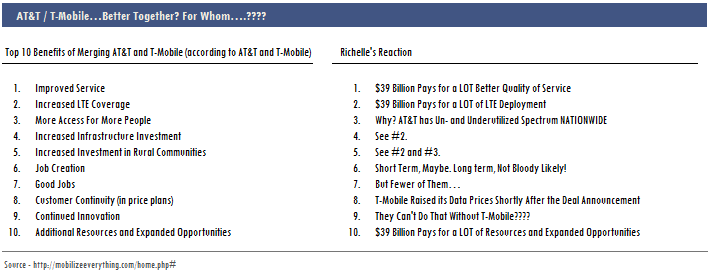
Fact is, this deal never made sense to me, not even for AT&T. $39b is a huge price to pay for a company that is losing market share, is spectrum constrained and behind in real 4G deployment (despite T-Mobile’s unabashed use of the term in its marketing since last fall).  At the web site set up by the two to promote the benefits of the deal, www.mobilizeeverything.com, the company lists the “Top Ten” reasons to support the deal. In the chart below, I’ve given my gut-reaction to each point (never mind the fact that several of the ten reasons are really the same thing):

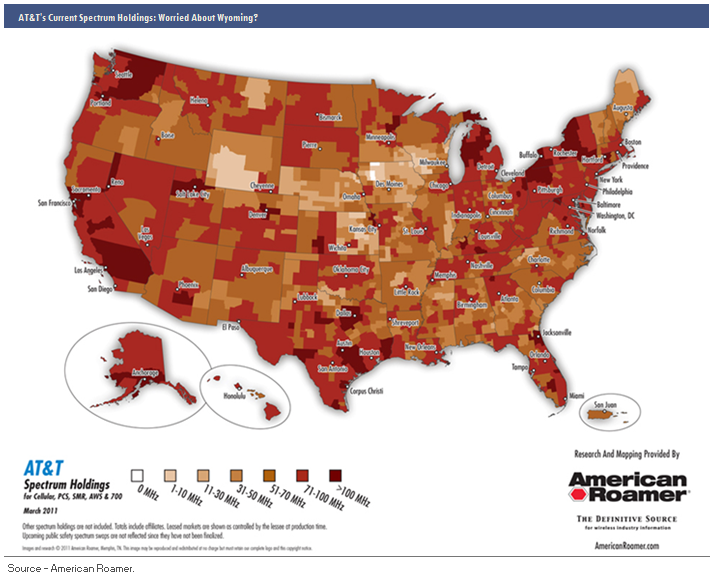
In a television commercial currently airing to promote the combination, AT&T says something to the effect  that “55m Americans will get broadband wireless service” as a result of the merger. What it doesn’t adequately explain is why they wouldn’t get it anyway! The map below shows AT&T’s spectrum depth across the U.S. at the time of the merger announcement.  There are precious few markets where the company has less than 30 MHz of spectrum. Take that $39b and build it out! 

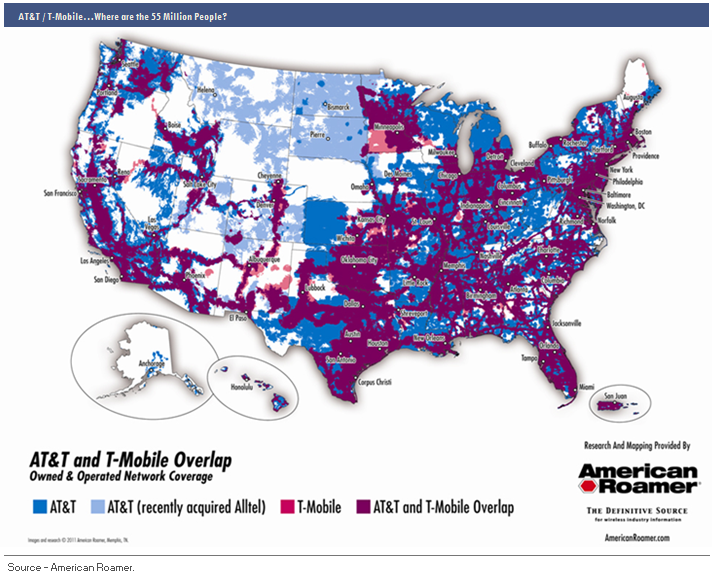
Furthermore, in terms of already served markets, the overlap between AT&T and T-Mobile is huge. That means one less competitor in those markets, as well as fewer retail outlets and, oh yeah, fewer  jobs.

Rival wireless provider Sprint, and its investors, cheered the news—shares in Sprint and step-child Clearwire rose between 8%-13% initially. But here too, I don’t really get it. Sprint has been very vocal in its opposition to the merger, but from my point of view, an AT&T/ T-Mobile combination would have served to eliminate Sprint’s biggest competitor in the market for budget-minded and prepaid customers. And with Sprint set to get the iPhone this fall, it should be reasonably well positioned to compete with the duopolists…

And make no mistake, the wireless industry has already become a full-fledged duopoly, in practice if not officially. As I noted above, AT&T and Verizon have been taking market share away from their smaller rivals for a couple of years now…with or without T-Mobile as a standalone operator, Sprint’s challenge to grow is daunting.

AT&T “Shocked and Appalled”

AT&T posted a response to the DOJ’s suit on mobilizeeverything.com a short time after the news:

DALLAS, August 31, 2011 – The following may be attributed to Wayne Watts, AT&T Senior Executive Vice President and General Counsel:

We are surprised and disappointed by today’s action, particularly since we have met repeatedly with the Department of Justice and there was no indication from the DOJ that this action was being contemplated.

We plan to ask for an expedited hearing so the enormous benefits of this merger can be fully reviewed. The DOJ has the burden of proving alleged anti-competitive effects and we intend to vigorously contest this matter in court.

At the end of the day, we believe facts will guide any final decision and the facts are clear. This merger will:

• Help solve our nation’s spectrum exhaust situation and improve wireless service for millions.

• Allow AT&T to expand 4G LTE mobile broadband to another 55 million Americans, or 97% of the population;

• Result in billions of additional investment and tens of thousands of jobs, at a time when our nation needs them most.

We remain confident that this merger is in the best interest of consumers and our country, and the facts will prevail in court.

Based on comments made by Stephenson on CNBC this morning, including his speculation that the deal would close in the first quarter of 2012, I do believe that the company was blindsided by the news…but really, the writing was on the wall.

And that $7b in cash and spectrum that T-Mobile will get as a breakup fee when the deal doesn't happen might just give it the juice it needs to get back in the game. Maybe that was Rene Obermann’s plan all along?

Thursday
Jul142011

United Telephone Sold for More than 4x Revenue!

Clearly Investors Gene Johnson and Partners See Upside

About a week ago I published an analysis estimating the value of the United Telephone Company sale to MSEquity Partners. It was admittedly based on a lot of assumptions, but I felt the rationale was sound. As it turns out most of my assumptions weren’t far off, EXCEPT I dramatically overestimated annual sales for the company by adding $5.5m in USF receipts to my $12m base revenue estimate. The $12m figure was based on monthly ARPU of $80 per access line, which in turn was based on our annual study of monthly revenue per unit for all of the public ILECs (as well as wireless and cable providers). I also ran the numbers using ARPU of $100 and $120 per month per access line. Based on recent deal multiples in the 2x revenue range, I figured the deal to be worth between $30m and $50m.

Well, the good thing about sticking your neck out is that it invites those in the know to react and point out your errors! A little birdy has since shared some additional information on the deal with me, and it turns out that the implications are (potentially) very bullish for ILECs. Either that, or very bad for MSEquity Partners…

Here’s what I’ve heard.  The price is actually near the top end of my estimated range, so let’s call it $49m.  But adding the substantial USF income to my base revenue estimate was a mistake—the trailing revenue is pretty close to the $12m figure I got using $80 per line per month.

That’s right—United Telephone Company sold to a newly formed investment vehicle for telco industry veterans Gene Johnson and William Bradford for (drumroll please) 4.1x revenue!  That’s twice the level of recent deal multiples; in fact—I checked our historical deal database—the last time we analyzed an ILEC deal that commanded more than 4x revenue was in 2003, before that pesky trend called ‘cord-cutting’ really gained traction.

That makes the value per access line nearly $4,000—and rising based on recent trends.  If you assume (there I go again) that broadband penetration is around 40% of access lines, there would be another 5m broadband connections and an implied deal value of $2,800 per connection.  At broadband penetration of 30% or 50%, the implied deal value per connection ranges from $3,000 down to $2,600.  

WOW! is right! So what are Johnson and Bradford thinking? We know from the filing with the Tennessee PUC that the buyers are eager to close the deal sooner rather than later (by September 1), and that they intend to immediately begin work on upgrades and "additional market opportunities."

But MSEquity will have to buy an awful lot of exchanges to make the economics appear attractive to me. Given that revenue is $12m, and $5.5m or so comes from USF (for now!), that implies just $6.5m in customer revenue--about $43 per access line per month.  Maybe that broadband penetration is well below my estimate...

Nevertheless, I still believe the move on the part of experienced industry players should be taken as a net positive. Only time will tell if it works out to be a positive for the buyers.

Tuesday
Jan252011

2010 Deal of the Year: CenturyLink's Acquisition of Qwest

A Big Deal that Scores Strong on all Counts

When defining our “Deal of the Year,” we look at four principal attributes.  1) Being the biggest deal of the year isn’t necessary, but size does matter.  So, all other things equal, a bigger deal is going to win over a smaller deal.  2) Overcoming seemingly insurmountable obstacles to make the deal happen is also a critical factor.  We’ve always been a sucker for a good old-fashioned, rags to riches type story.  3) A creative transaction structure is another important consideration.  Structures that unleash significant financing or tax benefits score bonus points in our analysis.  4) Finally, we place perhaps the greatest significance on transactions that foretell significant future trends.  Horizontal acquisitions for scale are common-place, but vertical acquisitions designed to leverage complimentary technologies or services are way more interesting and typically more reflective of overall industry trends.

Oh, and there’s one more factor that plays into our selection.  With all due respect to the Green Bay Packers, in our league you need to win your division to win the title.  Only those deals crowned “Deal of the Month” are considered for ascension to the coveted title of “Deal of the Year.”  With that in mind, here’s a list of 2010 Deal of the Month stories:     

In terms of raw transaction size, the biggest deal announced or closed during 2010 was, by far, CenturyLink’s (NYSE:CTL) pending acquisition of Qwest (NYSE:Q).  Back in April 2010, CTL announced that it would acquire Qwest in a tax-free, stock-for-stock transaction valued at $22.3b.  That was more than 16 times bigger than the next largest transaction – Cablevision System’s (NYSE:CVC) $1.37b acquisition of cable operator Bresnan Communications.

You also have to like the Horatio Alger underpinnings of the CTL/Qwest deal.  CTL traces its roots back to 1930 when William Clarke and Marie Williams acquired the 75-line Oak Ridge Telephone Company for $500.  What makes this deal so special is that it was CTL acquiring Qwest, not Qwest acquiring CTL.  There have been a number of deals over the years where RBOCs have sold smaller telephone companies large swaths of their unwanted lines – think Verizon Communications' (NYSE:VZ) March 31, 2008 sale of its Northern New England lines to FairPoint Communications or Verizon's July 1, 2010 sale of access lines in 14 states to Frontier Communications (NYSE:FTR) – but this is the first time we’ve seen a smaller ILEC acquire an entire RBOC.

The CTL/Qwest transaction also scored well in the structure creativity department given its tax-free, stock-for-stock structure.  But we liked the financial engineering of the CVC/Bresnan deal even more.  In announcing that deal, CVC’s ceo Robert Dolan made it clear that CVC’s interest in acquiring Bresnan was based on certain financial characteristics unique to the deal.  CVC financed the transaction with $1b of non-recourse debt, isolating CVC and its current bondholders from any potential hiccups.  Additionally, the transaction was structured as a “deemed asset sale” for tax purposes, meaning CVC was able to step up the basis of Bresnan’s assets to their fair market value as of the acquisition date.  By CVC’s calculations, the step up and the resulting future Bresnan tax depreciation and amortization will provide a shield against future CVC taxable income valued at roughly $380m.  That means in essence, CVC eliminated any downside for the deal and anticipates recovering the skin it has in the game - its $380m equity investment – through future tax savings.

There were a number of deals that amplified current trends within the communications industry.  Fiber networks and data centers are two of the hottest sectors in the communications industry and both were well represented in our list of Deals of the Month. 

Telephone & Data System’s (NYSE:TDS) acquisition of VISI Incorporated and Windstream’s (Nasdaq:WIN) acquisition of Hosted Solutions underscored a growing movement by large carriers to establish a beachhead in the “cloud” and enhance their ability to offer a growing range of cloud-based services including off-site storage and managed services. 

Although often a secondary business, fiber networks were nonetheless important assets fueling a number of 2010 deal announcements.  Private equity firm ABRY Partners parted with approximately $1.2b to acquire RCN, a decision no doubt helped along by RCN Metro’s (relaunched in September 2010 as Sidera Networks) extensive fiber assets. We venture a guess that WIN was more interested in Kentucky Data Link's 30,000 route mile fiber network than Norlight's 5,500 small and medium sized business customers when it agreed to acquire parent Q-Comm for $782m.  Ntelos Holdings (Nasdaq:NTLS) clearly had wireless backhaul in mind when it spent $170m to acquire FiberNet and its 3,500 route mile network covering all of West Virginia and surrounding areas in Ohio, Maryland, Pennsylvania, Virginia and Kentucky. And ITC^DeltaCom’s 16,400 route mile fiber network was a major selling point for Earthlink (Nasdaq:ELNK) when it agreed to pay $516m for the Southeast-based CLEC/transport carrier.

But where the other candidates scored well in one or two of our four deal attributes, CTL’s acquisition of Qwest blew away the competition on all counts, earning it the title of “2010 Deal of the Year.”  It was by far the largest deal and scored very strong on our “rags-to-riches” meter.  While we saw the transaction structure of the CVC/Bresnan deal as a bit more interesting, the structure of the CTL/Qwest deal was equally creative and, if measured by the amount of taxes saved, dwarfed the Bresnan deal.  Qwest’s traditional ILEC assets were clearly top of mind when the deal was announced, but for our money it was the RBOC’s 16 data centers, extensive long haul fiber network, and dominant market position in 14 Western states that were the real future value drivers.  Finally, in terms of prescience, the fact that the former US West would cede effective management control to the smaller CTL speaks volumes, in our view, about the overall state of the ILEC industry.                     

Tuesday
Nov302010

Windstream to Acquire Hosted Solutions for $310m

November 2010 Deal of the Month: Windstream Doubles Down on Data Centers

        November 2010Windstream Corp. (Nasdaq:WIN) announced on November 4, 2010 that it has entered into a definitive agreement with ABRY Partners (ABRY) to acquire Hosted Solutions Acquisition, LLC (Hosted Solutions) in an all-cash transaction valued at $310m. 

Hosted Solutions, based in Raleigh, N.C., is a regional data center and managed hosting provider focused on enterprise-class Infrastructure as a Service (IaaS) solutions (managed hosting, managed services, colocation, cloud computing and bandwidth) for small and medium-sized business customers as well as large enterprises. The company serves more than 600 customers and has approximately 125 employees. 

The acquisition of Hosted Solutions will transform WIN's data center business, increasing the scale and scope by adding five state-of-the-art SAS 70 Type II certified data centers in Raleigh, Charlotte, and Boston with a total of 68,000 square feet of data center capacity. As a result, Windstream will have a combined total of 12 data centers across the country. 

"Data center space is increasingly in demand among our existing business customers," said Jeff Gardner, president and ceo of WIN. "Hosted Solutions is an excellent complement to our existing enterprise service portfolio. For the past decade, they have been delivering highly complex managed hosting solutions to customers of various sizes. In addition, they have a proven track record of growing revenue and generating significant free cash flow." 

WIN expects to finance the transaction with existing liquidity through cash reserves and revolving credit capacity.  WIN will be able to fully amortize the purchase price goodwill over 15 years, resulting in expected tax benefits with an estimated net present value of $52m. 

WIN estimates the transaction will be accretive to free cash flow in the first year following the closing after expected annual synergies of approximately $1.5m in operating expense savings, excluding integration charges. 

The boards of both companies have approved the transaction, which is expected to close in the fourth quarter of 2010, subject to certain conditions, including necessary regulatory approvals. 

JSICA Observations:  Jeff Gardner and team are back at the well, moving the needle a little further in WIN’s effort to reduce dependency on the consumer business and bulk up its small/ medium business and enterprise offerings.  In the wake of its August announced deal for fiber network/ CLEC Q-Comm (The Deal Advisor, 8/10, p.1), where WIN invested nearly $800m, the company is putting $310m into five data centers located in North Carolina and Boston. 

As in other data center deals we’ve tracked this year, the multiples come in pretty strong, although the $52m in expected tax benefits tempers them somewhat. 

Based on reported trailing pro forma revenue of $51.7m, the revenue multiple comes in at 6x; 5x revenue if you back out the tax benefit.  Hosted Solutions (on a pro forma basis) cash flowed $25.7m in the trailing 12 months, for a nearly 50% margin and implying a 12x OIBDA multiple.  After the tax benefit, that falls to 10x. 

Growth in the data center business has been strong as companies increasingly outsource IT functions.  WIN said that Hosted Solutions has grown revenue and OIBDA at a 48% and 91% CAGR, respectively, over the past three years.  If that growth rate continues in the coming year, deal multiples fall to a more palatable 3.4x and 5.3x after tax benefits.  And with Hosted Solutions using just 70% of its square footage and 50% of its power capacity, continued strong growth should be expected. 

There have been a spate of data center deals in 2010, including Cincinnati Bell’s (NYSE:CBB) $525m buy of CyrusOne (The Deal Advisor, 5/10, p.19), Equinix’ $683m acquisition of Switch and Data Facilities (The Deal Advisor, 5/10, p.18) and TDS’ $18m buy of Minnesota-based VISI. 

The multiples we’ve been able to calculate have been between 9x-12x cash flow across the board, indicative of the growth anticipated, but we did notice that “smart money” investor ABRY Partners has been a seller in two of the recent deals, including WIN’s buy of Hosted Solutions and CBB’s buy of CyrusOne.  On the other hand, private equity firms Cequel III and Thompson Street Capital Partners were behind the Colo4Dallas deal…Hmmm. Which “smart” money is smarter? 

Probably the difference in investment strategy is more a question of stage and preference with regard to industry maturity than a profound statement on the prospects of the data center biz.  For WIN’s part, the company has now committed about $1.1b to “business and/ or broadband” targets in 2010, following on the $2.2b in acquisitions it made last year.  We have to give Gardner and Co. credit—these days, growth by (smart) acquisition is one of the few sure ways to deliver the growth Wall Street craves.