


Entries in Private Market Values (13)

Sunday
Dec112011

Leap Wireless and Verizon Wireless Announce Spectrum Deals

Is a Spectrum License Land Grab in the Offing?

Last week Verizon Wireless and the cable consortium known as SpectrumCo announced a $3.6b deal for AWS licenses covering 259m POPs; that deal implied a more than 50% increase in the value of the subject licenses since the 2006 FCC auction. This week, Verizon is back at the table, acquiring $360m worth of PCS and AWS licenses from Leap Wireless and Leap affiliate Savary Island. In exchange, Verizon is selling 12 MHz of 700 MHz spectrum covering nearly 11m POPs in Chicago to Leap, for $204m.

Both deals indicate a healthy increase in spectrum values—which doesn’t come as a surprise given the growing popularity of mobile broadband services and the carriers’ race to deploy 4G LTE service. I also see AT&T’s March announcement that it would (attempt to) acquire T-Mobile as well as AT&T’s December 2010 deal for $1.2b in Qualcomm spectrum as catalysts that prompted Verizon to start shopping more seriously.

It’s potentially the beginning of a real land grab for spectrum licenses; those who 'have' will benefit from the major projected increase in mobile broadband use, and those who ‘have not’ could well be left behind. Those who 'have and sell' might earn a nice return today, but that leaves open the question of how to participate in the coming hockey stick growth pattern. The good news is that it seems much of the long dormant AWS spectrum is going to emerge from its cocoon, providing options for ILEC license holders.

In the $204m deal for Chicago, Leap is paying nearly 34% more than Verizon spent at auction in 2008, or $1.58/MHz POP. Verizon paid $152.5m for that license.

Leap said in its Public Interest Statement filed with the FCC that the additional 12 MHz “is needed to supplement the 10 MHz of spectrum on which Cricket currently operates in the Chicago area. The additional spectrum will enable Cricket to deploy LTE technology and thereby expand its service offerings, strengthen its presence, and improve the quality of services available to consumers in Chicago.” It continues, “With carriers worldwide upgrading to faster and more efficient LTE technology, Cricket’s deployment of this technology is critical to its ability to deliver competitive services to customers in the coming years. The associated sale of PCS and AWS spectrum to Verizon Wireless also enables Cricket to substantially finance the purchase of spectrum in Chicago. This transfer will thus enhance competition by enabling Cricket to provide more consumers with access to a wider array of high quality wireless communications services.” 
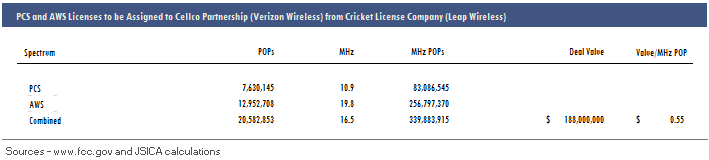
In the second transaction, Leap will sell nearly 340m MHz POPs comprised of both PCS and AWS spectrum licenses, for $188m, or $0.55/MHz POP, to Verizon. The licenses cover a total of 20.6m POPs and are scattered across the country.
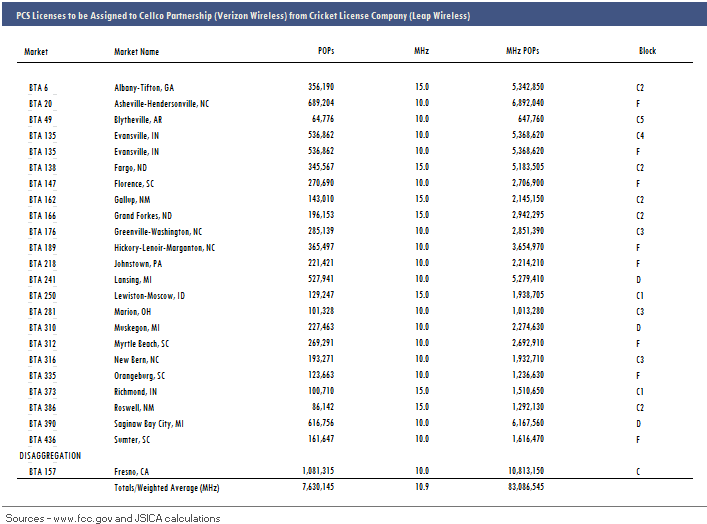
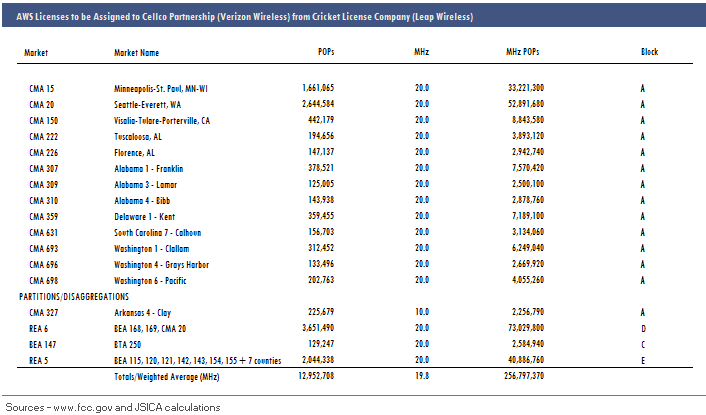
Also in the Public Interest statement filed with the FCC, Verizon Wireless said that it “seeks to acquire spectrum to augment its existing capacity in order to respond to the projected increase in customers’ use of its network, particularly the rapidly growing customer demand for high speed wireless data services. Consumer demand for such services is exploding. Smartphone adoption continues to surge: 59 percent of mobile handsets sold in the United States in the third quarter of 2011 were smartphones, and currently 43 percent of all U.S. mobile phone subscribers own a smartphone. As consumers experience higher speeds through the use of smartphones, they tend to consume more data. Today, smartphones use 24 times more spectrum capacity than traditional phones. According to public estimates, the average smartphone will generate 1.3 GB of traffic per month in 2015 (a 16-fold increase over the 2010 average) and aggregate smartphone traffic in 2015 will be 47 times greater than it is today. Similarly, the rapid adoption of tablets places another substantial drain on spectrum. Tablets use approximately 120 times the capacity of traditional phones. In 2015, it is projected that mobile-connected tablets will generate as much traffic as the entire global mobile network in 2010."

Whoa Nellie! Smartphone traffic nearly 50x greater than it is today by 2015? And tablets will use as much traffic as the entire global network does today? Sounds to me like a serious demand for spectrum is brewing, which means values should continue to increase.

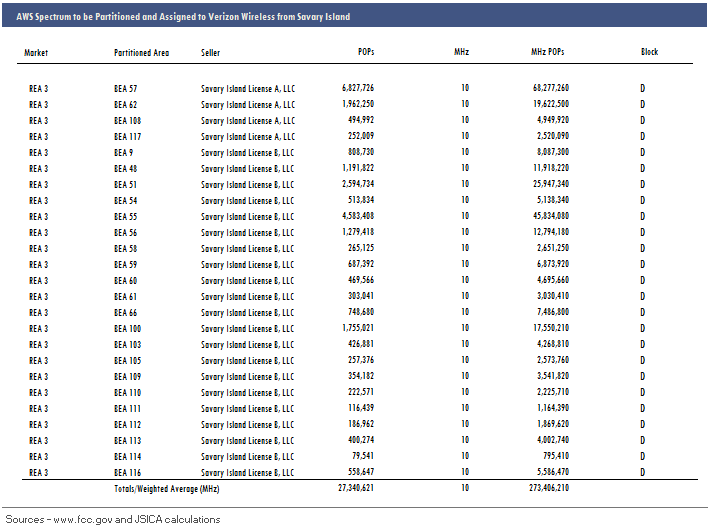
Finally, majority-owned (non-controlled) Leap Wireless affiliates Savary Island License A, LLC and Savary Island License B, LLC are selling an aggregate of 10 MHz of AWS spectrum covering 27.3m POPs to Verizon, for $172m or $0.63/MHz POP.

The receipts will be used to repay debt owed to Leap, which will in turn use the money to help pay for its Chicago 700 MHz buy and continue its LTE deployment. 
There's no doubt in my mind that we will continue to see the larger wireless carriers scoop up spectrum assets as the reality of the changing market sinks in. Verizon has been running its LTE network for a year now--clearly it's seeing a rapid increase in usage and as noted above, the tablet boom is only in its infancy. The question for you readers becomes how best to capitalize upon the opportunity. 
Monday
Nov282011

Carter Validus Mission Critical REIT Makes $95m Data Center Buy

Maryland-Based REIT Bought Richardson, Texas Facility Last July

Maryland-based Carter Validus Mission Critical REIT, Inc. (Carter Validus) filed on form 8-K with the SEC on November 25, 2011 that it has entered into an agreement to acquire 180 Peachtree, a 338k square foot data center with parking facilities in Atlanta, from Peachtree/Carnegie, LLC. The purchase price is $94.75m and the transaction is expected to close in January 2012. Carter Validus was formed in 2009 and is in the process of raising funding for additional data center acquisitions. It also spent $28.9m in July for a 20k square foot facility in Richardson, Texas.

Earlier this year the company filed a Form S-11 registration statement whereby it is offering for sale to the public on a “best efforts” basis a minimum of 200k and maximum of 150m shares of common stock at a price of $10/share. Another 25m shares are also offered pursuant to a distribution reinvestment plan (DRIP) under which shareholders may elect to have distributions reinvested into additional shares. In all, Carter Validus is seeking to raise upwards of $1.7b. Through September 30, the company had issued about 1.9m shares for gross proceeds of just under $19m.

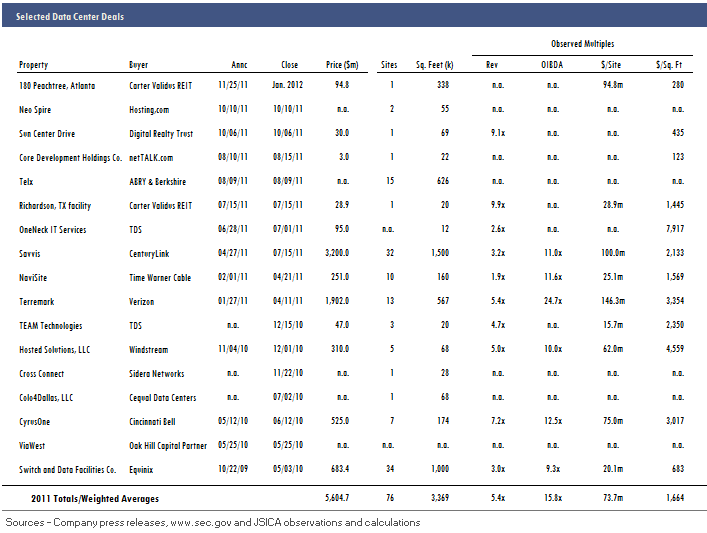
180 Peachtree is currently 100% leased to six tenants, including Switch and Data, Level 3 Communications, and Atlanta's 911 center operations. The $94.75m price tag implies a moderate price per square foot of $280. By way of comparison, in priced deals this year to date, the average data center deal price per square foot is more than $1,600.

Last summer Carter Validus spent nearly $30m for a Richardson, Texas facility, or about $1,445 per square foot. Pro forma revenue reported in the company’s latest 10-Q indicate run-rate revenue of just under $3m annually, indicating a run-rate revenue multiple of nearly 10x. The Richardson facility is fully leased to an unnamed national health organization with annual revenue of $9b.

With the addition of these latest two deals, we’ve now tracked data center deals in 2011 involving 76 facilities worth more than $5.6b. For the deals where we had financial information, the weighted average multiple of revenue was 5.4x; the weighted average OIBDA multiple is 15.8x, reflecting the very high growth anticipated for the sector.

Friday
Nov182011

Northland Cable Cleaning Up Partnerships

Buying and Selling at Limited Partnerships Seven and Eight

Seattle-based Northland Communications has filed for four separate cable TV system sales in Georgia and Alabama. Three of the systems are owned by Northland Cable Properties Seven Limited Partnership (Northland Seven); the fourth is owned by Northland Cable Properties Eight Limited Partnership (Northland Eight).  Northland Communications owns and operates smaller-market cable systems in Alabama, California, Georgia, Idaho, North Carolina, South Carolina, Texas and Washington.

In two of the transactions, Northland Cable Television, Inc. (Northland CATV), an affiliate of Northland Communications and managing general partner of the LPs, will acquire the systems. In the other two, Truvista Communications of Georgia, LLC and Charter Communications are the buyers. Because both of the limited partnerships file with the SEC, relatively detailed data was available with which to crunch multiples and evaluate the systems.

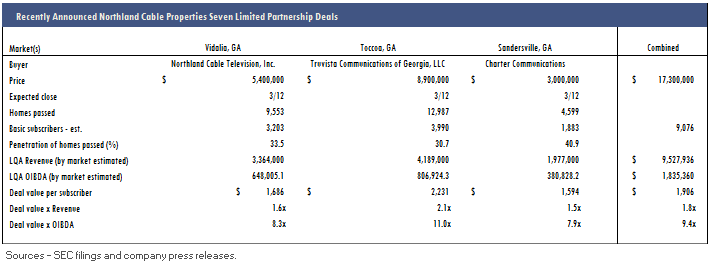
In the first transaction, Northland Seven is selling its systems in Vidalia, Georgia  to Northland CATV for $5.4m. Vidalia (home of the onion!) is midway between Savannah and Macon, and the system there passed about 9,500 homes. Basic subscribers as of the end of the latest quarter were estimated to be around 3,200 based on year-end 2010 reported figures and the percentage decline experienced by the three Northland Seven systems in the aggregate through September 30. Similarly, the Vidalia system revenue was estimated based on Northland Seven average ARPU across the three owned systems, as was OIBDA and margin. Using these assumptions, the deal for Vidalia in a sale to the managing general partner comes in at about 1.6x revenue and more than 8x OIBDA.

Next, Northland Seven is selling its Toccoa, Georgia system to Truvista Communications for $8.9m. Toccoa is in northeastern Georgia near the South Carolina border and the system passes about 13,000 homes. I estimate the Toccoa system was serving just under 4,000 basic customers and generating nearly $4.2m in annual revenue. Based again on LP-wide margins, OIBDA would be in the $807k range, indicating a revenue multiple of 2.1x and a cash flow margin of 11x.

Finally, Northland Seven will sell its Sandersville, Georgia system to Charter Communications for $3m, or about 1.5x revenue and 7.9x cash flow. Sandersville is also between Macon and Savannah and the systems pass about 4,600 homes.

In the aggregate, Northland Seven is liquidating its systems for $17.3m, or 1.8x actual LQA revenue and 9.4x actual aggregate cash flow.

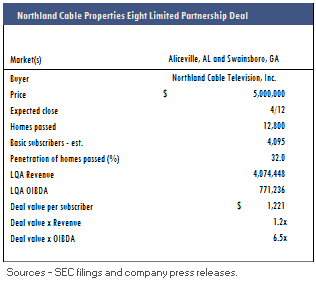
In the final transaction, Northland Eight is selling its systems in Aliceville, Alabama and Swainsboro, Georgia to Northland CATV for $5m, or 1.2x actual LQA revenue and 6.5x actual LQA cash flow (excluding the impact of an $860,000 writedown in the quarter for the fair value of the LP’s franchises).

Judging by comments made in the public filings as well as the 19% cash flow margins at both partnerships, it seems the systems may have been struggling recently. Subscriber losses for Northland Seven were around 9% year over year through September, compared with an average YoY loss of less than 3% for the major publicly-traded cable companies. Northland Eight’s subscriber base fell by 6% YoY through September.

Tuesday
Aug302011

WideOpenWest and Wave Broadband to Purchase Broadstripe Cable Assets

Former Broadstripe Exec Now Wave Broadband CEO

Denver-based WideOpenWest LLC may have dropped out of the auction for Insight’s cable systems in early-August, but that did not mean the cable provider was done seeking deals. WOW! announced last week that it will purchase Dallas-based Broadstripe LLC’s cable assets in Michigan. The bankrupt Broadstripe has also agreed to sell its cable systems in Washington and Oregon to Seattle-based Wave Broadband. The sales will leave Broadstripe with properties only in Maryland, which a few of its current executives will purchase under a new entity, Ann Arundel Broadband, for $8m. All deals are contingent on approval from the United States Bankruptcy court.

Broadstripe, a provider of bundled communication services, has been in Chapter 11 since January 2009. The company was formed in 1999 as Millennium Digital Media Systems—a venture of four cable veterans looking to acquire, develop and operate cable systems. It acquired a number of properties across the country, but ultimately took on far too much debt. Shortly after failing to pay licensing fees to the National Cable Television Cooperative in December 2008, the company filed for bankruptcy. Over two and a half years later, Broadstripe is giving up its Chapter 11 fight and has decided to sell its assets.    

WideOpenWest will add approximately 48k customers in the deal, expanding its existing footprint in Michigan. WOW!’s networks currently pass 1.5m households in Illinois, Indiana, Ohio and Michigan and the Broadstripe systems will add another 92k houses to its territories. It will pay $55m to Broadstripe in the deal—a fraction of the $3b it was ready to pony up in the Insight auction.

The other buyer in the deal, Wave Broadband has agreed to pay $32m for around 60k Broadstripe customers. In the past few years, Wave has purchased a number of cable systems on the West Coast including many from Charter Cable while it was dealing with its own bankruptcy issues. The systems targeted by Wave and its ceo Steve Weed have shared similar traits: they have been outdated and in need of repair, but have also offered potential to expand ARPU. Wave looks to upgrade these systems and generate more revenue per user, providing digital phone and television along with high speed Internet options to its customers.

For Wave’s ceo, the deal must provide a feeling of déjà vu. Weed was the coo of Summit Communications when it sold the same exact Northwest networks that Wave is acquiring to a startup cable provider in 1999. The startup? Millennium Digital Media. The connection between Wave and Broadstripe goes even deeper, as after the Summit sale, Weed served as Millennium’s Northwest vice president from 1999 to 2003. Weed left Millennium in 2003 to start his own cable venture—Wave Broadband. Wave later attempted to purchase cable systems from Broadstripe in deals that fell through.  

A glance at the different multiples paid by Wave and WOW! suggests that Broadstripe’s more profitable subscribers are located in Michigan. WOW! will pay around $1,145 per subscriber for its 48k Michigan customers. Wave on the other hand will pay less than half of that at $533 per customer for its 60k Washington and Oregon subs. This differential points to the fact that the systems acquired by Wave may be outmoded and in need of upgrades, which is consistent with its past purchases.

As expected from a bankruptcy deal, the revenue multiple paid by Wave, WOW! and the Broadstripe execs reflects a deep discount.  The entities combined will pay just over 1x trailing revenue, with the run rate multiple being about the same. By comparison, Time Warner paid around 3x for Insight, which was consistent with levels observed in other recently announced cable deals. To put the discount into perspective, Wave and WOW! will pay a combined $87m for Broadstripe’s Michigan and Northwest assets, while just five years ago Broadstripe turned down a $157m bid from Wave to buy the same systems.

Cable M&A has been active over the past few months—even among small to medium sized providers.  The smaller cablecos are expanding carefully however, purchasing systems located close to their existing operations: Baja Broadband in the Mid and Southwest, WOW! in the Central Region, and Wave in the Northwest. Cable providers are expanding regionally as opposed to nationally—just the opposite of the growth strategy that Broadstripe tried and failed with just twelve years ago.   

Thursday
Jul142011

Final Bids in Insight Auction 25% Off Price Target

Price for Insight Communications Still Not Cheap

Back in March, when Insight Communication’s announced that The Carlyle Group was looking to shop its 42% stake in the company, potential buyers and JSI Capital’s own Richelle Elberg balked at the hefty $4.1b price target for the deal. 

At the time, MCG Capital had just finished selling off its second major cable investment in under a year, and the deal landscape for cable looked more like a buyer's market. Observed revenue multiples for cable deals in 2011 had been trending downward, south of 3x, while Carlyle’s asking price implied a revenue multiple of nearly 4x.

Skeptics of the $4.1b price tag were validated last week, as it was reported that final bids for Insight came in at just over $3b.  The likely buyer will either be Englewood, CA-based WideOpenWest LLC or Mediacom Communications, as Cablevision (NYSE:CVC) has reportedly withdrawn interest.  Armed with a new price estimate, let’s revisit the revenue multiples implied by the rumored deal and compare with observed levels of recent cable deals…

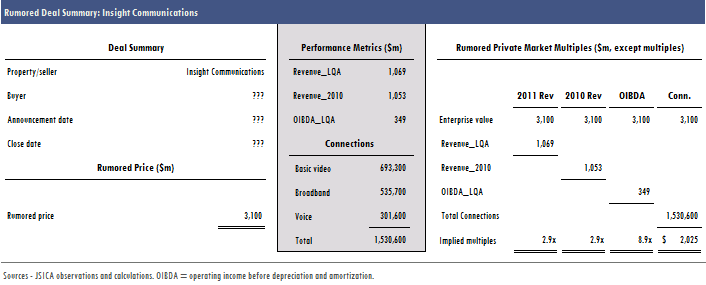
Given a purchase price of $3.1b and Insight revenues projected at near $1.1b for 2011, Carlyle would receive 2.9x trailing revenues should the deal go through.  While 2.9x revenue multiple represents a better value to a buyer than the 3.6x implied by the initial $4.1b price, a closer look suggests Carlyle still may be getting the better end of the deal should the $3.1b offer stick.

The average revenue multiple for priced cable deals over the past year was 2.7x, less than the 2.9x implied by the rumored Insight offer price.  Also, despite the reduced price estimate, the deal would still be done at near 9x OIBDA—about 20% higher than OIBDA levels observed in recent cable sales. In JSI Capital’s recent per unit analysis of cablecos for the Phone Numbers blog, Insight reported the lowest OIBDA per subscriber of the providers surveyed, which may explain the higher multiple, assuming bidders expect to benefit from synergies and improved margins.

Time Warner Cable (NYSE:TWC), the last publicly traded company involved in the bidding, is reportedly still interested in a deal if Insight's price falls to under $3b—at which point the deal's multiples would be more in line with recent averages. However, based on last week’s report, Mediacom and WideOpenWest are not ready to let that happen.