


Entries in Deals: Data Centers (26)

Wednesday
Jan112012

zColo Pays $15.9m for Las Vegas Data Center

Zayo Group Expands West Coast Presence

zColo, a Zayo Group Company, announced on January 3rd that is has acquired all of the net assets of MarquisNet, a Las Vegas-based co-location provider. According to documents filed with the SEC, zColo will pay approximately $15.9m in the deal, subject to post-closing adjustments. The purchase was funded through Zayo’s revolving line of credit, which prior to the deal was $63.3m. MarquisNet represents Zayo’s 18th acquisition since its inception in 2006.

The primary asset in zColo’s purchase is MarquisNet’s data center, located at 7185 Pollock Drive in Las Vegas. The facility features 28k square feet of co-location space, Tier 1 Internet access, N+1 routing equipment and HVAC redundant design.  Including this newly acquired facility, zColo owns and operates 12 data centers in 11 markets including Los Angeles, New York and New Jersey. Zayo Group, zColo’s parent company, has indicated that it will extend its fiber network to 7185 Pollock Drive, joining AT&T, XO, Cox Communications and Sprint among the nine carriers that have a fiber connection to the facility. 

The acquisition of MarquisNet and the forthcoming fiber build into the Las Vegas facility furthers Zayo’s efforts to expand its presence out West. In December, Zayo closed on its $393m purchase of 360networks, which provided it with access to a number of new markets on the West Coast including Albuquerque, San Francisco and Tucson. It also recently completed a fiber build into the Green House Data Center in Wyoming, providing the facility with metro and long haul connectivity, and it is in the middle of a fiber network build in San Diego.

zColo commented in its press release announcing the MarquisNet purchase that among its enterprise clients there has been a surge in demand for data centers as a location for disaster recovery on the West Coast.  Las Vegas in particular is a popular destination for data center owners to build and operate thanks to its cheap land, and relative lack of natural disasters. Data center specialist Switch operates multiple properties in Las Vegas including its flagship 400k square foot SuperNap facility and it will soon break ground on a $400m project to add 600k square feet of data center space in Las Vegas.  Both Zayo and Switch attribute the increase in data center demand at least in part to the increase in cloud computing.

At a price of $15.9m, zColo paid approximately $568 per operating square foot for MarquisNet, a multiple below the average price of $751 per square foot observed in recent transactions. We have no past financial information on MarquisNet, however recent data center deals have been struck at an average of 5.7x revenue which would indicate the facility could add around $2m-$3m to zColo’s top line. Based on its 3Q11 financials annualized, zColo currently generates approximately $39m in revenue annually.  

Wednesday
Dec282011

Telcos Take to the Cloud in 2011

Data Centers and Cloud Providers Targeted Early and Often in 2011

While there were only a handful of ILEC deals to speak of in 2011, telcos of all shapes and sizes kept The Deal Advisor busy this year with ventures into data centers and cloud services. Over the past twelve months, many telcos joined a diverse group of companies ranging from Best Buy to VoIP providers to cablecos that made acquisitions in the data center and managed services space. In the deals we observed, communications providers shelled out nearly $8.2b at an average price tag of nearly 5x revenue to get a piece of these growing industries.

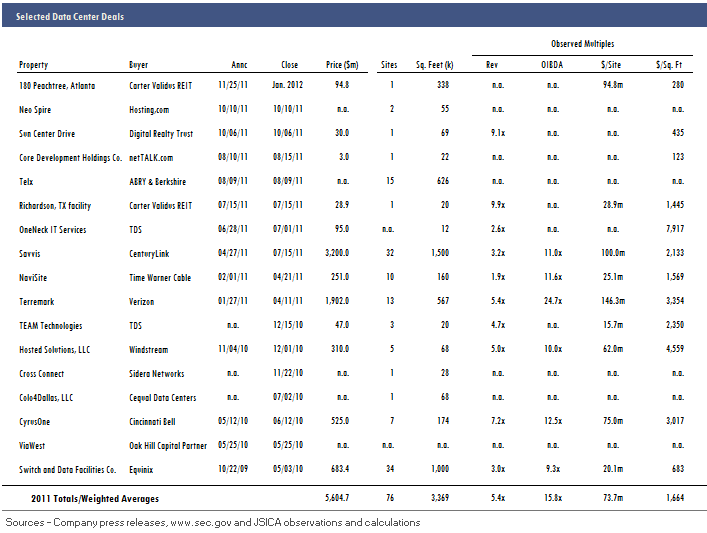
A trio of large publicly-traded ILECs made the biggest splashes into the data center arena in 2011, spending nearly $7.5b to acquire 3.5m square feet of data center space. Verizon got the action started with its $1.9b purchase of Terremark and its 13 data centers in January. Shortly after Verizon closed on its deal, CenturyLink picked up industry giant Savvis for $3.2b in what was the year’s largest data center deal. With the Savvis purchase under its belt, CenturyLink immediately became one of the largest data center operators in the U.S. with 48 facilities totalling 1.9m square feet. Not to be out done, Windstream announced on August 1st that it had purchased telecom services provider and data center operator PAETEC for $2.3b, picking up 7 data centers and an expansive fiber network in the deal.

While the big boys dominated the data center M&A scene, some relatively smaller, regional telcos moved into the cloud services space with a string of acquisitions in the latter half of the year. In July, New York-based Warwick Valley Telephone snatched up Philadelphia-based hosted VoIP and managed services provider Alteva for $17m. Then in November, Kansas-based telco Twin Valley Telephone acquired a majority stake in IT services and cloud computing company, ISG Technologies. Most recently, North Carolina-based ILEC North State Communications acquired a neighboring managed services provider and data center operator, DataChambers, to round out a busy year for the telcos.

While the size and scale of the data center and cloud purchases varied in 2011, the acquiring telcos shared similar motivations in making their deals. First,  the acquisitions furthered their efforts to diversify service and revenue mixes, shifting away from their reliance on traditional voice lines. Secondly, whether buying managed services providers, data centers, or both, the companies acquired portfolios of services targeted towards the higher ARPU-business customers. Lastly, through investing in data centers and cloud services, telcos are getting into businesses with attractive growth profiles.

Though projections of future growth in cloud spending and adoption range widely, all forecasts for the industry point upward. IDC estimates that spending on public cloud infrastructure will expand by a compound annual growth rate of 27.6% over the next four years, reaching $73b by 2015. Meanwhile, the Open Data Center Alliance (ODCA) expects cloud adoption amongst businesses of all sizes to triple over the next two years, with 40% of companies moving towards a cloud based computing infrastructure by the end of 2013.

The industry outlook for data centers is equally bullish, fueled at least in part by companies looking to outsource IT infrastructure to data centers. Data center industry analyst Clayton Moran expects colocation spending to increase 15%-20% in 2012, while a recent Gartner study projects that spending on data centers will hit $127b by 2015, up from $88b in 2010. 

By contrast to these rosy outlooks, telcos lost another 10% of voice access lines in 2011, and continue to face stiff competition from the cablecos, satellite providers and OTT providers for television and Internet market share. Although competition exists within cloud services and the data center space, these industries are growing. Telcos can also integrate their colocation and managed services with their traditional voice, video and Internet offerings, differentiating themselves from other communications providers.

Along with the potential for growth, moving into managed services and data centers will also bring about new challenges for telcos. The cloud services business is technology intensive and evolving rapidly, requiring providers to manage the changes in technology and to adapt quickly to clients needs. Through M&A, the phone companies have acquired the technology and expertise required to provide these cloud-based services, but managing these technologies and the business going forward is the next challenge. However, based on the flurry of M&A activity in 2011 it is a challenge that plenty of telcos are more than willing to take on.  

Wednesday
Dec212011

North State Diversifies Services with DataChambers Buy

ILEC to Acquire North Carolina-based Data Center Operator

High Point, North Carolina-based North State Communications announced on December 15th that it has entered into an agreement to acquire Winston Salem-based DataChambers, a data center operator and managed services provider. Financial terms of the deal were not disclosed. With its acquisition, North State becomes the most recent LEC to venture into the data center and managed service space, joining Warwick Valley Telephone (Alteva) and Twin Valley Telephone (ISG Technologies).

DataChambers is a ten year old company that provides data colocation and disaster recovery services for small-to-medium sized businesses within the Triad region (Greensboro, Winston-Salem and High Point) of North Carolina. The company currently operates two data centers in Winston-Salem, encompassing 120k square feet of data storage and disaster recovery space. It has also expressed interest in adding a third data center in order to increase its capacity. DataChambers' current roster of clients includes businesses from a variety of industries, including North State itself.

Upon the deal’s close, DataChambers will operate as a wholly-owned subsidiary of North State and Nick Kottyan will retain his position as ceo of the acquired entity. North State however will not acquire DataChambers’ records management segment, which provides hardcopy paper storage and management for customers.

The deal makes sense for North State on multiple levels. Geographically, North State operates in the same Triad Region of North Carolina that DataChambers calls home, and both companies serve the same business customers. From a competitive standpoint, the acquisition provides North State with a portfolio of business-centric services that it can offer alongside its broadband voice, video and Internet services, differentiating itself from other communications providers in the area. The independent LEC will also be able to cross-sell its existing business customers on DataChambers’ colocation and disaster recovery services, generating incremental revenue in the process. 

Most importantly, the data center/managed services space offers North State the potential for growth. Gartner projects data center spending to reach $99b in 2011, a 12.7% annual increase from 2010, and it forecasts that figure to rise to $127b by 2015. North Carolina in particular has become a hot-bed for data center development—with the likes of Apple and Google spending north of $1.6b to build properties in the state—thanks in part to its cost effective electric grid and relatively cheap land.

Consistent with the strong industry growth, DataChambers has improved its top line significantly over the past three years. The company grew its revenues from $3.5m in 2007 to $6.8m in 2010, expanding at a compound annual growth rate of 26% over that time frame.

While North State has not released details on how much it will pay for DataChambers, we have seen a number of priced data center deals over the past year, allowing us to make some educated estimates on the deal’s price tag. The weighted average revenue multiple for observed data center purchases in 2011 is around 5.4x while the median revenue multiple comes in at 4.3x. Based on these levels, and using DataChambers’ $6.8m revenue in 2010, we derive a price estimate in the range of $30-$36m.

In September, North State attempted to increase the visibility of its business services, rebranding its business segment “North State Business.” It stated that the name change reflects the type of customers that are critical to the LEC’s growth and longevity. The acquisition of DataChambers reinforces this sentiment.

Monday
Nov282011

Carter Validus Mission Critical REIT Makes $95m Data Center Buy

Maryland-Based REIT Bought Richardson, Texas Facility Last July

Maryland-based Carter Validus Mission Critical REIT, Inc. (Carter Validus) filed on form 8-K with the SEC on November 25, 2011 that it has entered into an agreement to acquire 180 Peachtree, a 338k square foot data center with parking facilities in Atlanta, from Peachtree/Carnegie, LLC. The purchase price is $94.75m and the transaction is expected to close in January 2012. Carter Validus was formed in 2009 and is in the process of raising funding for additional data center acquisitions. It also spent $28.9m in July for a 20k square foot facility in Richardson, Texas.

Earlier this year the company filed a Form S-11 registration statement whereby it is offering for sale to the public on a “best efforts” basis a minimum of 200k and maximum of 150m shares of common stock at a price of $10/share. Another 25m shares are also offered pursuant to a distribution reinvestment plan (DRIP) under which shareholders may elect to have distributions reinvested into additional shares. In all, Carter Validus is seeking to raise upwards of $1.7b. Through September 30, the company had issued about 1.9m shares for gross proceeds of just under $19m.

180 Peachtree is currently 100% leased to six tenants, including Switch and Data, Level 3 Communications, and Atlanta's 911 center operations. The $94.75m price tag implies a moderate price per square foot of $280. By way of comparison, in priced deals this year to date, the average data center deal price per square foot is more than $1,600.

Last summer Carter Validus spent nearly $30m for a Richardson, Texas facility, or about $1,445 per square foot. Pro forma revenue reported in the company’s latest 10-Q indicate run-rate revenue of just under $3m annually, indicating a run-rate revenue multiple of nearly 10x. The Richardson facility is fully leased to an unnamed national health organization with annual revenue of $9b.

With the addition of these latest two deals, we’ve now tracked data center deals in 2011 involving 76 facilities worth more than $5.6b. For the deals where we had financial information, the weighted average multiple of revenue was 5.4x; the weighted average OIBDA multiple is 15.8x, reflecting the very high growth anticipated for the sector.

Wednesday
Nov162011

PAETEC Deal Clears Key Hurdles

Shareholders Approve Deal, City Opposition Withdrawn

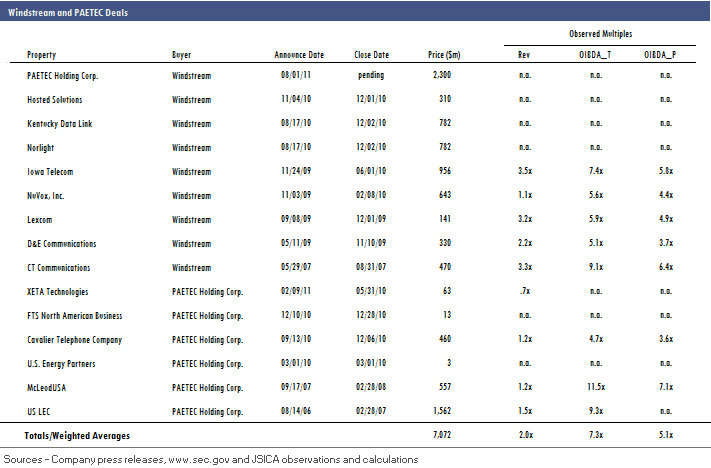
Since we last looked at Windstream’s (Nasdaq:WIN) pending $2.3b PAETEC acquisition on TDA, the deal has received key regulatory approvals, and Windstream has navigated some key opposition to the purchase, keeping it on track for its late 4Q11/early 1Q12 close.

In late August, PAETEC announced that it had received notice from the Federal Trade Commission of early termination of the waiting period for its merger. And on October 30th, PAETEC shareholders voted overwhelmingly (99% approval of voters present) to approve the deal, through which PAETEC stockholders will receive 0.460 shares of Windstream common stock for each share of PAETEC common stock.

While Windstream sailed through the FTC and PAETEC shareholder approvals, garnering support from PAETEC’s hometown, Rochester, NY, and New York state proved more difficult (and costly). On September 29th, the city decided to wage war with Windstream, filing its formal opposition to the PAETEC deal with the FCC. The subject of the complaint: concern that Windstream would renege on a PAETEC commitment to relocate its headquarters to downtown Rochester.

This past January, Arunas Chesonis, ceo of PAETEC, along with then mayor of Rochester, Robert Duffy, signed an agreement that would see PAETEC construct its corporate headquarters in downtown Rochester, creating what would be the flagship building in the city’s redevelopment. In what was dubbed “The PAETEC Project,” Rochester invested $60m of state and city funds to create a shovel-ready building site for PAETEC. In return, PAETEC's commitment was to construct a new building, to move existing jobs downtown, and to occupy the 225 square foot facility for 20 years. To fund the construction, PAETEC committed to obtain $34m in loans and use $5m of its own equity.

When Windstream announced its merger with PAETEC in August, the initial reaction in Rochester was that “The PAETEC Project” was dead before it even started. After Chesonis confirmed that 800 Rochester-area workers would lose their jobs post-merge, it became even more evident that Windstream didn’t plan to make good on PAETEC’s commitment. As job threats loomed, animosity towards the deal built.

The city filed its comments with the FCC and the New York public service commission, arguing the deal would adversely impact Rochester residents. US Senator Charles Schumer joined the city, putting pressure on Windstream to honor PAETEC’s commitment. Initially, Windstream and PAETEC fired back at city and state’s criticism, filing a joint response to the FCC.  The pair argued that concerns about the city and job losses were not within the FCC’s power to review, and that efficiencies (job losses) are created in every merger and couldn’t be used to block the deal. Political pressure however mounted, and Windstream decided to compromise.

At a press conference Monday, Windstream ceo Jeff Gardner announced that the company will move 335 employees to downtown Rochester. It will occupy 67k square feet of office space under a 15-year lease with annual payments around $1.2m, compared to the initial PAETEC agreement of a 225k square foot building and a 20-year lease.  

The city subsequently withdrew its complaints from the FCC and New York Public Service Commission. While Gardner maintains that the agreement to stay in Rochester was not a political move, the lease agreement included a stipulation that the city withdraw its complaints and support Windstream’s efforts to get regulatory approval. The New York Public Service commission is set to weigh in on the deal during its session on November 17th.

With the end of the regulatory hurdles in sight, the real work for Gardner and Windstream is set to begin after the deal’s close. Both Windstream and PAETEC turned in lackluster 3Q11 results, and Windstream has set aggressive cost synergy targets following the deals close—$50m in the first year and $100m per year after three years.

PAETEC reported a loss of $17.1m in 3Q11, on revenues of $536.3m. While its revenue was up 31% YoY in 3Q11, the gains were due to its acquisition of Cavalier Telephone. PAETEC, like Windstream, has generated top line growth through M&A in recent years, but the company has been in the red since 2007. In that time frame, PAETEC has spent $2.65b on its six acquisitions, but the deals have not benefited PAETEC’s bottom line.

We recently reviewed Windstream’s 3Q11 results in Phone Numbers, and the story once again was: where’s the growth?  Pro forma revenue was down at Windstream YoY in 3Q11 to $1.02b, as earnings and operating margins dropped as well. Acquisition and merger related costs, not cost synergies appear to be having the largest impact on Windstream’s earnings.

The struggle and compromise between the city of Rochester and Windstream reveals just how difficult (and ugly) a road Windstream has ahead of it in order to meet the $100m cost savings it projects. Windstream is set to invest around $18m into the Rochester development, and take on around $1.2m in annual lease payments—costs it had not factored in when projecting the PAETEC deal’s synergies. And while the city’s opposition to the deal was ultimately withdrawn, the root of the city’s complaint and the main driver of the deal’s synergies— the loss of 800+ jobs at PAETEC—is still likely to occur.