


Entries in Deals: Mobile Wireless (38)

Monday
Dec262011

The Deal is Dead! Now What?

AT&T and T-Mobile Consider Life Post Deal

After enduring nine months of an increasingly hostile regulatory review, AT&T finally threw in the towel and announced it would abandon its efforts to acquire T-Mobile USA.  Back on March 20, 2011, AT&T announced that it planned to acquire T-Mobile in a transaction valued at $39b.  Although there was plenty of opposition to the deal from the very start, most analysts nonetheless expected the deal to pass muster with the Department of Justice and the Federal Communications Commission, provided, that is, AT&T agreed to sell off large swaths of overlapping spectrum and operations.

In fact, word was that AT&T was ready to sell Leap Wireless spectrum and nearly 25% of T-Mobile’s U.S. subscriber base in an effort to gain regulatory approvals.

But the deal started to spiral south in late August when the DOJ filed suit to block the merger.  When, in late November, the FCC concluded that the deal would cause price increases and harm customers, all that was left was for the Fat Lady to sing.  Stick a fork in it, the deal was dead!

Now we begin the healing process and both AT&T and Deutsche Telekom, T-Mobile’s German parent, have gaping wounds to lick.  AT&T is saddled with what has been estimated to be a $6b deal break-up fee.  In addition to the two carriers entering a seven-year roaming agreement, the package requires AT&T to pay T-Mobile $3b in cash as well as spectrum in markets including Los Angeles, Dallas and Boston.

AT&T ceo Randall Stephenson is probably feeling a little vulnerable now that the deal has been killed.  It’s tough enough that Stephenson had to follow in the shadow of former AT&T ceo Ed Whitacre, who transformed the smallest of the Baby Bells, Southwestern Bell, into AT&T through a string of successful blockbuster deals – the culmination of which was the acquisition of AT&T.  Now Stephenson is faced with having to cut a $3b check to T-Mobile and is left with a core operation whose 4G wireless strategy has suffered a major setback while its principal competitor, Verizon Wireless, appears to be lapping the pack. 

Despite the setback, AT&T vows to continue to invest in its networks and encourages the government to free up additional spectrum.  With respect to investing in its network, AT&T will need to work quickly to meet the build-out requirements associated with the $6.6b worth of mostly B-block 700 MHz licenses it acquired during Auction 73 back in early 2008.  B-block licenses must provide service covering 35% of its geographical area by February 2013.   

Regarding spectrum, and perhaps as in a gesture of goodwill following a brutal past nine months, the FCC approved AT&T’s previously announced $1.9b acquisition of D- and E-block 700 MHz licenses from Qualcomm just two days after AT&T officially quit the T-Mobile deal.  The Qualcomm deal gives AT&T as much as 16 MHz of new 700 MHz spectrum and should help the carrier assemble the 20 MHz of contiguous spectrum necessary to provide robust 4G services in many markets.  But it is highly likely that AT&T will once again be shaking the trees for available spectrum, particularly 700 MHz spectrum.

As bad as things seem for AT&T, they’re probably even worse for T-Mobile.  Yes, T-Mobile ceo Philipp Humm will get $3b of cash and some pretty nice wireless licenses to soothe the pain but at the end of the day the spectrum-poor T-Mobile has some serious strategic issues.  There is plenty of speculation that T-Mobile will rekindle talks with Dan Hesse and Sprint.  Reportedly, Sprint and T-Mobile were close to a deal earlier in the year before AT&T threw a wad of cash at Deutsche Telekom.  In fact, just a few days before AT&T announced that it had come to a $39b agreement to acquire T-Mobile, the Wall Street Journal was reporting that Sprint and T-Mobile were closing in on a deal.  Other options for T-Mobile include acquiring Leap Wireless or doing a data deal with Clearwire.  There is even talk that T-Mobile might team up with DISH Networks, which finds itself with a bunch of spectrum in search of a wireless strategy after its acquisitions of DBSD North American and Terrestar Satellite Network. Interestingly, there is also an increasing buzz that AT&T may itself be making a run at DISH.

But it wasn’t just AT&T, T-Mobile and Deutsche Telekom who lost out on the deal.  According to reports, there were seven banks lined up to receive $150m of fees if the deal closed.  No deal means scaled back Holiday plans for a number of “poor” Wall Streeters!

Wednesday
Nov232011

FCC Calls for Hearing on AT&T; / T-Mobile Combo

This Deal is Doomed

Eight months after the surprise Sunday announcement that AT&T intended to acquire T-Mobile USA, and three months after the Department of Justice filed a lawsuit against the proposed deal, FCC Chairman Julius Genachowski revealed Tuesday that he opposes the combination. The Chairman circulated a draft Hearing Designation Order (HDO) amongst the other FCC Commissioners which effectively says that the FCC finds the proposed combination not to be in the public interest.

Assuming the HDO is approved by the other Commissioners, a hearing will be scheduled (not before the DOJ’s lawsuit) wherein an administrative judge will consider the facts. According to a note issued by the Rural Telecommunications Group (RTG) last night, the last time the FCC issued an HDO was when DirecTV and DISH Network were trying to merge; the DBS concerns walked away from that deal rather than fight the inevitable.

In my mind the failure of AT&T and T-Mobile’s efforts to merge has been inevitable all along, but especially following the August 31 filing of the DOJ’s lawsuit (never mind similar moves by Sprint and other opponents); the FCC’s action yesterday just confirms my long-held suspicions.  An AT&T spokesperson called the move “Disappointing…”  

Disappointing sure, but surprising?  No way, although clearly AT&T believed it could push the merger through when it announced the deal last March.  My initial response back then was:

“The announcement raises a plethora of issues that will certainly be discussed and debated for the next year or so as AT&T works to get approvals. First and surely foremost is the antitrust review; it remains highly speculative to assume this deal sails through. The FCC and other industry watchdogs have already noted that the wireless industry has devolved into a powerful duopoly and we’ve also been writing on the topic here in our blog. Expect heated debate and ultimately, should approval be granted, major concessions (read divestitures) on the part of AT&T. That said, AT&T has agreed to a particularly hefty breakup fee to DT/T-Mobile should the deal not go through, including a $3b cash payment as well as the transfer of unspecified spectrum licenses. I interpret this to mean that AT&T thinks it can get the deal done.” 

Despite AT&T’s vehement denials that thousands of American jobs would be lost and its promise to bring 5,000 overseas call center positions back home, there’s simply no way that the company could achieve the touted synergies without eliminating a massive number of T-Mobile jobs.  Back in June, my colleague David Selzer analyzed the composition of the $40b in long-term synergies that AT&T told investors it expected and concluded that a HUGE number—as many as 30,000—of jobs would be eliminated in the long run:

“The fact is that a merger like the one contemplated in this case will require a significant work force reduction to achieve AT&T’s publically predicted synergy value…Notice that the NPV of the non-headcount related synergies creates only about $19b in value, which is a hefty sum for sure, but is a far cry from $40b…Factoring in a workforce reduction of just under 85% of the T-Mobile employee base, based on my assumptions, provides about $900m in annual cash savings and another $7.8b in NPV. Combining these figures gets you annual savings in the $3b range and provides a total net present value of nearly $27b. This seems reasonable given that our calculations do not include the value of synergies generated in the first two years of operation after the deal closes, or any spectrum related synergies.”

Basically, Dave’s math concluded that it simply wouldn’t be possible to create that much in synergy value without firing the bulk of T-Mobile’s staff.

But the most obvious reason why I’ve been sure that this deal wouldn’t pass antitrust scrutiny is the fact that AT&T and Verizon Wireless already account for the vast majority of the wireless industry in the United States at this time, and are taking more and more subscribers from smaller competitors each quarter. In the third quarter of this year, AT&T added more net new subscribers than even Verizon Wireless; my analysis of the top wireless providers showed that AT&T and Verizon grabbed more than half of both gross and net adds in the period…and as we noted last summer, “Between 2006 and 2009 the combined share of net subscriber additions for AT&T and Verizon Wireless rose from 59% to 92%…and over the four years analyzed, the top-two carriers accounted for 71% of total net additions. Figures like these speak for themselves.”

The fat lady is about to sing. AT&T may decide to stubbornly fight in court or just walk away (after handing over substantial cash and spectrum to T-Mobile), but either way the deal is doomed. As a consolation prize, however, the FCC did indicate yesterday that it will support AT&T’s pending $1.9b buy of 700 MHz spectrum from Qualcomm.

As far as I’m concerned, Randall Stephenson and other AT&T execs need to seriously consider just walking away from T-Mobile as they consume tomorrow’s turkey. Take the $33b that’s left after paying T-Mobile’s breakup fee and deploy LTE as quickly as possible! How many markets does Verizon Wireless now serve with LTE (including this analyst’s home town)? Oh that’s right…179. And how many does AT&T serve now? 9. Time’s a wastin’. 

Monday
Sep192011

NTELOS Poised to Split into Two Companies

Strong Growth at Lumos Networks Implied by Current Trading Levels

About nine months after first announcing its intention to split into two companies-a wireless operation that would retain the brand name NTELOS and a wireline operation comprised of the NTELOS wireline and FiberNet fiber operations-NTELOS announced last month that it intends to effect its separation on October 3, 2011.

James Hyde, Michael Moneymaker and the team have worked furiously over the past year to ensure that both sides of the business have attractive growth prospects and achieve better cost efficiencies in advance of the spin. New executives have been named for Lumos Networks—the recently announced brand name of the to-be-spun wireline business—and the company’s second quarter results press release and conference call were filled with discussion related to future growth prospects—although pro forma results for the wireline business in particular did not demonstrate substantial growth just yet…

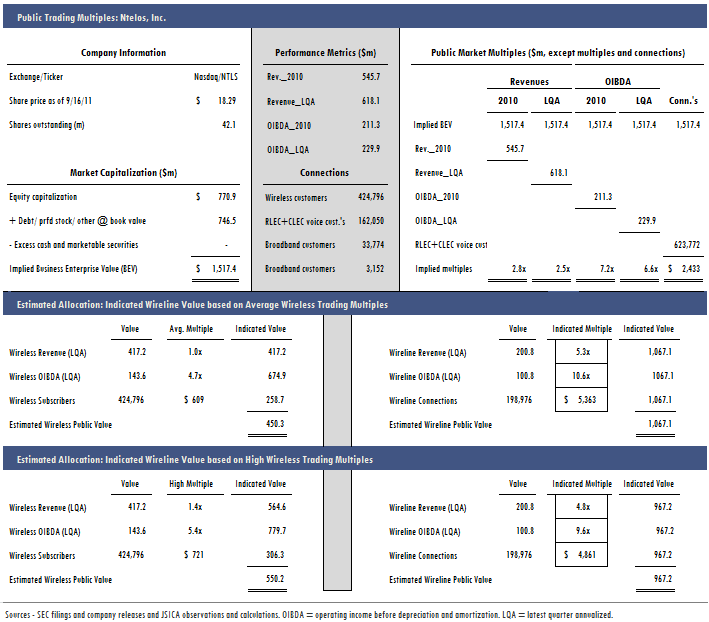
Investors, nonetheless, appear to be bullish on the split. By analyzing the wireless and wireline segments separately, and comparing to the trading multiples of other public wireless service providers, I was able to back into an “implied” public value for what will become Lumos Networks…and it’s up there.

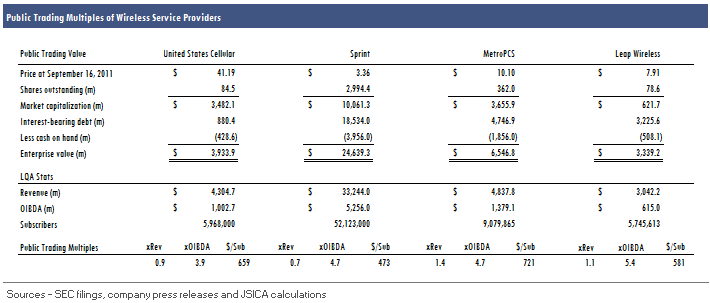
First, my analysis of the public wireless companies indicated that investors today are paying relatively modest multiples for standalone (non-AT&T and non-Verizon) wireless providers. Each of United States Cellular, Sprint, MetroPCS and Leap Wireless are facing intense competitive issues, most directly from the aforementioned dynamic duo of wireless iPhone fame. But so is NTELOS Wireless. Given that NTELOS derives much of its wireless business via its Sprint PCS wholesale arrangement—and more importantly, much of the anticipated growth is expected from that source—I figure the Sprint trading multiples should represent (at worst) a down side value proxy (Sprint has its own issues weighing on the share price). Sprint is trading presently for about 0.7x revenue, 4.7x cash flow and less than $500 per subscriber-it’s the cheapest of the four comparables. 

But NTELOS Wireless, I believe, deserves better, if only due to its regional focus and the revenue upside it should enjoy as it penetrates its subscriber base with smartphones. Perhaps not dramatically better, but if I base the wireless division valuation on the mean of the four companies, and then the mean of the three values implied by the revenue, cash flow and per subscriber multiples, you get a wireless operation worth about $450m (public value).  That implies more than a billion dollars for the Lumos Networks side of the scale, and multiples of 5.3x revenue, 10.6x cash flow and nearly $5,400 per connection.  These are strong growth multiples!

If I take the high end wireless multiples and apply them to NTELOS Wireless’ recent performance, the indicated value is closer to $550m, which still implies Lumos Networks’ public value is nearly 5x revenue, nearly 10x cash flow and nearly $5,000 per connection.  I guess Lumos Networks is “nearly” considered a growth story!   

I’m only being partially facetious. There’s no doubt in my mind that Lumos, with its aggressive fiber deployment and backhaul initiatives, will enjoy relatively rapid growth over the next few years. But will that growth be strong enough to support today’s trading value? Or have I underestimated the value of the wireless business?

It’s hard to say just yet, but Standard & Poors said at the end of August that it expects to lower the rating of NTELOS (Wireless’) secured debt by one notch upon separation of the two businesses, “reflecting our view that despite the reduction of the term loan from the Lumos dividend, spinning off the wireline properties weakens recovery prospects for NTELOS' secured credit facilities." The press release added, “In particular, that view contemplates the potential scenario in which the Sprint wholesale services contract, responsible for a significant and growing share of revenue, either is not renewed in 2015 or is renewed under markedly less favorable terms. Accordingly, we expect to revise the recovery rating for the secured credit facilities to '3', indicating our expectation of 50%-70% recovery of principal in the event of a default from the current '2' recovery rating, which denotes 70%-90% recovery of principal. “

In other words, S&P doesn’t like NTELOS Wireless as well without the growth prospects of Lumos Networks.

Of course, investors holding the shares today will get to play both sides once the tax-free distribution occurs, presumably in a couple of weeks. The question is, will they continue to hold both pieces of the former NTELOS Holding Corp.?

Wednesday
Aug312011

Surprise, Surprise...DOJ Says "No Way" to AT&T; - T-Mobile Merger

It’s a Dumb Deal Anyway

Just this morning I watched AT&T ceo Randall Stephenson tell CNBC how the combination of AT&T and T-Mobile was going to result in some 5,000 call center jobs being brought back to the United States from their present overseas locations…I laughed and wondered aloud at CNBC’s willingness to allow such blatant political posturing to be presented as “news”…

An hour or so later, I laughed even harder as I read the Breaking News Headline cross my muted television screen: DOJ Files Suit to Block AT&T/ T-Mobile Merger…Guess the folks in D.C. were unimpressed by Stephenson’s gushing. Good for them.

What really blows my mind, however, is that anyone was surprised by the news that the Department of Justice has found that the merger between the largest and the fourth largest wireless providers will be anti-competitive…Yet clearly they were.

Shares in AT&T were off more than 4% immediately, and have traded as low as $28/share, down from nearly $30 pre-announcement. Guess Wall Street wasn’t paying attention all these months as we at JSI Capital Advisors warned that in order to achieve the massive $40b in long-term synergies that the parties predicted, tens of thousands of American jobs would need to be eliminated…or when we pointed out that T-Mobile had started limiting its data plan usage just a short time after the merger announcement, despite the fact that it continued to bleed subscribers…or that AT&T and Verizon Wireless already accounted for the vast majority of subscriber growth over the past several years…or that literally thousands of Americans - an unprecedented number - had filed their opposition to the merger with the FCC.

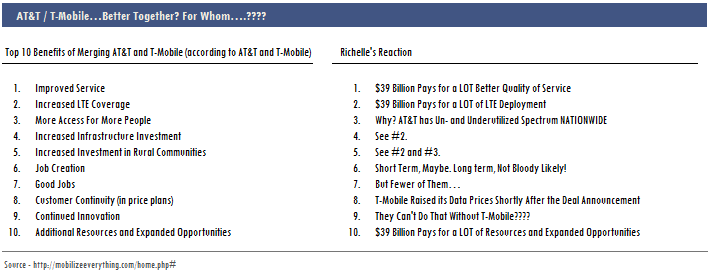
Fact is, this deal never made sense to me, not even for AT&T. $39b is a huge price to pay for a company that is losing market share, is spectrum constrained and behind in real 4G deployment (despite T-Mobile’s unabashed use of the term in its marketing since last fall).  At the web site set up by the two to promote the benefits of the deal, www.mobilizeeverything.com, the company lists the “Top Ten” reasons to support the deal. In the chart below, I’ve given my gut-reaction to each point (never mind the fact that several of the ten reasons are really the same thing):

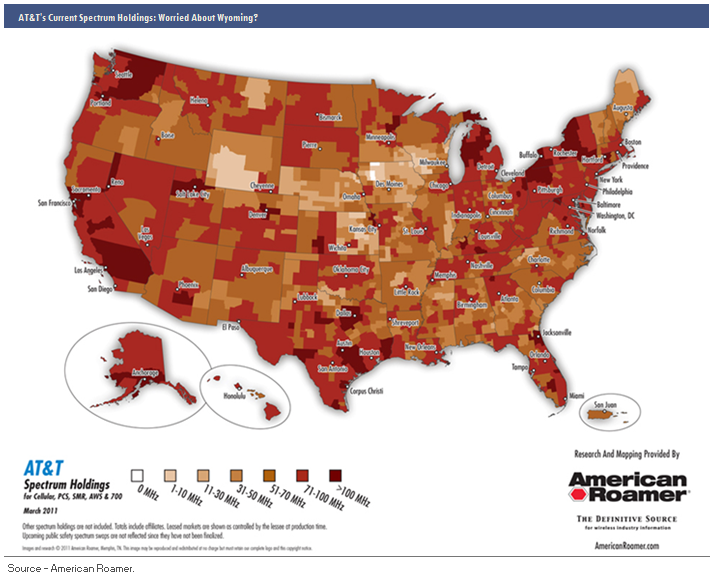
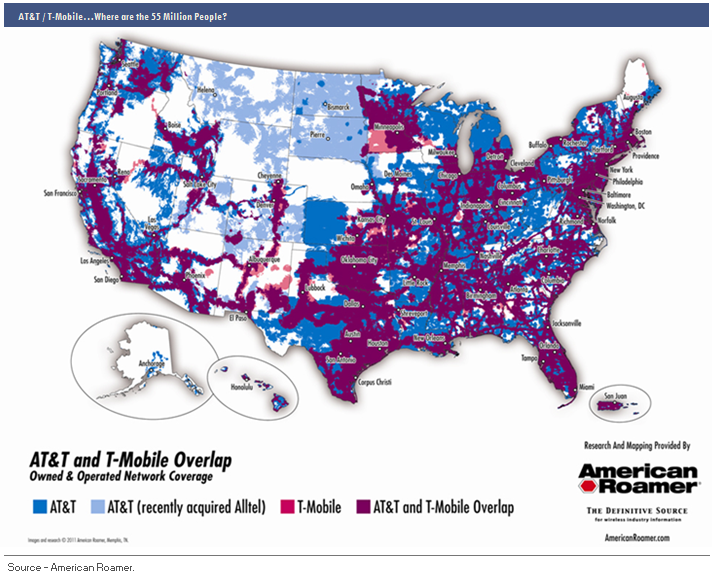
In a television commercial currently airing to promote the combination, AT&T says something to the effect  that “55m Americans will get broadband wireless service” as a result of the merger. What it doesn’t adequately explain is why they wouldn’t get it anyway! The map below shows AT&T’s spectrum depth across the U.S. at the time of the merger announcement.  There are precious few markets where the company has less than 30 MHz of spectrum. Take that $39b and build it out! 

Furthermore, in terms of already served markets, the overlap between AT&T and T-Mobile is huge. That means one less competitor in those markets, as well as fewer retail outlets and, oh yeah, fewer  jobs.

Rival wireless provider Sprint, and its investors, cheered the news—shares in Sprint and step-child Clearwire rose between 8%-13% initially. But here too, I don’t really get it. Sprint has been very vocal in its opposition to the merger, but from my point of view, an AT&T/ T-Mobile combination would have served to eliminate Sprint’s biggest competitor in the market for budget-minded and prepaid customers. And with Sprint set to get the iPhone this fall, it should be reasonably well positioned to compete with the duopolists…

And make no mistake, the wireless industry has already become a full-fledged duopoly, in practice if not officially. As I noted above, AT&T and Verizon have been taking market share away from their smaller rivals for a couple of years now…with or without T-Mobile as a standalone operator, Sprint’s challenge to grow is daunting.

AT&T “Shocked and Appalled”

AT&T posted a response to the DOJ’s suit on mobilizeeverything.com a short time after the news:

DALLAS, August 31, 2011 – The following may be attributed to Wayne Watts, AT&T Senior Executive Vice President and General Counsel:

We are surprised and disappointed by today’s action, particularly since we have met repeatedly with the Department of Justice and there was no indication from the DOJ that this action was being contemplated.

We plan to ask for an expedited hearing so the enormous benefits of this merger can be fully reviewed. The DOJ has the burden of proving alleged anti-competitive effects and we intend to vigorously contest this matter in court.

At the end of the day, we believe facts will guide any final decision and the facts are clear. This merger will:

• Help solve our nation’s spectrum exhaust situation and improve wireless service for millions.

• Allow AT&T to expand 4G LTE mobile broadband to another 55 million Americans, or 97% of the population;

• Result in billions of additional investment and tens of thousands of jobs, at a time when our nation needs them most.

We remain confident that this merger is in the best interest of consumers and our country, and the facts will prevail in court.

Based on comments made by Stephenson on CNBC this morning, including his speculation that the deal would close in the first quarter of 2012, I do believe that the company was blindsided by the news…but really, the writing was on the wall.

And that $7b in cash and spectrum that T-Mobile will get as a breakup fee when the deal doesn't happen might just give it the juice it needs to get back in the game. Maybe that was Rene Obermann’s plan all along?

Monday
Aug222011

Sprint, Clearwire and the Cablecos Dance Around a Deal 

Clearwire Shares Double on Word of Renewed Talks

Earlier this month I commented on the untenable situation that has developed between Sprint (NYSE:S) and Clearwire (Nasdaq:CLWR), and also wondered about the wisdom of the announcement Sprint made that it had entered into a nine year, $13.5b network deployment deal with startup LTE wholesaler LightSquared. 

Specifically, I pointed out that if Sprint continues to ignore Clearwire’s financial woes, it stands to lose its nearly 50% ownership position should Clearwire end up restructuring via bankruptcy….I also mentioned the fact that LightSquared’s spectrum is still constrained by interference issues with GPS providers.

Well according to a report published by Bloomberg last Friday, Sprint hasn’t completely lost sight of its investment in, not to mention reliance upon, Clearwire. In fact, the two may be in deal discussions as I write, and their cable step-brothers Time Warner Cable (NYSE:TWC) and Comcast (Nasdaq:CMCSA) may also be seated at the table.

Shares in Clearwire skyrocketed on the rumor last Friday, more than doubling from the sub-$2/share level they had fallen to in the wake of the Sprint/LightSquared announcement.  While Clearwire was trading at present levels (around $3/share) just a month or so ago, after tumbling to a low of $1.32 in early August, $3+ per share suddenly looks a lot better.

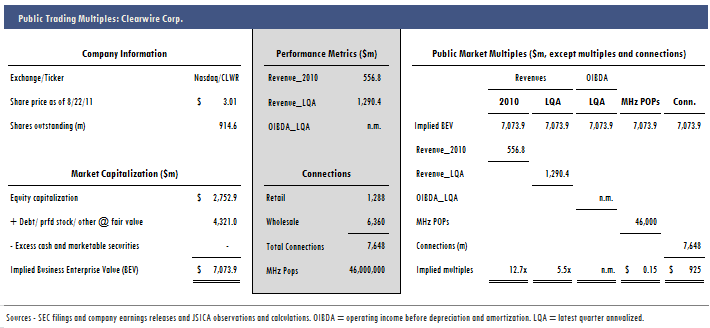
But what does it imply in terms of Clearwire’s value?  Back in June I wrote a story on Clearwire’s ongoing struggles to raise capital via a spectrum sale or a broader deal.  At the time, Pardus Capital’s Karim Samii had written a letter to interim ceo John Stanton bemoaning the fact that, at $4.60/share, Clearwire’s massive spectrum holdings were valued at less than $0.20 per MHz POP.  Samii urged Stanton to sell off some of Clearwire’s excess spectrum in order to get the company’s business plan back on track.

After Friday’s run-up, Clearwire appears to trade at an even more discounted $0.15/MHz POP, and at its low two weeks ago, Clearwire’s public market cap indicated a value of just $0.12/MHz POP….But according to the FCC, not to mention AT&T in its T-Mobile lobbying efforts, U.S. wireless carriers are facing a serious spectrum shortage!

I’ve been flummoxed by Sprint’s refusal to step up and support Clearwire for some time now…clearly the company’s bet on WiMax technology has proven to be a misstep in hindsight, but in the meantime Sprint keeps adding 4G customers, to the tune of 1.7m net new 4G customers on the Clearwire network in the second quarter.

Sprint needs every advantage it can get its hands on in the face of the AT&T/Verizon Wireless duopoly.  Why bet billions on LightSquared’s fledgling plan when it already bet billions on Clearwire’s 4G plan years ago?  And why haven’t the cable guys stepped up sooner?  They desperately need a wireless strategy—and that’s what their investments in Clearwire was supposed to be…but the partnerships have floundered in recent years; the vast majority of Clearwire’s wholesale customers have come from Sprint.

Clearwire’s 2.5 GHz spectrum isn’t as desirable as the 700 MHz licenses that Verizon and AT&T will use to deploy their 4G systems on, but it has LOTs of it. Furthermore, the FCC is still considering a proposal to raise the out of band emission limits, which would enable Clearwire to use 20 MHz of spectrum and deliver speeds of 90 Mbps.

It just makes sense for Sprint and the cable players to really get behind Clearwire and make it the basis of their next generation wireless strategies. But after the drubbing the stock has taken this year, due largely to Sprint’s relative lack of support, Clearwire’s existing backers may now be in a position to take over for a much lower price than would have been demanded last winter.  Maybe that was the point?