


Entries in Deals: ILEC (89)

Thursday
Jan122012

Vision Purchase Complete, Helping EATEL Achieve Expansion Goals  

New Opportunities in Services and Territory for Louisiana RLEC

The sale of BV Investment Partners’ Vision Communications to Gonzales, Louisiana-based RLEC EATEL, announced in September 2011, wrapped up last week. EATEL, under president and vice chairman John D. Scanlan, looks to gain new customers, expanded service area, and a plethora of communications services from the deal. According to the BV Investment Partners press release on the deal closure, “Vision provides a comprehensive suite of residential and commercial services, including digital video, high-speed Internet, local and long distance telephone, alarm monitoring, and commercial data services.” Add this to EATEL’s extensive100%  FTTH network, FiberEdge, and EATEL appears well-poised for a competitive advantage in its new and existing Southern Louisiana service areas.

Vision and EATEL have long-standing histories in rural Louisiana, as both were founded to bring service to areas not seen as profitable by the Bell system. Vision (formerly SJI, LLC) was founded in 1945 and family-owned until 2007 when it was sold to BV Investment Partners; and EATEL, also family-owned, dates back to 1935 and “has earned a reputation as a communications pioneer.” Despite humble beginnings, both companies grew throughout the generations, continually innovated and added infrastructure—EATEL claims to have started one of the first 100% FTTH networks in the country, and both companies were early entrants in other advanced services.

When JSI Capital Advisors first reported this deal in September, we estimated a value of $11-12m. Since financial information about the deal has not been made public, our rough estimate was based on access lines. Our Phone Lines 2011 lists 10,156 access lines and 1,710 broadband lines for Vision and 28,854 access lines and 11,542 broadband lines for EATEL in 2010. The deal appears to add a nice-sized chunk of access lines to EATEL’s holdings, but JSI Capital Advisors also noted that Vision experienced an unusually high annual line loss of 9% (The Deal Advisor: EATEL to Acquire Vision Communications).

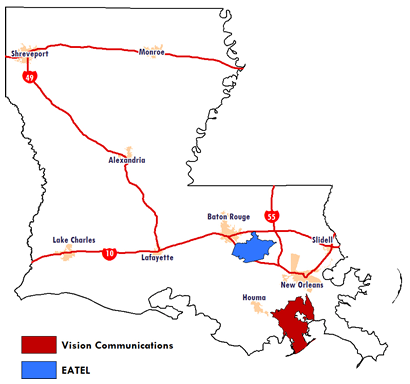
Given rampant line loss throughout the market, it is unlikely that any RLEC deal is going to be based solely on adding new telephone subscribers, so the purchase of Vision presumably is providing a strategic advantage for EATEL. It appears as though the deal will add new services and territory as well as potential opportunities for future growth for EATEL. The service areas, although not directly adjacent, are relatively comparable in size and both located in Southern Louisiana. Although rural, the respective service areas are also close to Baton Rouge (EATEL’s) and New Orleans (Vision’s). One can make the argument that an RLEC located in close proximity to an urban/suburban hub is fairly attractive in terms of opportunities for population growth and new business.

EATEL also appears to be experiencing a “just go for it” moment as Vision is not their only expansion project right now. EATEL’s website shares one of the company’s key objectives: “Grow the customer base and market area through planned expansion by market segment and by geography.” The Vision deal may help EATEL achieve the geography component, but EATEL is hoping to edge into the 4G wireless market through a partnership with LightSquared.

Following in its footsteps of being one of the first 100% FTTH providers, EATEL was also the first RLEC to partner with LightSquared. According to LightSquared’s press release announcing the partnership on November 28, “This agreement will allow EATEL, an Incumbent Local Exchange Carrier, to provide its customers with a world-class broadband service that competes on price and quality with any wireless carrier in the nation.” EATEL ceo Arthur “Smokey” Scanlan commented that “LightSquared’s unique ability to offer both broadband and satellite connectivity over the same device will be a breakthrough product for our customers.” Of course, approval for LightSquared’s extensive 4G service is pending approval, but this has not stopped multiple carriers of all shapes and sizes from entering partnerships with the wholesale 4G/satellite provider whose mission is “to revolutionize the U.S. wireless industry.”

LightSquared uncertainty aside, EATEL appears to be determined to forge ahead in achieving its growth objectives in both service territory and market segments. Coming at the end of a year with only 6 ILEC deals, the EATEL-Vision deal may prove to be a sign of a turn-around in this market as companies begin to have some closure regarding regulatory issues and realize that it will take more than simply keeping the lights on to be attractive to potential buyers.

Sunday
Jan082012

2011 ILEC Deals Few and Far Between: Has the Ship Sailed? 

Will a Little Regulatory Certainty Kick-start this Tepid Market in 2012?

Despite fervent deal activity in most telecom sectors in 2011, ILEC deals were incredibly slim. Sixteen deals were announced in 2010, but JSI Capital Advisors only tracked 6 new deals in 2011—plus one more that didn’t quite make it to the finish line. Although there could be a variety of reasons why ILEC deals were so few and far between in 2011, the single most likely culprit is regulatory uncertainty surrounding USF and ICC. The question is:  did small ILECs miss the boat on a good deal before USF/ICC took a dark turn, or will there be a revitalization of ILEC deals once the fog clears and companies (hopefully) have a somewhat brighter future?

Of the 6 small ILEC deals in 2011, less than half were RLECs buying other RLECs, one involved an RLEC buying a telecom utility, and two involved investment firms on one side or another:


2011 was not the first year for a decrease in ILEC deals, but definitely the first year for such a steep decline- JSI Capital Advisors reported 16 deals in 2010, 18 deals in 2009, 19 in 2008 and 20 in 2007 (The Deal Advisor: ILEC Sales Closing in 2010 Approach $10b). Many of you may remember “The Great Dallas Debate” at the 2011 NTCA annual meeting where National Broadband Plan director and Aspen Institute fellow Blair Levin faced off against RLEC duo Randy Houdek (Venture Communications Cooperative) and Delbert Wilson (Hill County Telephone Cooperative). This debate became notorious for a lot of things, but Levin did make one point that even the most dedicated RLEC advocate would have a hard time denying—the “deal” that the rural industry could have gotten with USF/ICC reform a few years ago would have been relatively better than the deal they got in 2011, and the deal we ended up with in 2011 is probably better than the one we would get in the future. Can the same logic be applied to ILEC mergers and acquisitions?

If so, can we expect less than 6 small ILEC deals in 2012? It may depend on how the USF/ICC changes impact the value of these companies. Even though the sheer fact that USF/ICC reform has technically been achieved (assuming the pending appeals cases don’t change anything significantly), it sure doesn’t seem like there is a whole lot of “regulatory certainty”—at least not the level of certainty that could help increase valuations and make RLECs attractive to buyers as they were back in the day. An industry that was once considered safe, profitable and solid as a rock is starting to look like anything but when you factor in the regression analysis-induced “race to the middle,” reduced access revenue, declining landline connections and myriad competitive forces.

A couple of 2011 deals, like La Motte Telephone purchasing Andrew Telephone (both in Iowa) and Otelco acquiring Vermont-based Shoreham Telephone Company were fairly straightforward examples of convenient deals that would boost the buyer’s footprint and create various operating and strategic synergies. Interestingly the Otelco-Shoreham deal reflects the issue mentioned above—that RLECs have possibly missed the boat on a good deal—as Shoreham was reportedly offered three times more from a prospective buyer in 2003 than what Otelco offered in 2011 (The Deal Advisor: Otelco to Acquire Shoreham Telephone for $4.5m).

Also interesting is that the FCC has made no effort to hide its desires that small RLECs merge—consolidated switching is strongly recommended in the ICC section of the Order. The FCC may not have considered that its very own actions on USF/ICC are prohibiting a vibrant market for high-value small rural telephone company deals, but there are more factors to consider than just regulatory uncertainty. The almost-merger between small Minnesota RLECs Farmers Mutual Telephone Company and Federated Telephone Company illustrates this point quite effectively. It was the members of one of the cooperatives who killed a deal that (on paper at least) appeared to be a perfect match (The Deal Advisor: Farmers Mutual Fails to Approve Merger with Federated Tel.).

Is there any optimism for an upswing in ILEC deals in 2012? If prospective buyers are willing to accept the regulatory risks and if ILECs can figure out how to build value in this environment, then it is certainly possible. But will we look back at the 6 deals of 2011 as an unusually low outlier simply because of the year’s heightened regulatory uncertainty, or are single-digit deals the new norm?

Tuesday
Sep272011

EATEL to Acquire Vision Communications

Deal Includes Nearly 12K Connections


Boston-based BV Investment Partners announced September 20 that it has agreed to sell La Rose, Louisiana-based Vision Communications to Gonzales, Louisiana-based EATEL. Financial terms were not disclosed. BV acquired Vision (formerly known as SJI and parent of Lafourche Telephone and Lafourche Long Distance) from the founding Brady family in late 2007.

According to Phone Lines 2011, Vision Communications had 10,156 access lines at the end of 2010 and another 1,710 DSL connections in Larose, Grand Isle, Golden Meadow, Leeville, and Galliano, Louisiana. That’s down from more than 13k access lines at the time of the sale to BV—implying an annual line loss rate of nearly 9%, well above the 3%-5% annual declines many smaller ILECs have experienced in recent years.

At around $1,000 per connection, the deal value would be in the $11-$12m range—although the public ILECs trade for anywhere from $500 to $3,000 per connection, so that’s a rough estimate at best. Given the hefty line losses and low broadband penetration, the value may have come in lower.

EATEL, which began building its FTTH network in 2004 in the Ascension and Livingston Parishes, describes its network as “one of the only 100% fiber-to-the-home networks in the country.” Its FiberEdge service provides broadband speeds up to 60 Mbps as well as digital video and voice service. Clearly, the company sees its upside in expanding that service in to the nearby Vision market areas to improve broadband penetration.

EATEL is run by third generation family member John D. Scanlan, who was appointed president in 1994 and vice chairman earlier this year.

Monday
Sep192011

NTELOS Poised to Split into Two Companies

Strong Growth at Lumos Networks Implied by Current Trading Levels

About nine months after first announcing its intention to split into two companies-a wireless operation that would retain the brand name NTELOS and a wireline operation comprised of the NTELOS wireline and FiberNet fiber operations-NTELOS announced last month that it intends to effect its separation on October 3, 2011.

James Hyde, Michael Moneymaker and the team have worked furiously over the past year to ensure that both sides of the business have attractive growth prospects and achieve better cost efficiencies in advance of the spin. New executives have been named for Lumos Networks—the recently announced brand name of the to-be-spun wireline business—and the company’s second quarter results press release and conference call were filled with discussion related to future growth prospects—although pro forma results for the wireline business in particular did not demonstrate substantial growth just yet…

Investors, nonetheless, appear to be bullish on the split. By analyzing the wireless and wireline segments separately, and comparing to the trading multiples of other public wireless service providers, I was able to back into an “implied” public value for what will become Lumos Networks…and it’s up there.

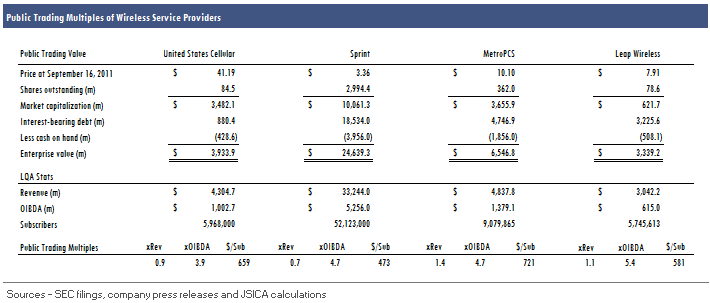
First, my analysis of the public wireless companies indicated that investors today are paying relatively modest multiples for standalone (non-AT&T and non-Verizon) wireless providers. Each of United States Cellular, Sprint, MetroPCS and Leap Wireless are facing intense competitive issues, most directly from the aforementioned dynamic duo of wireless iPhone fame. But so is NTELOS Wireless. Given that NTELOS derives much of its wireless business via its Sprint PCS wholesale arrangement—and more importantly, much of the anticipated growth is expected from that source—I figure the Sprint trading multiples should represent (at worst) a down side value proxy (Sprint has its own issues weighing on the share price). Sprint is trading presently for about 0.7x revenue, 4.7x cash flow and less than $500 per subscriber-it’s the cheapest of the four comparables. 

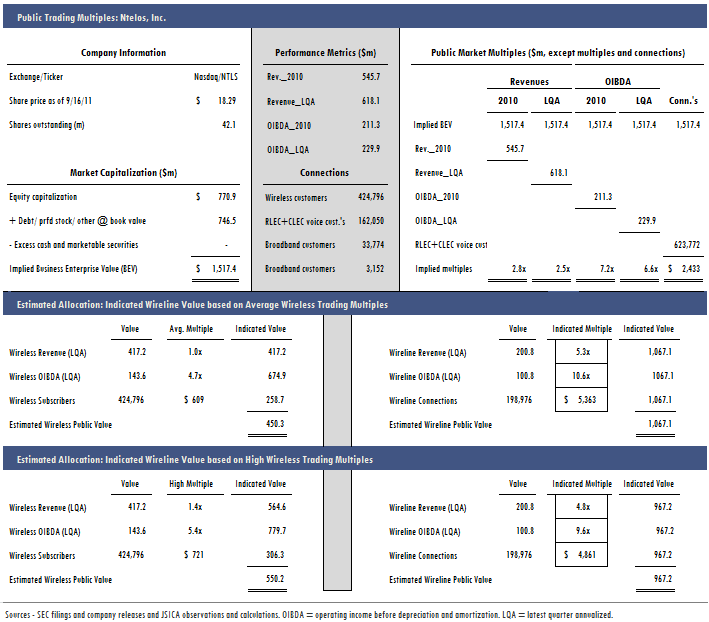
But NTELOS Wireless, I believe, deserves better, if only due to its regional focus and the revenue upside it should enjoy as it penetrates its subscriber base with smartphones. Perhaps not dramatically better, but if I base the wireless division valuation on the mean of the four companies, and then the mean of the three values implied by the revenue, cash flow and per subscriber multiples, you get a wireless operation worth about $450m (public value).  That implies more than a billion dollars for the Lumos Networks side of the scale, and multiples of 5.3x revenue, 10.6x cash flow and nearly $5,400 per connection.  These are strong growth multiples!

If I take the high end wireless multiples and apply them to NTELOS Wireless’ recent performance, the indicated value is closer to $550m, which still implies Lumos Networks’ public value is nearly 5x revenue, nearly 10x cash flow and nearly $5,000 per connection.  I guess Lumos Networks is “nearly” considered a growth story!   

I’m only being partially facetious. There’s no doubt in my mind that Lumos, with its aggressive fiber deployment and backhaul initiatives, will enjoy relatively rapid growth over the next few years. But will that growth be strong enough to support today’s trading value? Or have I underestimated the value of the wireless business?

It’s hard to say just yet, but Standard & Poors said at the end of August that it expects to lower the rating of NTELOS (Wireless’) secured debt by one notch upon separation of the two businesses, “reflecting our view that despite the reduction of the term loan from the Lumos dividend, spinning off the wireline properties weakens recovery prospects for NTELOS' secured credit facilities." The press release added, “In particular, that view contemplates the potential scenario in which the Sprint wholesale services contract, responsible for a significant and growing share of revenue, either is not renewed in 2015 or is renewed under markedly less favorable terms. Accordingly, we expect to revise the recovery rating for the secured credit facilities to '3', indicating our expectation of 50%-70% recovery of principal in the event of a default from the current '2' recovery rating, which denotes 70%-90% recovery of principal. “

In other words, S&P doesn’t like NTELOS Wireless as well without the growth prospects of Lumos Networks.

Of course, investors holding the shares today will get to play both sides once the tax-free distribution occurs, presumably in a couple of weeks. The question is, will they continue to hold both pieces of the former NTELOS Holding Corp.?

Thursday
Sep012011

La Motte Telephone to Purchase Bordering LEC Andrew Telephone

Andrew Telephone Sellers Remain Invested in Iowa Telecom

While cable and data center purchases have dominated The Deal Advisor of late, ILEC deals have been few and far between. The telcos that have been active buyers are targeting new revenue streams in cloud computing, data storage and managed services—not looking to expand their wireline operations. Iowa-based La Motte Telephone Company breathed some life into ILEC M&A last week, announcing its purchase of fellow Iowa LEC, Andrew Telephone Company. Financial terms of the deal were not disclosed. 

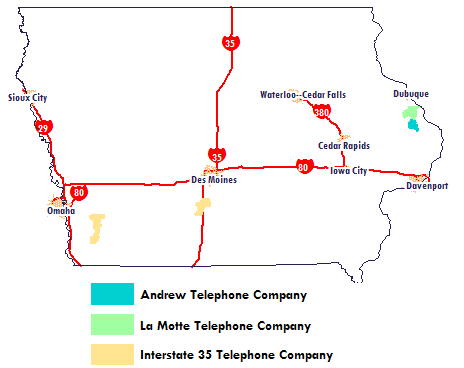
La Motte currently serves around 700 access lines in the cities of La Motte, St. Donatus and Zwingle, located in Northeastern Iowa. It offers voice, television and high speed Internet services in addition to wireless phone and Internet through its PCS tower in Bellevue, IA. The smaller Andrew serves around 280 access lines in its exchange which borders La Motte’s territory to the south, making it a logical acquisition target. La Motte will begin offering digital television services to its Andrew exchange customers—a service Andrew Telephone did not offer previously.

The deal appears to have been done as much out of convenience, as it was from an expansion effort on La Motte’s part. In addition to the closeness of their territories, La Motte has provided maintenance service for Andrew’s customers over the past two years. Andrew’s current office will also remain in operation under La Motte after the acquisition is finalized, rendering cost savings from the deal minimal. JoAnne Gregorich, the general manager at La Motte describes a cordial and neighborly relationship between the two telcos, adding that future deals are not likely in La Motte’s future.

“We are not considering any additional acquisitions of LECS at this time. Andrew Telephone Company and La Motte Telephone Company are next door to each other; we have been neighbors for years,” commented Gregorich, adding “financially, we feel that purchasing Andrew will be good for La Motte and Andrew.”    

Andrew in this case refers to the telco's four current owners: Robert Mauer, Virginia Mauer Cox, Valerie Mauer Weis and Ed Buchanan. The Mauers account for 90% of Andrew’s ownership, and while they are exiting this telecom investment, they will remain players in Iowa telecom. 

The trio also owns a 95% stake in Interstate 35 Telephone Company, the holding company of the Southwest Telephone Exchange—an independent LEC that serves around 1,750 access lines in the southwest part of the state. Interstate 35 also owns CATV provider Interstate Cablevision Company and maintains partnerships with various cellular providers. While the Andrew deal might suggest the Mauer’s are starting to unwind their telecom investments, it feels more like a one-time sale of one of its smaller entities. 

Although La Motte suggested that it will not target other properties, if there is one state ripe for more ILEC consolidation, it would be Iowa.  With 134 telcos, Iowa has far more phone carriers than any other state. Texas with 51 comes the closest, but Iowa LECs serve only 13% of the access lines that Texas telcos manage. And while Andrew with its 280 access lines seems tiny, there are more than 20 smaller telcos in the Hawkeye State that are logical acquisition targets for larger neighbors like La Motte.