



Site Search

Entries in In Search of Success (51)

Wednesday
Feb012012

For Peoples Telephone Coop, Not Even a Tsunami Will Stop Fiber Build

Peoples Telephone Cooperative Works to Build 600-Mile Fiber Network to Unserved Areas

Last week, while President Obama lamented “an incomplete high-speed broadband network” in rural areas and his Republican dissenters placed blame on the FCC for over-regulation, one thing was missing from the discussion: rural telecom providers. The truth is, the cries for “more broadband!” are only half of the story, when rural and independent telecommunications providers have made tremendous progress building out broadband networks in unserved and underserved areas. These are the companies and cooperatives we like to highlight here—to follow up on federal stimulus dollars and see how new broadband roll-outs have been received in rural communities.

Peoples Telephone Cooperative, based in Quitman, Texas, is one such example. The cooperative, which first opened its doors in the early 1950s, received a sizable stimulus grant in March of 2010 to lay over 600 miles of fiber optic cable throughout East Texas. The $36m project is being funded in part by $28m of federal BTOP grant and has encountered some delays. But according to PTC Marketing Director Lisa Webber, about 30% of the project is completed and the company has “already begun service contracts with several businesses along our new broadband network. We are also negotiating with the schools and hospitals along the route since providing connection to the anchor institutes is a primary focus of this project."

The broadband network will be an extensive one, connecting medical, educational and governmental institutions in 13 East Texas counties—some of which have few, if any, options for high-speed. While primarily a middle-mile network, PTC will also provide end-use infrastructure to residential customers. So far, Webber says, “The response from residential consumers has been encouraging as well. These potential customers currently have little or no broadband options and are very excited to see Peoples laying fiber in their area.”

In areas where competitors do provide high-speed service, it's usually “satellite providers such as HughesNet and Texas Cellnet” that attract customers, Webber said.

To some rural Texans (and, likely, to many politicians) the progress in rural broadband may seem slow, but laying fiber is, in reality, a sizable infrastructure project that takes time. And for PTC, there were some delays that no one could have predicted. For instance, Webber explained, “Much of the initial progress was delayed due to the fiber shortage caused by last year’s tsunami in Japan that damaged a major fiber supplier located in that area. We found ourselves in a line with our larger nationwide competitors, all vying for the first available fiber supplies.”

Assistant General Manager Steven Steele said, “When ATT, CenturyTel and Verizon go to a supplier that I’m using, I very seldom get a phone call back, so you can imagine what it has done to my fiber supply. We have been slowed almost to a complete stop several times as far.” To keep progressing, Steele said crews worked ahead to install conduit, making it easier to insert the fiber when shipments came in, and since last November shipments of optical fiber have picked up, allowing them to resume installation.

Talk about the repercussions of a global economy.

To date, PTC is finished with Phase I, and has moved into Phases II and III of the build out. Once complete, PTC's broadband network will connect with the Texas Lone Star Network, a group of 39 rural telecommunications carriers that also is connected to many of the state’s educational institutions and medical facilities.

According to Webber, Peoples currently serves 13 exchanges in landline telephone service—a little more than 11k subscribers—in rural East Texas. The company also offers high-speed internet through DSL and a wireless broadband option, for residents outside the co-op's telephone exchanges. Webber said, “Over 95% of our service area has DSL service available. Over 51% of our total landline subscribers also subscribe to our DSL service. Through our wireless broadband service, we have been able to offer service to residents living in surrounding underserved areas. We currently have 334 wireless broadband subscribers on our 3.65 and 700 spectrum services. A recent upgrade to utilize our 700 [MHz] spectrum is allowing a greater customer growth potential and enhanced speeds and quality of wireless broadband service through our partnership with NetAmerica.”

Webber echoed the sentiments of many other rural providers, stating that, “Broadband has had a huge impact on our local schools, hospitals and businesses as in any other rural area... [These] connections have allowed our local schools to connect to area colleges and form partnerships to offer higher education courses to the high school students.”

For Webber, the education benefit of broadband is personal: “I’ve seen this benefit first-hand, as a parent of a high school senior. This May, my daughter will graduate with 30 college semester hours which will qualify her as a college sophomore. Her 'dual-credit' courses allowed her to complete the hours needed to fulfill her high school requirements while, at the same time, earn credit for college classes…all while attending her current high school. A partnership between her high school and an area college provided the framework for the course structures.” For example, Webber said that “video classes, online testing and online assignment submissions allowed the students to meet course requirements without ever leaving the city limits or the farm.” Such connections saved time and money, and has been an experience Webber deemed “priceless.”

For rural residents like Webber, broadband in East Texas will also likely bring medical advancements and world-class medicine to small communities. “Quality medical care is a major factor when determining the quality of one’s life in a rural setting,” Webber said. “Broadband technology allows rural residents to overcome geographic challenges in accessing medical care by placing their local physicians and health care facilities only a computer screen away from a network of specialists, larger medical staffs, medical files and other telemedicine benefits.” Again, the effects can be personal. “When put into perspective, this benefit is one of great importance since the medical care administered—and the life saved—could be one of ours or that of our family members,” Webber said.

Whether for education, medical services or connectivity to a global market, Webber acknowledged that the benefits of broadband still hinge, in part, on funding availability that will get broadband projects off the ground. Like so many other independent telephone companies, PTC has seen its wireline subscriber base dramatically decrease and, simultaneously, seen shifting criteria for how newer services are funded. “Among the many challenges in our industry is the nationwide trend of consumers 'cutting the cord' and going mobile only,” Webber said. “This trend has obviously made us expand the original focus of our company to encompass more broadband and cellular services. As with any other rural provider, one of the biggest challenges is building-out our services in areas that simply do not have the population base to offer much return on the investment. This challenge is one reason the recent changes in USF funding has our industry so concerned.”

As for the here-and-now, PTC has 3 years to complete its fiber network, or will risk losing the $28m in federal funds. Additionally, Steele said the network “has to be economically self-sustaining, so we have to hook up enough businesses and institutions to make this thing pay for itself.”

Wednesday
Feb012012

U.S. Cellular, King Street Wireless Announces Launch of 4G LTE Network

Source: U.S. Cellular Press Release

U.S. Cellular (NYSE:USM), in conjunction with its partner, King Street Wireless, is launching a 4G LTE network next month. The 4G LTE network will cover 25 percent of U.S. Cellular's customers and will coincide with the launch of the Android-powered Samsung Galaxy Tab 10.1 4G LTE mobile tablet followed shortly by the Samsung Galaxy S Aviator 4G LTE smartphone.

The March rollout of 4G LTE includes select cities in Iowa, Wisconsin, Maine, North Carolina, Texas and Oklahoma, including some of U.S. Cellular's leading markets such as Milwaukee, Madison and Racine, Wis.; Des Moines, Cedar Rapids and Davenport, Iowa; Portland and Bangor, Maine; and Greenville, N.C. U.S. Cellular is the first wireless carrier to offer 4G LTE in several of these markets. The next wave of market launches will be announced later this month.

King Street Wireless, L.P. currently holds 700 MHz wireless spectrum in 27 states and is partnering with Chicago-based U.S. Cellular to deliver high-speed 4G LTE service to U.S. Cellular's customers in several of the carrier's markets.

Wednesday
Jan252012

Verizon's LTE Partnerships: A Win-Win for Rural America?

Small, Rural Companies Across the U.S. Link Up with National LTE Network

When I talk to rural telecom providers and ask about the future of broadband connectivity, there's one thing they're sure to mention, either as impending threat or future hope: LTE. It's the acronym everyone is buzzing about these days, and for some regional providers and state networks in rural areas, LTE could undermine years and dollars spent building out fiber networks. But other rural providers see LTE as the answer to years spent searching for a cost-effective way of providing broadband to sparsely populated areas. For both of these reasons, Verizon's LTE for Rural America plan is an interesting test model for what could happen when telecom giants partner with smaller providers to deliver LTE. In all honesty, I have said for a while that, just as partnerships have been the key to rural telecom success in the past, strategic partnerships could also provide entries into newer, larger-scale technologies going forward. And LTE is certainly larger-scale—something that could finally close the broadband gap, while also working in tandem with existing wired services.

Verizon's LTE deployment is a result of years of international collaboration, but now that the tide is rolling, it has certainly begun to make waves in rural areas. As the first Verizon rural partner to announce LTE network testing, Oklahoma-based Pioneer Cellular said in December that it had completed data testing of its new LTE network, which covers 17k miles of terrain and will launch this spring.

Pioneer is just one of Verizon's many rural LTE partners—a list that traverses much of the central U.S. To date, partners include: Appalachian Wireless (Kentucky), Bluegrass Cellular (Kentucky), Chariton Valley (Missouri), Custer Telephone (Idaho), Carolina West Wireless (North Carolina), Cellcom (Wisconsin), Convergence Technologies (Illinois & Indiana), Cross Wireless (Oklahoma), Pioneer Cellular (Oklahoma), S and R Communications (Indiana), Strata Networks (Utah), and Thumb Cellular (Michigan). Verizon's stated goal is to, “aggressively build the nation’s first 4G LTE network across the same footprint that is currently covered by its nationwide 3G network, which covers more than 90% of the U.S. population.” In order to bring 4G LTE to customers living in rural areas, Verizon says it “plans to work with rural companies to collaboratively build and operate a 4G network in those areas using the tower and backhaul assets of the rural company and Verizon Wireless’ core LTE equipment and 700 MHz spectrum.”

It's fitting that Verizon selected the broad term “rural companies” to describe its partners. As press releases about the rural LTE plan trickled out this past year it became clear that the telecom giant's plans included multiple types of providers—traditional wireline ILECs and CLECs, rural cellular companies, fixed wireless providers, and even a cellular joint-venture between two wireline providers (Swayzee Communications and Rochester Telephone, resulting in S and R Communications). In each instance the rural company will lease 700 MHz spectrum from Verizon while building out a 4G LTE network of their own, in markets where Verizon doesn't intend to provide coverage. This seems like a win-win, because rural customers will enjoy data transfer rates that are much faster than 3G networks and DSL.

Currently Verizon appears to have set reasonable expectations for its LTE download and upload speeds, though these “reasonable” data rates may sound downright tantalizing to rural customers. Verizon predicts that “LTE will be supporting average data rates per user of 5-12 Mbps in the forward link, and 2-5 Mbps in the reverse link.” In its white papers, the company has said that LTE rates could “theoretically” be as high as 100 Mbps download, with a shocking potential for 50 Mbps upload. Again, these are “theoretical peaks,” and not likely to come down to earth anytime soon. But according to the most recent “State of the Internet” report by content delivery network Akamai, the average U.S. broadband connection has a download rate of just 5.1 Mbps, making LTE pretty robust for most Americans' needs.

It is significant that Verizon will operate its LTE over recently-auctioned 700 MHz spectrum, because lower frequencies are able to travel further with less signal loss (by comparison, AT&T's LTE services operate on a combination of 700 and 1700 MHz spectrum). Verizon's network, then, can be deployed across wider areas with fewer towers—something that reduces labor, time, and cost. And not only is 700 MHz a suitable frequency for rural areas and rough terrain, but it also allows for better building penetrability for urban settings (again, in comparison, Sprint's WiMAX network operates on 2500 MHz and has been mired in complications, as users have had problems getting signals deep inside of buildings). It's likely that the attractiveness of 700 MHz spectrum is why Verizon said it would also 100% overlay its existing EVDO network in 2013.

For those of us living in cities or larger town, this focus on Verizon may appear to be nothing more than hype about “next big thing”—but for rural customers, it's no secret that faster broadband speeds and mobile broadband have consistently been out of reach, either because they're too expensive or simply not available. And of course, for rural communications providers, the excitement of new technology is sometimes outweighed by cost (again) or competition. That's why, for now, we're interested to see what the LTE for Rural America plan brings. The technology really does have the ability to complement networks already in place by rural carriers, and it also connects sparsely populated areas to a fast and (moderately, for now) powerful nationwide network.

For the time being, it seems Verizon's rural partners are choosing to be “mum” about future testing and launches, but it's certain that Verizon has its sights set on rural customers through pragmatic rural partnerships. Could this really be a win-win?

Monday
Jan232012

Galaxie Music Mediaroom Launches with Hawaiian Telcom, Lumos and Paul Bunyan

Source: Hawaiian Telcom Press Release

Stingray Digital, a Montreal-based provider of music services to multi-channel operators, announces the launch of its Galaxie Digital Music Service with Hawaiian Telcom, Lumos Networks (formerly known as nTelos) and Paul Bunyan Communications.

These companies are the first television services provider in the US to launch the Galaxie Mediaroom Application. This exciting new application gives Galaxie users an enhanced, interactive experience that leverages the flexibility of the Microsoft Mediaroom IPTV platform. The application allows users to browse all 50 channels and see what’s playing without changing the current channel, provides a pleasing look and feel to the Galaxie service and includes album art for the currently playing, and previously played songs on each channel. Galaxie users can also review the playlist of the last 24 hours of songs played on each channel, the most requested feature.

The 50 commercial-free music channels of the Galaxie music service will be included for no additional fee for all TV service customers of Hawaiian Telcom, Lumos Networks and Paul Bunyan Communications. Users will enjoy the professionally programmed music channels in all popular genres including Rock, Pop, Jazz, Classical, Country and many more.

Thursday
Jan192012

NRTC Readies Members for Exede Data Plans, Voice Offerings in the Hopper

NRTC hosted a webinar today to update its members on the transition to the new Exede satellite data offering, and I thought I would sit in to see how this differed from the old WildBlue services sold by members. The call was conducted by Alana Pilkington, vp Internet services at NRTC, and Stephanie Copeland, coo of WildBlue.

NRTC and ViaSat relationship began in 2003 with a $29m investment made by NRTC to help launch the WildBlue service. NRTC was the first distribution partner. Today, more than 100 telcos offer WildBlue Internet services with a combined 54k subscribers.

Exede officially launched on January 16 after the successful launch of Via-Sat-1. The service will offer speeds up to 12 Mbps downstream and 3 Mbps upstream with packages beginning at $50. Copeland said it was purposefully branded different from the old WildBlue service to differentiate the improvements made.

Copeland told NRTC members that the improvements go beyond the launch of the high capacity satellite. ViaSat has also launched new ground network equipment and new equipment for the customer's home. Copeland said new acceleration technology has also been installed which gives them a 40% more efficient use of bandwidth and will give customers the “feel of fiber.” She also disclosed that ViaSat is looking at launching another satellite which will allow for more services and more users – that announcement will be made in the middle of this year.

Copeland described the various price plans emphasizing that the plans were not based on speed but volume. She said, “… [the service is] not about paying for going fast but paying for how much you use.” Usage based pricing is similar to what we are seeing in the wireless industry. Copeland emphasized that the basic $50, 7.5 GB data allowance package was an affordable option for rural Americans. 

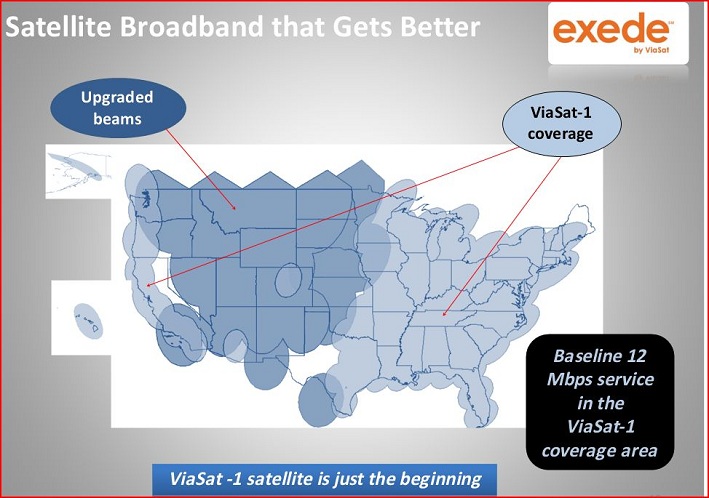
As for coverage, the service will cover 70% of the United States. However, geographically the new coverage is basically east of Kansas and Texas with spot beams in certain places including the West coast. Old coverage areas will have upgraded beams and, although will not have the 12 Mbps, will have a 5 Mbps offering. The service will launch in four sets working its way from the east to the west coast. The entire service area should be up and running by the first week of March.

Many callers into the webinar asked the key question that comes to mind when we think of satellite. What about latency and is it impacted by the weather? As for latency, things are improving but this is still an issue. Copeland said movies, with one stream into the home, worked well, even in high-definition. However, real time applications, such as gaming might not be a good fit for this service. Interestingly, she did say that during voice trials the perceptible latency was hard to detect and those testing the service described it as similar to a wireless voice call. As expected, weather, and to a lesser extent, solar flares still occasionally impact satellite service.

Callers were also interested in subscriber acquisition costs, which NRTC said averaged around $400 and advised members to structure contracts with early termination fees so that cost can be recouped if the customer cancels. Pilkington pointed out that telcos will have no upfront investment and can order equipment in minimal quantities. She said NRTC is working on initial marketing pieces and hope to have those available next week. Old WildBlue customers will need to have their equipment upgraded to transfer over to the new service. ViaSat is still fine-tuning enterprise bundles but Pilkington said that old plans are still valid for NRTC member enterprise customers.

Dampening the end of the call as it raises competition concerns, one caller asked if it was true about a reseller arrangement between DISH and ViaSat. DISH Network announced on January 9 that it will bundle ViaSat’s service with its satellite television offerings. Packages start at $79.98 for the 12 Mbps, with installation starting at $99. Copeland confirmed the relationship.

Page 1 ... 2 3 4 5 6 ... 11 Next 5 Entries »